Key takeaways
- Pro: Works across nearly every major platform without adapters
- Pro: Built-in carry handle and compact chassis
- Con: Joystick feel is average compared to Sanwa or Seimitsu options
Buying a pc joystick arcade is one of those purchases where the gap between a satisfying setup and a frustrating one comes down to a handful of decisions most people don’t think through until the box is already on their desk. Are you pairing the stick with a fighting game on a console or running MAME on a desktop? Do you want plug-and-play compatibility or a DIY kit you assemble yourself? Budget plays a role, but build quality and input responsiveness matter more once you’re actually playing at a competitive pace.
We compared these eight options based on published specifications, listed prices, and recurring themes in owner feedback. The standout differences in this category are not subtle. A $25 parts kit solves a completely different problem than a $250 officially licensed stick with Sanwa components, and pretending otherwise leads buyers to either overspend on something they’ll never assemble properly or underspend on a board that registers phantom inputs during a critical match.
Our top picks
 MAYFLASH F300 Arcade Fight Stick Joystick for
- Compatible with Switch/Switch 2, PS4, PS3, Xbox Series…
- Compatible with Sanwa Denshi buttons and joystick that…
- Supports the XINPUT and DINPUT when being used…
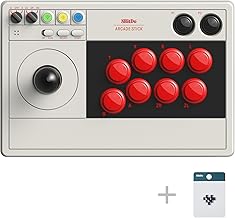
 8Bitdo Retro Wireless Arcade Fight Stick for
- 【8BitDo Ultimate Software】Customize button mapping and create macros…
- 【Dynamic Button Layout】When you switch between Switch and…
- 【3 Ways to Connect】Bluetooth, 2.4g and wired USB-C
 SUBSONIC Arcade Stick Controller for PS4
- Heavy-duty steel joystick with microswitch contact buttons: precise…
- 8 action buttons with microswitch leaf contacts: smoother,…
- AUTO function: trigger very fast repetitive shots
| Product | Key specs | |
|---|---|---|
| MAYFLASH F300 Arcade Fight Stick Joystick for | Compatible with Switch/Switch 2, PS4, PS3, Xbox Series… Compatible with Sanwa Denshi buttons and joystick that… Supports the XINPUT and DINPUT when being used… | Check price |
| 8Bitdo Retro Wireless Arcade Fight Stick for | 【8BitDo Ultimate Software】Customize button mapping and create macros… 【Dynamic Button Layout】When you switch between Switch and… 【3 Ways to Connect】Bluetooth, 2.4g and wired USB-C | Check price |
| SUBSONIC Arcade Stick Controller for PS4 | Heavy-duty steel joystick with microswitch contact buttons: precise… 8 action buttons with microswitch leaf contacts: smoother,… AUTO function: trigger very fast repetitive shots | Check price |
 Nacon Daija Arcade Fight Stick Officially Licensed Nacon Daija Arcade Fight Stick Officially Licensed | Nacon Daija arcade stick officially licensed for PlayStation… A leading brand among professional fighting game players… Buttons are fully configurable using the Nacon Daija… | Check price |
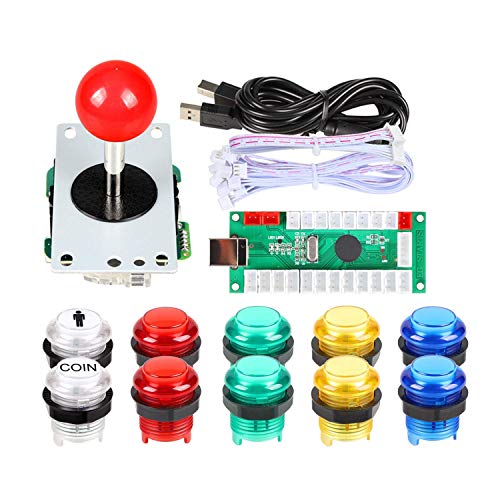 EG STARTS Arcade Buttons 1 Player DIY EG STARTS Arcade Buttons 1 Player DIY | Quality Components: Excellent Control USB Encoder with high… Advanced Functionality: DC 5V Arcade Illuminated Pushbutton with… Mounting Specifications: Joystick requires 24mm mounting hole while… | Check price |
 Qanba N3 Drone 2 Wired Joystick for Qanba N3 Drone 2 Wired Joystick for | Compatible with PlayStation5, PlayStation4, and PC Officially licensed Sony peripheral Authentic Qanba buttons and lever | Check price |
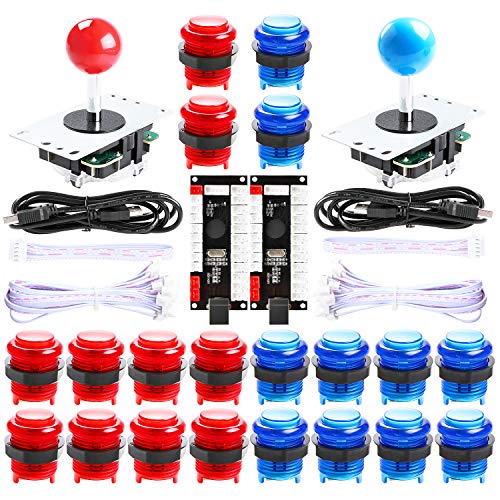 Qenker 2-Player LED Arcade DIY Kit for Qenker 2-Player LED Arcade DIY Kit for | Beautiful LED Arace Game DIY Parts for MAME… 100% Zero Delay USB Encoders and Perfect work… Perfect Parts for 2 Player Arcade MAME DIY… | Check price |
 EG STARTS 2 Player Arcade Games DIY EG STARTS 2 Player Arcade Games DIY | Exquisite LED arace game DIY MAME parts selection! 100% Zero Delay Encoder and USB work perfectly… 2 Player Arcade MAME DIY Style Perfect Accessory! | Check price |
As an Amazon Associate we earn from qualifying purchases at no extra cost to you.
Quick Picks
| Product | Best for | Price |
|---|---|---|
| MAYFLASH F300 | Cross-platform play on a tight budget | $59.95 |
| 8Bitdo Retro Wireless | Wireless convenience for Switch and PC | $89.99 |
| SUBSONIC Arcade Stick | Low-cost entry into console and PC fighting games | $44.99 |
| Nacon Daija | Serious PlayStation players who want premium internals | $249.99 |
| EG STARTS 1 Player DIY Kit | First-time custom stick builders | $25.99 |
| Qanba N3 Drone 2 | PS5 and PC players wanting licensed reliability | $99.99 |
| Qenker 2-Player LED DIY Kit | Coin-op style two-player cabinet builds | $44.99 |
| EG STARTS 2 Player DIY Kit | Matching parts sets for dual-station cabinets | $44.99 |
How We Picked
We focused on four criteria: platform compatibility breadth, component quality claims in the listing, value relative to price tier, and the consistency of owner-reported input accuracy. Cross-platform support matters because many pc joystick arcade buyers use one stick across multiple devices. Component quality is especially relevant for DIY kits where the encoder chip and switch mechanism determine whether inputs feel crisp or mushy. Value is assessed within each price bracket rather than across the entire list, since comparing a parts kit to a finished stick on cost-per-input-quality is misleading.
The 8 Best PC Joystick Arcade in 2026
MAYFLASH F300
The F300 is the most compatible stick on this list by a wide margin, covering Switch, Switch 2, PS4, PS3, Xbox Series S/X, Xbox One, Xbox 360, macOS, Windows, and Steam Deck at a price under $60. Owners praise the compact footprint and the included carrying handle, which makes it practical for tournament travel or shelf storage. The main criticism centers on the included ball-top joystick, which several users describe as feeling loose over extended sessions compared to higher-end alternatives. Skip this if you prioritize tournament-grade button response or want a wireless option.
- Pro: Works across nearly every major platform without adapters
- Pro: Built-in carry handle and compact chassis
- Con: Joystick feel is average compared to Sanwa or Seimitsu options
8Bitdo Retro Wireless
If wireless freedom matters to you, this fight stick fills the role for Switch and Windows PC without a cable in the way. The retro color palette and rounded shell give it a look that suits living-room setups better than industrial black sticks. Owners highlight the Bluetooth pairing reliability and the solid directional feel from the included joystick. The limitation is platform breadth: this is a two-device stick, so if you jump between Xbox and PlayStation you’ll need something else. Skip it if you need more than Switch or PC support.
- Pro: Wireless connection with stable latency on both supported platforms
- Pro: Distinctive design that stands out on a desk or TV stand
- Con: Limited to Switch and Windows only
SUBSONIC Arcade Stick
At $44.99, this is one of the cheapest finished sticks that still covers PS4, PS3, Xbox Series X/S, Xbox One, and PC. It’s a sensible choice for someone who wants to try the format before investing more. Owner feedback frequently notes the buttons feel somewhat stiff out of the box, though several report they loosen up after a few weeks of use. The build is functional rather than premium. Skip it if you care about button sensitivity or plan to compete at a level where actuation weight matters.
- Pro: Broad console and PC support at the lowest finished-stick price here
- Pro: Decent weight and grip feel for casual play
- Con: Stiff button actuation, especially early in the product’s life
Nacon Daija
This is the premium pick for PlayStation players. Officially licensed and built with Sanwa components, the Daija justifies its $249.99 price through internals that competitive players expect: crisp button response, a smooth gate on the joystick, and a removable top panel for customization. Owners consistently call it tournament-ready out of the box. The trade-off is clear: this is a PlayStation-only stick, so PC support is limited to whatever compatibility layer you’re comfortable using. Skip it if your primary platform isn’t PlayStation.
- Pro: Sanwa components deliver consistently crisp inputs
- Pro: Removable top panel for easy custom swaps
- Con: PlayStation-focused, with minimal native PC support
EG STARTS Arcade Buttons 1 Player DIY Kit
At $25.99, this parts kit is the entry point for anyone who wants to build their own stick from scratch. It includes 5V LED arcade buttons and a single-player joystick configuration designed for MAME setups or Raspberry Pi builds. Owners appreciate the low cost of experimentation and the fact that the LEDs provide visible feedback without external power. The kit does not include a full encoder board in every listing variant, so check what’s in the box before assuming it will connect to a PC directly. Skip it if you want a finished product or need encoder certainty.
- Pro: Extremely low cost for learning custom stick assembly
- Pro: LED-lit buttons work at 5V, ideal for Pi and USB setups
- Con: May not include a full PC encoder depending on bundle contents
Qanba N3 Drone 2
This is the middle-ground pick that balances licensed build quality with a price under $100. Officially licensed for PlayStation 5, PS4, and PC, the Drone 2 uses components that owner reviews describe as reliable and responsive for the cost tier. The wired connection eliminates latency concerns, which matters for competitive play. The downside is that Qanba’s button feel sits between the SUBSONIC stiffness and the Sanwa crispness found in the Daija. Skip it if you want wireless or if you play primarily on Xbox.
- Pro: Officially licensed with solid PS5 and PC compatibility
- Pro: Wired connection ensures consistent input timing
- Con: No Xbox support, so less versatile than the MAYFLASH
Qenker 2-Player LED Arcade DIY Kit
For anyone building a two-station cabinet, this kit at $44.99 provides two joysticks, twenty LED buttons, and two zero-delay USB encoders in matching blue and red colorways. The zero-delay encoders are the key selling point here because they map directly to keyboard or controller inputs without software configuration. Owners report satisfaction with the packaging and the completeness of the parts list. The limitation is aesthetic: the included joystick stems and button shells are functional but not interchangeable with premium brands without modification. Skip it if you want a plug-and-play finished stick.
- Pro: Includes zero-delay USB encoders, removing soldering and software steps
- Pro: Full two-player part set at a single low price
- Con: Components are not standard-fit for Sanwa or Happ upgrades
EG STARTS 2 Player Arcade Games DIY Kit
Another two-player kit at $44.99, this set from EG STARTS includes ellipse-shaped oval joystick handles and twenty LED buttons in red and blue. The oval handles are a distinctive design choice that some owners prefer for palm comfort over long sessions, though they require a specific mounting hole pattern that won’t suit every cabinet layout. The button quality is comparable to the Qenker kit. Skip it if your existing cabinet uses standard round joystick mounts.
- Pro: Oval joystick handles offer a unique ergonomic profile
- Pro: LED buttons included in a color-matched set
- Con: Non-standard mount shape limits compatibility with pre-built cabinets
Buying Guide
Encoder and Input Method
The encoder is what translates your physical button press into a signal the computer or console understands. Finished sticks ship with the manufacturer’s chosen encoder baked in, and quality varies. DIY kits like the Qenker and EG STARTS sets include zero-delay USB encoders, which behave as native controller or keyboard input with no translation lag. If you’re building from parts, confirm the encoder supports your target OS and that it maps every button and direction without software layers, because driver-based encoders add latency that competitive players notice immediately.
Joystick Gate and Actuation
A good pc joystick arcade experience depends heavily on the gate shape and spring weight of the joystick. Square gates provide firm corner detection for diagonal inputs but can feel restrictive. Octagonal gates offer more forgiveness and are generally preferred for fighting games. The spring tension determines how quickly the stick returns to neutral. Owners of budget sticks often report that the spring weakens over months, creating inconsistent neutral positions. If you’re a heavy user, prioritize sticks with replaceable joystick assemblies so you can swap the component without buying a new unit.
Platform Compatibility vs. Price Tier
Compatibility breadth and price are not always correlated. The MAYFLASH F300 covers more platforms than the $250 Nacon Daija simply because it was designed as a universal stick. Before you pay a premium, determine which platforms you actually use daily. If you only play on one console and a PC, a focused stick saves money without sacrificing anything that matters. If you rotate between three or more devices, prioritize a multi-platform stick even if individual component quality is a tier below dedicated options.
Our Verdict
For most readers, the Qanba N3 Drone 2 is the top pick. It is officially licensed, wired for reliability, covers PS5 and PC at a price that leaves room for a good controller mat or cable management setup, and owner feedback on input consistency is strong for the tier. The budget pick is the MAYFLASH F300, which offers unmatched platform coverage for under $60 and makes sense if you play across multiple systems. The condition under which another product wins: if you are a serious PlayStation competitor who wants Sanwa components and a removable panel, the Nacon Daija justifies its price and is clearly the best in that niche.
FAQ
Can I use any arcade stick on PC?
Not every stick supports PC out of the box. Sticks that include Windows in their compatibility list will work via USB without additional software, while console-only models may require third-party adapter software or simply won’t register all inputs. Always check the listing for explicit Windows or PC mention before purchasing.
Is a DIY kit better than a pre-built stick?
A DIY kit gives you control over component selection and can be more cost-effective for multi-player builds, but it requires assembly time and the finished product depends on your soldering and mounting work. A pre-built stick is plug-and-play and comes with the manufacturer’s tuned input configuration.
What makes Sanwa components worth the premium?
Sanwa buttons and joysticks are the standard in competitive arcade play because of their low actuation force, crisp response, and consistent tolerances across units. In a pc joystick arcade context, this translates to fewer missed inputs and more reliable neutral return, which matters most at high levels of play.
Do LED arcade buttons need extra power?
Most 5V LED buttons included in DIY kits draw power from the same USB line that feeds the encoder, so no separate power supply is needed. Just confirm the voltage rating in the listing matches your encoder’s output, since some older kits use 12V bulbs that will not illuminate from a 5V USB source.