Key takeaways
- Under 10 mm: easy to store and less intrusive with a chair, but limited cushioning on concrete, tile, or other hard floors.
- 12–18 mm: a practical range for occasional standing, carpeted rooms, and users who prefer a firmer feel.
- 18–25 mm: the most versatile range for long workdays, especially on hard floors.
- Over 25 mm: potentially comfortable for prolonged standing, but more likely to interfere with chair wheels and create a noticeable step at the perimeter.
Best Anti-Fatigue Standing Desk Mats for Long Workdays
The best anti-fatigue standing desk mats balance medium firmness, enough depth for natural foot movement, a low-trip edge, and a surface that stays stable when you shift your weight; the ideal choice depends more on your standing habits and floor than on thickness alone.
Quick picks by standing-desk setup
| Your situation | Best specification to prioritize | Recommended starting point |
|---|---|---|
| Occasional standing, carpeted floor | Moderate cushioning and a stable underside | 12–18 mm thick, 50–65 cm deep |
| Standing several hours daily | Supportive medium firmness rather than maximum softness | 18–25 mm thick, 60–75 cm deep |
| Hard tile, concrete, or laminate floor | Dense foam or rubber with strong floor grip | 18–25 mm thick, beveled edges |
| Frequent chair-to-standing transitions | Compact footprint and smooth chair clearance | 45–60 cm deep, 60–90 cm wide |
| Wide desk or two-monitor setup | Extra depth and lateral room | 75–90 cm deep, 120–150 cm wide |
| Shifting weight, barefoot use, or balance board | Textured, slip-resistant upper surface | Medium-firm surface with raised or patterned grip |
What makes a standing mat anti-fatigue?
Standing mats do not remove the need for movement, supportive footwear, or periodic sitting. They reduce fatigue mainly by cushioning hard floors and allowing small, comfortable changes in posture. Those changes encourage the calf and foot muscles to keep working instead of holding one rigid position.

The Standing Desk Mat - Topo by Ergodriven | Premium Not-Flat Anti-Fatigue Standing Desk Mat with Calculated Terrain | Ultra-Thick Deluxe Comfort Foam, Durable, PVC-Free | Accessories | Obsidian Black
Included for 'Best Anti-Fatigue Standing Desk Mats for Long Workdays' because the listing specifies Topo by Ergodriven and Ultra-Thick Deluxe Comfort Foam, details this guide uses to compare options.
View on Amazon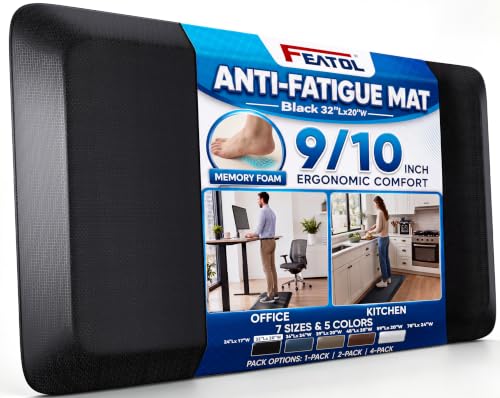
FEATOL Anti Fatigue Mat for Standing Desk & Kitchen Floor, 9/10 Extra Thick
Included for 'Best Anti-Fatigue Standing Desk Mats for Long Workdays' because the listing specifies 9/10 Extra Thick, details this guide uses to compare options.
View on Amazon
Standing Desk Mat - Topo Mini by Ergodriven | The Smaller Not-Flat Anti-Fatigue Standing Desk Mat with Calculated Terrain | Ultra-Thick Premium Comfort Foam, Durable, No PFAs or PVC | Obsidian Black
Included for 'Best Anti-Fatigue Standing Desk Mats for Long Workdays' because the listing specifies Topo Mini by Ergodriven and Ultra-Thick Premium Comfort Foam, details this guide uses to compare options.
View on Amazon
Rocalt Standing Desk Mat, Cushioned Cork Anti Fatigue Mat
Included for 'Best Anti-Fatigue Standing Desk Mats for Long Workdays' because the listing specifies Cushioned Cork Anti Fatigue Mat, details this guide uses to compare options.
View on AmazonA good mat should compress slightly under your weight but recover quickly when you step away. If it collapses deeply, your feet and lower legs must work harder to stabilize you. If it feels almost as hard as the floor, it provides little pressure relief. For most desk users, medium-firm foam or rubber is a better compromise than either a very soft cushion or a thin decorative mat.
Thickness: choose support, not maximum padding
Thickness affects comfort, stability, edge safety, and how easily your chair rolls onto the mat. A thicker mat is not automatically better.
- Under 10 mm: easy to store and less intrusive with a chair, but limited cushioning on concrete, tile, or other hard floors.
- 12–18 mm: a practical range for occasional standing, carpeted rooms, and users who prefer a firmer feel.
- 18–25 mm: the most versatile range for long workdays, especially on hard floors.
- Over 25 mm: potentially comfortable for prolonged standing, but more likely to interfere with chair wheels and create a noticeable step at the perimeter.
Consider the combined height of your flooring and mat. A thick mat can effectively raise your standing position while your chair and keyboard remain at their normal height. If your desk is already close to its maximum or minimum adjustment, check whether the added height affects elbow position and monitor level.
Firmness matters more than foam thickness
Two mats with the same thickness can feel completely different. Density, foam formulation, rubber composition, and the way the top layer is bonded all influence support.
Use this simple test when shopping in person or evaluating a returnable mat: stand in your normal work position for 30 seconds, then shift your weight from heel to toe. Your feet should sink enough to relieve pressure, but you should not feel as though you are standing in a depression. When you step off, the surface should recover without a permanent footprint.
For online specifications, look for descriptions such as medium-firm, high-density foam, or supportive rubber construction. Treat “cloud-soft” and “extra plush” as signals to investigate further rather than as automatic benefits. Very soft mats can feel pleasant initially but may increase ankle and calf effort over several hours.
Surface texture: grip without irritating bare feet
The top surface has two jobs: keeping your feet stable and helping you change position without slipping. A smooth vinyl-like surface is easy to clean, but it can feel slippery with socks or during a quick pivot. A deeply ridged surface offers more traction but may be uncomfortable for barefoot users and harder to wipe clean.
- Fine texture: the best all-purpose option for socks, shoes, and occasional barefoot use.
- Raised massage points: useful if you like changing foot pressure, but distracting if you want a stable, quiet platform.
- Fabric or carpet-like finish: warmer and visually subtle, though more difficult to clean after food or drink spills.
- Rubberized pattern: a strong choice for hard floors and users who frequently shift their stance.
Do not confuse upper-surface texture with underside grip. The top should hold your feet, while the bottom should hold the mat to the floor. A mat that creeps several centimeters during the day can create a trip hazard even if its upper surface is highly textured.
Dimensions: measure your movement zone, not just your desk
Measure the space from the front edge of the desk toward the room, then add room for your normal stance. A narrow mat may cover only your toes when you lean toward the keyboard, forcing your heels onto the hard floor.
For one standing position, 50–60 cm of depth is usually workable. For natural forward-and-back movement, 60–75 cm is more comfortable. If you alternate between sitting and standing, confirm that the chair can approach the desk without its front casters catching on the mat edge.
Width depends on how often you move sideways. A 60–90 cm width suits a compact workstation. A 120 cm or wider mat makes more sense under a wide desk, especially if you move between a primary monitor, laptop, and accessories.
As a practical calculation, suppose your desk is 120 cm wide and you normally use a 70 cm standing zone. A mat that is only 60 cm wide covers the center but leaves 30 cm of the desk’s working width outside the mat on each side. If you regularly reach toward both sides, a 90–120 cm mat gives your feet more room to follow your hands.
Edge design can decide whether a mat is safe
Look for beveled or tapered edges rather than a vertical foam wall. A bevel reduces the height change between the floor and mat, making it easier to step on from the front and less likely that a toe will catch the edge.
Edge details also affect chair use. A flexible, tapered edge may let chair casters cross more smoothly, while a thick square edge can stop small wheels abruptly. If the mat will remain under your chair all day, choose a model specifically described as chair-compatible and check its maximum thickness.
Rounded corners reduce snagging when you walk around the desk. A heavier mat with a flat underside is generally less prone to curling, but rolled packaging can temporarily leave edges raised. If an edge remains curled after being laid flat at room temperature, it is safer to replace the mat than to rely on tape in a high-traffic area.
How to choose between common mat constructions
Dense polyurethane or high-density foam
These mats usually provide the most noticeable cushioning for long periods on hard floors. They are often lighter than thick rubber and comfortable under shoes. The trade-off is that low-quality foam can dent, crumble, or develop a permanent compressed area near the desk.
Rubber or rubber-composite mats
Rubber offers strong floor grip, durability, and a stable feel. It is a good match for tile, concrete, and users who move their feet frequently. Dense rubber can be heavier and firmer, and some products may have an odor when new, so ventilation can matter.
Layered mats
A layered design combines a supportive core with a textured or easy-clean upper surface. These can provide a better balance than a single-material mat, but inspect the perimeter and seams. Separation at the top layer can become a trip point before the center of the mat wears out.
Setup details that improve comfort
- Place the mat square to the desk. A rotated mat creates corners that project into your walking path
FAQ
What makes a standing mat anti-fatigue?
Standing mats do not remove the need for movement, supportive footwear, or periodic sitting. They reduce fatigue mainly by cushioning hard floors and allowing small, comfortable changes in posture. Those changes encourage the calf and foot muscles to keep working instead of holding one rigid position.Affiliate disclosure. As an Amazon Associate we earn from qualifying purchases at no extra cost to you. Prices accurate as of the date shown.Best Anti-Fatigue Standing Desk Mats for Long WorkdaysCheck price on Amazon