Key takeaways
- The best egg incubators for reliable hatching are the Brinsea OvaEasy 190 for serious multi-species work, the R-Com King Suro 20 for small batches with precise automation, and the Nurture Right 360 for beginners hatching chicken or duck eggs at…
The best egg incubators for reliable hatching are the Brinsea OvaEasy 190 for serious multi-species work, the R-Com King Suro 20 for small batches with precise automation, and the Nurture Right 360 for beginners hatching chicken or duck eggs at home.
Incubator performance depends less on the advertised egg count than on stable temperature, correct humidity, gentle turning, fresh air exchange, and how well the design matches your egg type. A large cabinet incubator can be wasteful for 12 eggs, while a compact tabletop model may struggle when filled with large duck or goose eggs.

18 Egg Incubators for Hatching Eggs, Automatic Egg Turning and Humidity Control Incubator for Hatch Chicken Duck Quail Pigeon Pheasant Partridge Home Classroom Lab-
Included for 'Best Egg Incubators for Reliable Hatching' as a relevant option in this category; details come from the product listing.
View on Amazon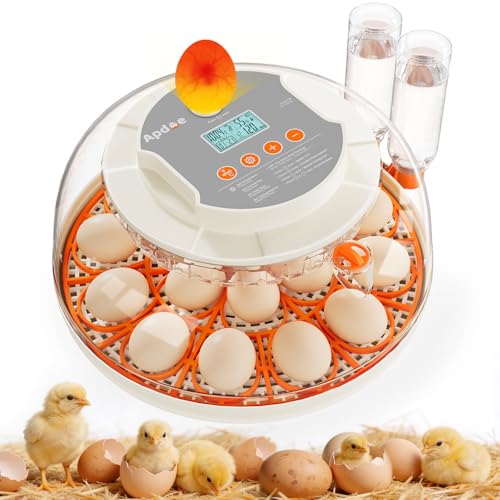
APDOE Egg Incubators for Hatching Eggs, Temperature and Humidity Control, Automatic Egg Turning, Egg Candler, External Water Bottle, Air Vent, for Chicken, Duck & Quail Eggs, 18 Eggs
Included for 'Best Egg Incubators for Reliable Hatching' because the listing specifies Temperature and Humidity Control and Automatic Egg Turning, details this guide uses to compare options.
View on Amazon
Harris Farms Nurture Right Egg Incubator with Auto Turner, Holds 22 Eggs
Included for 'Best Egg Incubators for Reliable Hatching' because the listing specifies Holds 22 Eggs, details this guide uses to compare options.
View on AmazonBest egg incubators by use case
| Best for | Recommended model or class | Usable capacity | Notable strengths | Typical market range |
|---|---|---|---|---|
| First-time chicken keeper | Nurture Right 360 | Up to about 22 chicken eggs | Clear visibility, automatic turning, simple controls | Usually $200–$300 |
| Small, precise batches | R-Com King Suro 20 | About 20 chicken eggs | Automatic temperature, humidity, and turning control | Usually $250–$400 |
| Budget home hatching | HovaBator Genesis 1588 class | About 40 chicken eggs, depending on tray | Forced-air heating and straightforward operation | Usually $150–$250 |
| Mixed poultry and frequent batches | Brinsea OvaEasy 100 or 190 | Roughly 100–190 chicken eggs | Cabinet layout, strong airflow, expandable capacity | Usually $900–$2,000+ |
| Small specialist or ornamental eggs | Brinsea Maxi II Advance class | About 14 chicken eggs | Excellent visibility and automatic turning | Usually $300–$500 |
Capacity figures are approximate because trays, dividers, and egg size change the real number. A tray advertised for chicken eggs may hold substantially fewer duck, turkey, or goose eggs.
Head-to-head: which incubator fits your hatching plan?
Nurture Right 360: easiest visibility for chicken eggs
The Nurture Right 360 is a strong choice when you want to observe development without repeatedly opening the lid. Its integrated viewing design, automatic egg turning, and circulating-air layout reduce the handling that causes temperature swings. It is best suited to chicken eggs and similarly sized poultry eggs.
Its main limitation is flexibility. The built-in design is convenient, but it is not the ideal tool for a broad range of exotic eggs or large goose eggs. Humidity is adjustable, but it relies on adding water to the correct channel rather than providing the laboratory-style precision of a dedicated humidity pump.
R-Com King Suro 20: precise control in a compact footprint
The R-Com King Suro 20 is designed for hatchers who value automatic regulation over maximum capacity. It provides controlled temperature, humidity monitoring, and motorized turning in a compact unit. This makes it useful for valuable small batches where losing a few eggs would matter more than maximizing volume.
Choose it for chicken, duck, quail, pheasant, or other manageable batches after checking the appropriate tray and spacing. The trade-off is cost per egg: it is more expensive than a basic foam incubator, and its capacity is limited for a small farm.
HovaBator Genesis 1588: practical value with fewer refinements
The HovaBator Genesis 1588 is a sensible budget option for chicken keepers who want forced-air circulation and stable electronic temperature control without paying for a premium cabinet. It has enough room for routine home batches and is relatively easy to understand.
Compared with more advanced incubators, expect less polished humidity management, less elegant visibility, and more dependence on the operator’s setup. It can hatch reliably, but the user must monitor water levels, turning, ventilation, and calibration rather than assuming every setting is automatic.
Brinsea Maxi II Advance: premium control for small batches
The Brinsea Maxi II Advance is a good fit when you want a compact, well-insulated incubator with clear visibility and automatic turning. It is particularly attractive for hobbyists working with a small number of valuable eggs, where easy cleaning and consistent operation justify the higher price.
Its usable capacity is modest, especially with larger eggs. It is not the economical choice for producing dozens of chicks, but it is easier to manage than a large cabinet when your batches are small.
Brinsea OvaEasy 100 or 190: the choice for scale
The OvaEasy cabinet range is better suited to breeders, schools, small farms, and anyone running repeated batches. Cabinet construction generally provides more stable airflow and temperature distribution than a lightweight tabletop unit. Shelves and removable trays also make it easier to separate egg types or stagger hatch dates.
The disadvantages are size, price, and cleaning effort. A cabinet incubator also creates a larger single point of failure: a prolonged power outage or failed control board can affect many eggs at once. A backup plan is essential at this capacity.
Decision matrix for different egg types
| Your eggs or situation | Preferred capacity | Temperature target | Humidity approach | Best design choice |
|---|---|---|---|---|
| Chicken eggs | 12–40 eggs for most homes | 37.5°C / 99.5°F in forced air | Moderate early humidity; increase substantially at lockdown | Automatic tabletop unit |
| Duck eggs | 8–30 eggs, allowing extra space | About 37.5°C / 99.5°F in forced air | Usually higher moisture needs; follow the breed-specific method | Roomier tray with easy cleaning |
| Quail eggs | 24–120 eggs | About 37.5°C / 99.5°F in forced air | Small eggs lose moisture quickly, so monitor weight or air cell | Fine-spaced automatic turning tray |
| Turkey or large poultry eggs | 6–24 eggs | About 37.5°C / 99.5°F in forced air | Use a humidity system that can handle longer, larger eggs | Adjustable cabinet or large tabletop unit |
| Mixed species | Separate batches where possible | Species-dependent | Different eggs may require different moisture loss | Multiple compartments or separate incubators |
These are starting points, not universal prescriptions. Breed, altitude, shell porosity, egg storage, and the incubator’s calibration all affect the correct settings. Duck eggs also require particular attention to ventilation and, in some methods, periodic cooling or misting.
Features that matter more than the egg-count claim
Usable capacity and turning space
Subtract the space occupied by dividers, turning rails, water channels, and the clearance needed for hatchlings. If a unit claims 24 chicken eggs but your eggs are unusually large, plan around 18–20. Overcrowding can restrict airflow and make it harder for chicks to move during hatch.
Temperature control and airflow
Forced-air incubators distribute heat more evenly than still-air designs, but only if the fan circulates properly and vents are not blocked. Use a separate calibrated thermometer at egg height. A 0.5°C error sustained over days can be more damaging than a brief fluctuation caused by opening the lid.
Humidity control
Water volume alone does not determine humidity; exposed surface area does. A shallow, wide channel raises humidity more quickly than a deep, narrow reservoir. The best systems let you add water without opening the main chamber, but even then, verify the reading with an independent hygrometer when possible.
Turning systems
Automatic turning is valuable because eggs should be moved regularly during incubation, while rough or inconsistent manual turning can damage developing membranes. Look for a gentle rocking system with removable trays. Stop turning at lockdown, commonly around day 18 for chicken eggs, so the chick can position itself for hatching.
Visibility and cleaning
A large window or transparent lid lets you inspect eggs without releasing heat and humidity. However, visibility is not a substitute for sanitation. Smooth, removable, washable parts are more useful than decorative transparent panels. Avoid porous foam surfaces that are difficult to disinfect if repeated batches are planned.
Power backup: calculate it before you buy
Incubators often draw between 40 and 150 watts depending on size, heater activity, and fan operation. To estimate battery requirements, use:
Required watt-hours = incubator watts × backup hours ÷ inverter efficiency.
For example, a 60-watt incubator needing six hours of backup through an inverter at 85% efficiency requires:
60 × 6 ÷ 0.85 = about 424 watt-hours.
A 500-watt-hour portable power station would therefore provide a practical minimum, but its real runtime may be lower in cold conditions or if the battery is aging. For a cabinet incubator drawing 120 watts, the same six-hour outage would require about 847 watt-hours. Keep the incubator closed during an outage, insulate around—not over—the ventilation openings, and restore normal airflow once power returns.
Settings and setup checklist for a reliable hatch
- Run the empty incubator for 24 hours. This reveals temperature swings, fan problems, and inaccurate displays before eggs are at risk.
- Calibrate independently. Place a known-good thermometer and hygrometer near egg level rather than trusting the built-in sensor alone.
- Set the room first. Keep the incubator away from windows, heaters, exterior doors, and direct sunlight. A stable room around 20–25°C is easier for most household units.
- Pre-warm clean eggs gradually. Avoid placing cold eggs directly into a hot chamber, because condensation can form on the shell and encourage contamination.
- Mark eggs with an X and O. If turning manually, rotate them at least three times daily using a gentle, consistent schedule. Automatic turning is preferable for most users.
- Increase ventilation near hatch. As embryos grow, oxygen demand rises. Do not chase humidity by sealing every vent.
- Clean after the hatch. Remove shell fragments and down, wash according to the manufacturer’s instructions, disinfect compatible surfaces, and dry completely before storage.
Bottom line
Choose the Nurture Right 360 for a convenient chicken-egg starter setup, the R-Com King Suro 20 or Brinsea Maxi II Advance for precise small batches, the HovaBator Genesis 1588 for practical value, and the Brinsea OvaEasy range when capacity and repeatability matter most. Whichever model you select, buy enough physical space for your largest eggs, verify temperature with independent instruments, and budget for power backup. Those decisions support hatch rates more reliably than simply choosing the incubator with the biggest advertised capacity.