Key takeaways
- High-carbon steel: Usually easy to sharpen and capable of a very keen edge, but it may require more frequent honing.
- A2 tool steel: Common in premium planes and generally offers improved edge life, especially in abrasive woods. It may take longer to sharpen.
- PM-V11 and similar powdered steels: Used in some Veritas planes; these aim to combine edge retention with practical sharpening behavior.
- Thickness: An iron around 3–4.5 mm is typically more resistant to chatter than a thin replacement blade, provided the bedding is accurate.
The best hand planes for most woodworkers are a No. 5 jack plane for general stock preparation, a No. 4 smoothing plane for final surfaces, and a low-angle block plane for end grain and small parts—but the right choice depends on sole flatness, iron quality, adjustment design, weight, and the work you do most often.
Quick Comparison: Which Hand Plane Fits Your Work?
| Plane type | Typical length | Typical iron width | Best suited tasks | Useful weight range |
|---|---|---|---|---|
| Block plane | 150–180 mm | 40–45 mm | End grain, chamfers, fitting doors, small parts | 0.6–1.0 kg |
| No. 4 smoother | 240–250 mm | 50–52 mm | Final smoothing on boards and panels | 1.8–2.3 kg |
| No. 5 jack plane | 350–380 mm | 50–52 mm | General dimensioning, flattening, edge work | 2.2–2.8 kg |
| No. 6 fore plane | 450–480 mm | 55–60 mm | Fast flattening and preparing wide boards | 3.0–3.7 kg |
| No. 7 jointer plane | 550–600 mm | 55–60 mm | Straightening long edges and faces | 3.8–4.5 kg |
| Low-angle jack plane | 350–380 mm | 50–60 mm | Mixed grain, end grain, shooting, general work | 2.0–2.7 kg |
These dimensions are useful starting points rather than strict standards. A heavy plane can maintain momentum in difficult timber, while a lighter plane may be easier to control during long sessions or overhead work.

Amazon Basics Woodworking Hand Planer - No.4 Adjustable Bench Plane with 2-Inch Steel Blade for Quality Wood Smoothing Cuts, Grey/Black
Included for 'Best Hand Planes for Woodworking' because the listing specifies Grey/Black, details this guide uses to compare options.
View on Amazon
JORGENSEN No.102 Wood Planer, Low Angle Block Plane for Woodworking
Included for 'Best Hand Planes for Woodworking' because the listing specifies Low Angle Block Plane for Woodworking, details this guide uses to compare options.
View on Amazon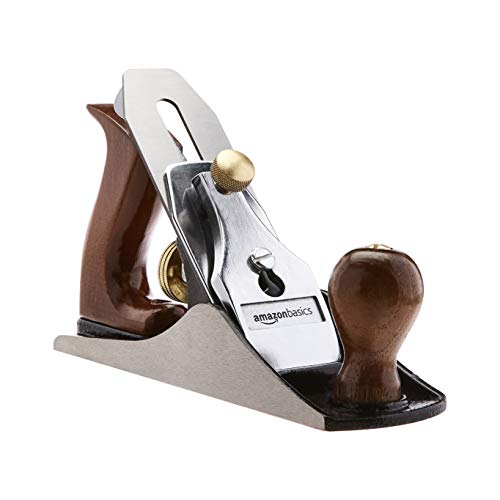
Amazon Basics No.4 Adjustable Precision Smoothing Bench Hand Plane with 2-Inch Blade and Wooden Handles for Woodworking, Brown
Included for 'Best Hand Planes for Woodworking' because the listing specifies Brown, details this guide uses to compare options.
View on Amazon
KAKURI Japanese Hand Plane 42mm, Woodworking Block Plane 5.9" x 2.1"
Included for 'Best Hand Planes for Woodworking' because the listing specifies Woodworking Block Plane 5.9" x 2.1", details this guide uses to compare options.
View on AmazonBest Hand Planes by Woodworking Task
Best all-purpose choice: No. 5 jack plane
A No. 5 jack plane is the most versatile single plane for a traditional woodworking bench. Its roughly 350–380 mm sole is long enough to bridge modest hollows, but short enough to follow curved or uneven stock. With a cambered iron, it removes material quickly; with a lightly cambered or nearly straight iron, it can prepare edges and faces for joinery.
The Stanley No. 5 is the classic example, while the Lie-Nielsen No. 5 and Veritas Jack Plane represent higher-specification versions. A vintage plane can also perform extremely well if its sole, frog, mouth, and adjustment hardware are in good condition.
Choose this type if you make furniture, dimension rough boards by hand, or want one plane that can perform several jobs. It is less convenient than a No. 4 for delicate final smoothing and less precise than a No. 7 for long-edge jointing.
Best for final surfaces: No. 4 smoothing plane
A No. 4 smoother is compact enough to control precisely and heavy enough to cut consistently. It is designed for the final few passes over a surface, especially when the blade is sharpened finely and set for a thin shaving.
The Lie-Nielsen No. 4, Veritas No. 4-1/2 and Stanley No. 4-type planes are common choices in this category. A No. 4-1/2 is wider and heavier than a standard No. 4, making it more stable on broad surfaces but more tiring to push.
For a smoother, look for a tight mouth, a rigid frog or bed, and an iron that can hold a keen edge. A plane with a slightly cambered blade is more forgiving because its corners are less likely to leave tracks.
Best for end grain and small jobs: low-angle block plane
A low-angle block plane places the bevel of the iron upward and commonly uses a bedding angle near 12 degrees. With a 25-degree bevel, the effective cutting angle is about 37 degrees, which is efficient for end grain. A 38- or bevel can raise the effective angle when tear-out is a problem.
Veritas Low-Angle Block Plane and Lie-Nielsen No. 60-1/2 Low-Angle Block Plane are established examples. A standard-angle block plane is often better for general trimming and chamfers, while a low-angle model is particularly useful for shooting end grain and fitting components.
Its short sole is not intended to flatten large boards. It follows local contours rather than averaging them out, so use it for a specific edge or small area rather than broad stock removal.
Best for long edges: No. 7 jointer plane
A No. 7 jointer plane is the right tool when the reference surface is longer than the workpiece’s local bumps and hollows. Its long sole helps create straight edges for edge-to-edge glue joints and accurate boards for cabinet construction.
The Lie-Nielsen No. 7 and Veritas No. 7 Jointer are high-end examples. A Stanley No. 7 or Record No. 7 can also be an excellent option when properly restored.
Long does not automatically mean better. On a short board, a No. 7 can ride over the ends and remove material in the wrong places. For general furniture work, a No. 5 often offers a better balance between reach and maneuverability.
Iron Quality: The Part That Determines Cutting Performance
The iron is more important than polished handles or decorative finish. A good iron should be thick enough to resist chatter, flat enough to seat securely, and made from steel that can take a durable edge.
- High-carbon steel: Usually easy to sharpen and capable of a very keen edge, but it may require more frequent honing.
- A2 tool steel: Common in premium planes and generally offers improved edge life, especially in abrasive woods. It may take longer to sharpen.
- PM-V11 and similar powdered steels: Used in some Veritas planes; these aim to combine edge retention with practical sharpening behavior.
- Thickness: An iron around 3–4.5 mm is typically more resistant to chatter than a thin replacement blade, provided the bedding is accurate.
For smoothing, prioritize edge stability and easy honing. For heavy jack-plane work, thickness and toughness matter more than achieving the finest possible polish. A replacement iron can transform an otherwise sound vintage plane, but it cannot compensate for a loose frog, poor bedding, or a badly distorted sole.
Sole Flatness: How Much Is Enough?
A plane sole does not need to be mirror-flat across every square millimeter. It needs reliable contact around the mouth, toe, heel, and areas that establish the cut. A small hollow in an unimportant area may have no practical effect, while a ridge directly ahead of the mouth can prevent the plane from seating consistently.
For a smoother, a useful target is roughly 0.03–0.05 mm of deviation across the main reference areas. A jack plane can work well with somewhat more deviation if its mouth and contact points are sound. A jointer plane benefits from a straight sole along its length, but excessive polishing is unnecessary and can remove valuable casting material.
To check a plane, clean the sole, apply a thin permanent-marker grid, and make a few passes over a known-flat abrasive surface. The marker pattern shows high spots. Do not grind until the entire sole is uniformly bright unless measurement shows that this is needed; concentrate on functional contact areas.
Adjustment Systems Compared
Bailey-style frog and lateral adjustment
The traditional Bailey pattern uses a frog, cap iron, depth-adjustment yoke, and lateral lever. It is familiar, widely supported, and easy to service. Its lateral lever corrects an iron that is not perfectly square, while the depth wheel controls projection.
The limitation is that changing the mouth opening may require loosening frog screws and repositioning the frog. That is slower than a movable-mouth design, particularly when switching between heavy and fine cuts.
Bevel-up adjustment
Bevel-up planes seat the iron on a fixed bed and commonly use a combined depth-and-lateral adjustment mechanism. Changing irons with different bevels can alter the effective cutting angle quickly. This makes the design attractive for difficult grain and end-grain work.
For example, a 12-degree bed with a 25-degree bevel produces about a 37-degree effective angle. Increasing the bevel to 38 degrees produces about a 50-degree effective angle, which can reduce tear-out in figured wood but requires more pushing force.
Movable-mouth systems
Some premium planes allow the mouth opening to be changed with a front sole section or other integrated mechanism. A tight opening supports thin smoothing shavings; a wider opening provides clearance for heavier cuts and thicker shavings. The convenience is valuable if you frequently change tasks, but it increases cost and adds moving parts that must remain clean and accurately set.
Decision Matrix for Buying Your First Plane
| Your situation | Best starting choice | Why | What to add next |
|---|---|---|---|
| One plane for general furniture work | No. 5 jack plane | Handles stock preparation, edges, and moderate smoothing | No. 4 smoother or block plane |
| You buy already-machined boards | No. 4 smoother | Focuses on final surfaces and small corrections | Low-angle block plane |
| You prepare rough, wide boards by hand | No. 5 or No. 6 | Removes material efficiently without the reach of a jointer | No. 7 jointer |
| You build cabinets or tables with long glue joints | No. 7 jointer | Long sole supports straight reference edges | No. 4 smoother |
| You make small boxes, instruments, or model parts | Low-angle block plane | Precise control in end grain and small areas | Small shoulder or rabbet plane |
| You work mostly figured or reversing-grain wood | Bevel-up plane with interchangeable irons | Allows effective cutting angle changes | High-angle iron or scraper |
Weight, Balance, and Ergonomics
Weight helps a plane carry momentum through a cut, but it does not replace sharpness. A 2.5 kg jack plane can feel efficient on long, straight passes, while a 1 kg block plane is easier to hold in one hand and use at awkward angles.
Balance matters as much as the number on a scale. The plane should sit naturally on the work without excessive downward pressure. If you must grip the tote tightly to stop the tool from twisting, the handle shape, blade projection, or workholding may be wrong for you.
For repeated stock removal, choose enough mass to maintain a steady cut. For joinery fitting, end grain, and overhead work, prioritize control and lower fatigue. A sharp iron and a properly waxed sole can make a lighter plane feel faster than a heavy plane with a blunt blade.
Recommended Buying Priorities
- Choose the plane type for your main task. A flawless No. 4 will not replace a jointer plane when you need to straighten a long edge.
- Inspect the sole and mouth. Avoid major twists, deep corrosion around the mouth, or damaged bedding surfaces.
- Check the iron and cap iron. The iron should seat firmly, and the cap iron should mate closely enough to prevent shavings from wedging underneath.
- Evaluate adjustment backlash. A little movement is normal in older planes, but the depth wheel should respond predictably rather than moving several turns before the iron shifts.
- Budget for sharpening. A reliable honing guide, flattening method, and suitable abrasives often improve results more than upgrading from a good mid-range plane to an expensive one.
For many woodworkers, the most capable progression is a No. 5 jack plane first, a low-angle block plane second, and a No. 4 or No. 7 selected according to whether final smoothing or long-edge jointing is the bigger need. The best hand planes are not necessarily the heaviest or most expensive models; they are the ones whose geometry, iron, adjustment system, and weight match the cuts you make repeatedly.