Key takeaways
- Height: Most senior chassis (Tony Kart Racer 401 RR, Birel ART, CRG) fit 5’4″ to 6’3″ with adjustable pedal box, seat struts, and steering column. Riders under 5’2″ will need a junior chassis or a heavily moved seat and shorter pedals to reach full brake pressure.
- Weight limit: Chromoly racing frames are rated for 220-265 lbs rider weight when the seat is properly mounted. Exceeding this does not break the frame immediately, but it flexes the chassis outside its designed window, causing unpredictable handling and rapid seat strut fatigue. Recreational high-end frames like the Sodi Furia or heavier-duty off-road buggies (Hammerhead, TrailMaster 300 class) often list 300-350 lb rider capacities because they use thicker tubing and do not rely on chassis flex for grip.
- Seat size: Racing seats are sized in centimeters (e.g., Tillett T11). A 190 lb adult with a 34″ waist typically needs a Large, a 140 lb teen needs a Medium. A loose seat costs you control and bruises ribs; too tight restricts breathing under lateral load.
- Leg length vs. braking: If your knees are sharply bent at full extension, you cannot modulate a hydraulic brake. High-end karts allow 60-80mm of pedal travel adjustment. Test it seated: with your back flat against the seat, you should be able to apply full brake pressure without lifting your shoulders.
The best high end go karts for adults and teens are 125cc 2-stroke racing chassis like the Tony Kart Racer 401 RR with a Rotax 125 MAX Evo or IAME X30 engine for track performance, and 48V-72V electric performance karts like the Segway Ninebot GoKart Pro 2 for low-maintenance, high-torque recreation, with the right choice depending on your weight, terrain, and whether you need track-legal competition specs or versatile off-track use.
What “High-End” Means at This Level
High-end does not just mean faster. For adults and teens, it means a full-size chassis (1040mm-1080mm wheelbase), hydraulic braking, adjustable geometry, and an engine or motor that delivers consistent power without overheating or sagging after 10 minutes. Recreational karts in the $800-$1,500 range use a simple steel tube frame, mechanical brakes, and a 196cc-270cc 4-stroke clone engine. High-end karts step up to chrome-moly or 32mm steel frames, CNC-machined hubs and spindles, hydraulic calipers, and either a race-tuned 2-stroke or a high-output brushless electric drive.

Segway Ninebot Gokart Pro 2 - High-Speed Electric Go Kart for Ages 14+, Drift & Race with Speeds Up to 26.7 mph
Included for 'Best High-End Go-Karts for Adults and Teens' because the listing specifies High-Speed Electric Go Kart for Ages 14+ and Drift & Race with Speeds Up to 26.7 mph, details this guide uses to compare options.
View on Amazon
First Ride On 48V Go Kart with Top Speed 15 MPH, Licensed McLaren Drift Kart for Teens 14+ w/Handbrake and 3-Speed Transmission, Electric Go Kart w/Adjustable Seat, Seat Belt, Rubber Tire and LED
Included for 'Best High-End Go-Karts for Adults and Teens' because the listing specifies Electric Go Kart w/Adjustable Seat and Seat Belt, details this guide uses to compare options.
View on Amazon
HHH Adults and Youth VITACCI GR2-125cc Go Kart with 3-Speed Semi-Automatic with Reverse and Big 18 inch Aluminium Rim Wheels RPS TK125JP (Red) - Extra Large
Included for 'Best High-End Go-Karts for Adults and Teens' because the listing specifies Extra Large, details this guide uses to compare options.
View on Amazon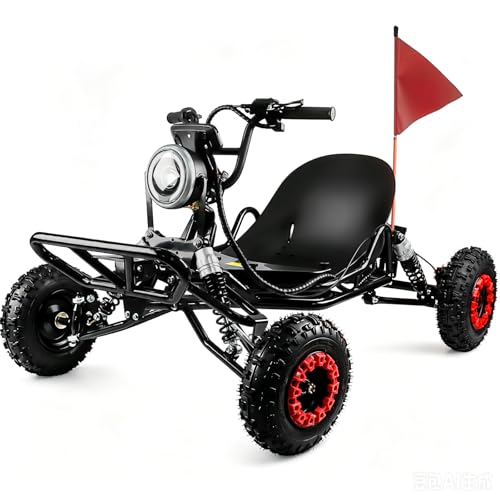
Electric Go Kart, 2100W Motor Go Kart for Adults & Kids with Premium Steel Tubular Frame, 3 Speed Off-Road Kart with 6'' Off-Road Tires with Hydraulic Brake, 30MPH (Black, 53x35x29IN)
Included for 'Best High-End Go-Karts for Adults and Teens' because the listing specifies 30MPH (Black and 53x35x29IN), details this guide uses to compare options.
View on AmazonFor teens, check the class fit first. Most sanctioning bodies allow 13+ on 100cc-125cc junior/senior packages with a 32mm chassis, while full 125cc shifter and 30mm-32mm senior chassis are intended for riders 14-15+ and over 140 lbs. Weight and height matter more than age for comfort and control.
Engine vs. Motor Power: What You Actually Feel
Power figures are misleading without weight. A 6.5 hp rental-style 4-stroke feels slow because it moves 350+ lbs total. A 28 hp 125cc 2-stroke feels explosive because it moves 370-400 lbs total with superior power-to-weight.
| Kart Class (Real Examples) | Power Output | Total Weight (Kart + 165 lb Rider) | Top Speed (Geared for Track) | Power-to-Weight | Typical Market Range |
|---|---|---|---|---|---|
| 4-Stroke Recreational (Honda GX270, Tillotson 212/225 class) | 9-13 hp | 380-420 lbs | 35-50 mph | 0.022-0.034 hp/lb | usually $1,800-$3,200 |
| Rotax 125 MAX Evo / IAME X30 125cc (Tony Kart Racer 401 RR, Birel ART AM29, CRG Black Mirror chassis) | 28-32 hp | 365-400 lbs | 70-85 mph | 0.070-0.088 hp/lb | usually $4,500-$7,000 chassis + $3,000-$5,500 engine package |
| 125cc Shifter (IAME X30 Shifter, TM KZ-R1 on Sodi Sigma KZ, Kart Republic KR2) | 38-48 hp | 385-415 lbs | 80-100+ mph | 0.092-0.125 hp/lb | usually $6,000-$9,000 chassis + $4,500-$6,500 engine |
| High-End Electric (Segway Ninebot GoKart Pro 2, OTL E-Pro / Blue Shock Race spec) | 4.8-12 kW peak (6.4-16 hp) | 400-460 lbs | 25-60 mph (limited by controller) | 0.014-0.040 hp/lb | usually $2,200-$4,500 |
Worked Calculation: Do You Have Enough Power for Hills and Heavier Riders?
Spec sheets list peak horsepower on flat ground. If you are 190-220 lbs or you ride on anything other than a flat track, calculate your hill-climb power budget. This explains why a 13 hp kart struggles where a 30 hp kart does not.
Formula: Power to climb = mass (kg) x gravity (9.81) x speed (m/s) x grade (%)
Example: Adult rider 90 kg (198 lbs) + kart 85 kg (187 lbs) = 175 kg total. You want to hold 30 mph (13.4 m/s) up a 10% asphalt incline.
Power needed just for the climb = 175 x 9.81 x 13.4 x 0.10 = 2,300 watts (3.1 hp). Add rolling resistance and aero drag at 30 mph, roughly 1,800-2,400 watts more. Total needed: ~4,100-4,700 watts (5.5-6.3 hp) just to maintain speed uphill. A 9 hp 4-stroke has little left for acceleration after that, so it bogs down. A 28 hp Rotax/IAME package still has 22 hp in reserve to accelerate, which is why it feels effortless for heavier riders.
For electrics, use the same math to estimate runtime. A 1,500Wh battery pack (common on 72V performance electric karts) delivering an average 3,500W on a mixed track session lasts: 1,500Wh / 3,500W = 0.42 hours = 25 minutes at pace. At a recreational average of 1,800W, runtime extends to ~50 minutes. If a seller claims 60+ minutes at full pace on a 1,000Wh pack, the math does not support it.
Rider Size Limits and Fit
High-end racing chassis are adjustable, but they are built around adult/teen dimensions, not kids.
- Height: Most senior chassis (Tony Kart Racer 401 RR, Birel ART, CRG) fit 5’4″ to 6’3″ with adjustable pedal box, seat struts, and steering column. Riders under 5’2″ will need a junior chassis or a heavily moved seat and shorter pedals to reach full brake pressure.
- Weight limit: Chromoly racing frames are rated for 220-265 lbs rider weight when the seat is properly mounted. Exceeding this does not break the frame immediately, but it flexes the chassis outside its designed window, causing unpredictable handling and rapid seat strut fatigue. Recreational high-end frames like the Sodi Furia or heavier-duty off-road buggies (Hammerhead, TrailMaster 300 class) often list 300-350 lb rider capacities because they use thicker tubing and do not rely on chassis flex for grip.
- Seat size: Racing seats are sized in centimeters (e.g., Tillett T11). A 190 lb adult with a 34″ waist typically needs a Large, a 140 lb teen needs a Medium. A loose seat costs you control and bruises ribs; too tight restricts breathing under lateral load.
- Leg length vs. braking: If your knees are sharply bent at full extension, you cannot modulate a hydraulic brake. High-end karts allow 60-80mm of pedal travel adjustment. Test it seated: with your back flat against the seat, you should be able to apply full brake pressure without lifting your shoulders.
Braking, Suspension, and Safety Equipment
This is where high-end karts separate clearly from mid-range.
- Braking: Entry-level karts use a single mechanical rear disc. High-end road-legal racing karts use hydraulic systems: single rear disc on Rotax/X30 single-speed (e.g., Ven11 or MCP systems), and front + rear hydraulic on shifter karts (required to control 45+ hp). Look for a 180mm-200mm vented rear disc with a 2-piston caliper minimum, braided lines, and a self-adjusting master cylinder. Electric performance karts add regenerative braking, which extends pad life but should not be relied on as the sole brake for emergency stops.
- Suspension: True racing karts have no suspension by design. Grip comes from chassis flex, axle stiffness, and tire pressure (typically 12-16 psi cold for track slicks). Off-road high-end karts and larger buggies are the exception and offer double A-arm front suspension with coilovers and a rear swingarm. If you plan to ride on grass, gravel, or uneven pavement, a rigid racing chassis will be harsh and will crack at the bearing hangers over time. Choose a suspended platform for that terrain even if you sacrifice lap time.
- Safety equipment: High-end packages should include a CIK-FIA homologated chassis (check homologation number on the rear crossbar), an adjustable side-pod and front bumper system, and a 4-point or 5-point harness on suspended buggies. For track karts, a harness is not used; retention comes from a molded seat and you must wear a proper karting suit, rib protector, full-face helmet (Snell K2020 or ECE 22.06), gloves, and high ankle boots. Do not use a bicycle or skate helmet. For electric karts, insist on a battery management system with over-current cutoff, steel battery enclosure, and a mechanical kill switch in addition to electronic cutoff.
Terrain Fit: Choose by Where You Will Actually Drive
Engine and chassis choice should follow terrain, not just speed.
- Paved kart track or smooth lot: Rotax 125 MAX Evo or IAME X30 on a 32mm OTK, Birel ART, or CRG chassis. Slick tires, no suspension, maximum lateral grip. Not suitable for dirt or grass.
- Mixed asphalt / light off-road / neighborhood roads: 48V-72V electric or 270cc-390cc 4-stroke with turf or semi-slick tires. Better torque at low speed, quieter, no jetting changes with temperature. Limited top end but far more usable.
- Dirt, gravel, or grass fields: Suspended off-road kart/buggy class (TrailMaster 300 XRX, Hammerhead GTS 150/250 class) with low-pressure knobby tires and CVT. Much higher ground clearance but not track-legal for CIK competition.
Adults and heavier teens sink small 10″ slick tires into soft ground. If your primary surface is not pavement, you need 18″-22″ rear tires and at least 6″ ground clearance regardless of engine power.
Maintenance: What Ownership Really Costs
High performance demands more frequent service. Budget for it before you buy.
- 2-stroke race engines (Rotax, IAME): Piston rebuild every 20-30 hours, full rebuild every 45-60 hours. Requires pre-mixed fuel (castor or synthetic 2-stroke oil at 4-6% ratio), carburetor jetting for altitude/temperature, and careful warm-up. Best power-to-weight, highest maintenance attention.
- 4-stroke racing/senior engines (Tillotson T4, Briggs LO206 built, Honda GX390 tuned): Valve check every 20 hours, oil change every 5-10 hours. Much longer rebuild interval (80-150 hours). Easier for teens and families who want to ride more than wrench.
- Electric brushless: No fuel mixing, no jetting, chain and brake pads are the main consumables. Check battery health every ride, store at 50-60% charge if not used for weeks, avoid full discharge. Battery pack replacement after 500-800 cycles is the largest long-term cost, usually $400-$900 depending on capacity.
- Chassis: All classes need chain lube every ride, brake bleed every 15-20 hours, axle bearing cleaning if run in dust/wet, and frame crack inspection at welds and seat struts. Tire sets last 40-120 laps on track at full pace, or 40-80 hours recreationally.
Which Kart Should You Choose? Decision Matrix
| Your Situation | Best Fit Class | Why |
|---|---|---|
| Teen 13-16, 110-150 lbs, wants to race at a local track | 100cc-125cc Junior/Senior on junior or 30mm chassis (Rotax Mini MAX / X30 Junior) | Age-legal, lighter steering effort, lower running cost than shifter, eligible for sanctioned classes |
| Adult 170-220 lbs, wants fastest lap times on pavement | 125cc Rotax MAX Evo or IAME X30 on senior 32mm chassis | Highest usable power-to-weight without shifter complexity, hydraulic rear brake handles weight |
| Adult or teen, no track access, needs neighborhood/grass versatility | 72V electric or 300cc suspended kart | Instant torque, quiet, no fuel mixing, suspension protects frame on uneven ground |
| Family sharing one kart between adult and teen | Electric performance or 4-stroke 270cc-390cc with adjustable pedals/seat | Widest adjustment range, lowest tuning knowledge needed, easiest handoff between riders |
| Experienced adult seeking maximum speed and already has track support | 125cc Shifter (KZ) on CRG / Sodi Sigma KZ / Kart Republic | 6-speed sequential, front brakes, 40+ hp, but demands precise maintenance and skill |
If you are between classes, prioritize fit and where you will ride 80% of the time. A perfectly fitted 28 hp kart you can drive weekly is faster and safer than a 45 hp shifter that only suits a track you visit twice a year. For first-time high-end buyers, a Rotax MAX or X30 package on a proven OTK, Birel ART, or CRG chassis offers the broadest parts support, or a 72V electric if you value low maintenance over ultimate lap time.
Buying Checklist Before You Pay
- Verify CIK-FIA homologation or local track eligibility if you plan to race. Recreational buggies are not accepted in sprint races.
- Sit in the kart with your helmet and shoes. Check pedal reach at full brake, knee clearance to steering wheel, and rib clearance to seat sides.
- Inspect braking: hydraulic fluid should be clear/golden, not dark; pads should show >3mm thickness; disc should be free of deep grooves.
- For used 2-strokes, ask for hour meter log and last rebuild receipt. No log means assume a rebuild is due.
- For electrics, request battery cycle count and a demonstrated full-speed run showing no voltage sag warnings.