Key takeaways
- You are roughly average height or taller and want shoulder-level immersion.
- You have floor space for a footprint around the low-to-mid 3-foot range but not room for a long tub.
- You expect to plunge several times per week and want the option to add filtration or chilling.
- You prefer a standing entry rather than reclining in a horizontal bath.
The best ice barrel cold plunge tubs for athletes are the Ice Barrel 400 for most home users, the smaller Ice Barrel 300 for tight spaces, and a rigid barrel-style tub paired with a dedicated chiller when daily recovery matters more than the lowest purchase price.
The right choice depends less on the lowest advertised temperature than on four practical details: how much water you need to cool, how well the tub holds temperature, whether its fittings match a chiller, and how easily you can drain and refill it. A tub that looks inexpensive can become inconvenient if it requires frequent ice, occupies a permanent footprint, or has no sensible route for wastewater.

Ice Barrel 500 Portable Ice Bath Freestanding Cold Plunge (Charcoal Black)
Included for 'Best Ice Barrel Cold Plunge Tubs for Athletes Recovery' as a relevant option in this category; details come from the product listing.
View on Amazon
Ice Barrel 300 Insulated Cold Plunge Tub Built-in Chiller Ports (Black)
Included for 'Best Ice Barrel Cold Plunge Tubs for Athletes Recovery' as a relevant option in this category; details come from the product listing.
View on Amazon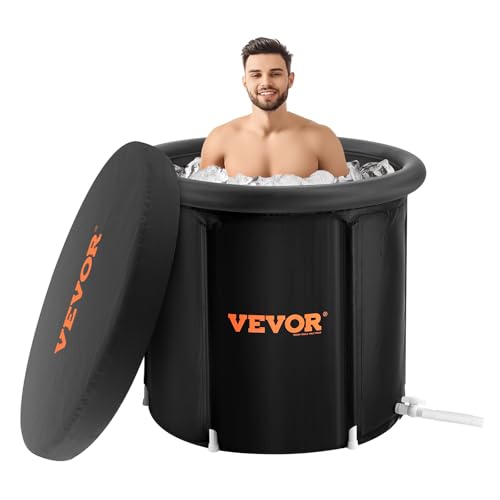
VEVOR Ice Bath Tub XL, Cold Water Therapy Plunge Tub for Athletes, Portable Outdoor Ice Barrel Plunge Pool for Recovery (Black, 105 Gal)
Included for 'Best Ice Barrel Cold Plunge Tubs for Athletes Recovery' because the listing specifies Cold Water Therapy Plunge Tub for Athletes and Portable Outdoor Ice Barrel Plunge Pool for Recovery (Black, details this guide uses to compare options.
View on Amazon
The Cold Pod Ice Bath Tub for Athletes with Cover: 88 Gallons Cold Plunge Tub for Recovery, Multiple Layered Portable Ice Bath Plunge Pool
Included for 'Best Ice Barrel Cold Plunge Tubs for Athletes Recovery' because the listing specifies Multiple Layered Portable Ice Bath Plunge Pool, details this guide uses to compare options.
View on AmazonQuick comparison for athlete recovery
| Option | Approximate capacity | Best for | Cooling approach | Typical market range |
|---|---|---|---|---|
| Ice Barrel 300 | About 77 gallons | Shorter athletes, balconies, compact patios | Ice or compatible external chiller | Usually $1,000–$1,500 before premium accessories |
| Ice Barrel 400 | About 105 gallons | Most athletes wanting upright immersion | Ice or compatible external chiller | Usually $1,200–$1,800 before premium accessories |
| Insulated horizontal plunge tub | About 80–150 gallons | Users who prefer a seated or reclined position | Integrated or external chiller | Usually $1,500–$5,000 |
| Rigid barrel-style tub with chiller ports | About 80–120 gallons | Daily use with automatic temperature control | External chiller and filtration | Usually $2,000–$6,000 |
Capacities vary with fill level, user size, and the manufacturer’s measurement method. Treat the figures as planning numbers, then confirm the current dimensions and connection specifications before buying.
1. Ice Barrel 400: the best all-around upright choice
The Ice Barrel 400 is the strongest fit for athletes who want deep, upright immersion without committing to a large horizontal bath. Its roughly 105-gallon capacity gives enough water depth for full-body use while retaining the compact vertical footprint that makes a barrel practical on a patio, beside a garage, or in a dedicated recovery area.
Its main advantage is access: stepping into an upright barrel is quick, and the smaller exposed water surface can reduce heat gain compared with a wide, uncovered tub. It is also easier to cover between sessions than many improvised stock tanks.
Choose it when
- You are roughly average height or taller and want shoulder-level immersion.
- You have floor space for a footprint around the low-to-mid 3-foot range but not room for a long tub.
- You expect to plunge several times per week and want the option to add filtration or chilling.
- You prefer a standing entry rather than reclining in a horizontal bath.
The trade-off is water volume. A larger volume feels more stable and comfortable, but it takes more energy to cool and more time to drain. If you use ice rather than a chiller, the running cost can quickly outweigh the initial simplicity.
2. Ice Barrel 300: the compact pick
The Ice Barrel 300 is better suited to smaller users, limited outdoor areas, or a recovery setup that must be moved or stored more easily. Its capacity of roughly 77 gallons is materially lower than the 400’s, so it needs less ice or cooling energy to reach a target temperature.
That lower volume is useful for athletes who plunge briefly at a consistent temperature. It is less forgiving for taller users, who may find the waterline or leg position restrictive. Check the internal dimensions—not just the exterior height—if you are near the upper end of the tub’s intended user range.
Choose it when
- Your available floor area is limited or you need to preserve a clear walkway.
- You want lower ice consumption than a 100-gallon-class tub.
- Your routine is a short seated or crouched immersion rather than a long full-body soak.
- You plan to move the tub seasonally and value a smaller water load.
A 77-gallon tub still weighs more than 640 pounds when full, before adding the user. “Compact” does not mean suitable for every deck, balcony, or upper-floor room. Confirm the surface’s load rating and provide a spill-safe drainage route.
Capacity is a comfort decision and a power decision
Capacity affects more than legroom. It determines how much heat must be removed and how much water must be treated. Here is a useful estimate for an unchilled tub: cooling 100 gallons of water from 70°F to 50°F requires removing approximately:
100 gallons × 8.34 pounds per gallon × 20°F = 16,680 BTU
One pound of melting ice absorbs roughly 144 BTU. Ignoring heat from the tub, air, plumbing, and the user, that would require about 116 pounds of ice. In real use, the requirement is higher because the ice itself becomes water and the surrounding environment continuously adds heat.
This calculation explains why a smaller barrel can be cheaper to operate with ice, while a larger barrel becomes more attractive with a properly sized chiller. It also shows why adding a cover is not optional: reducing heat gain protects every pound of ice or every hour of chiller operation.
Ice versus chiller: match the cooling method to your routine
Ice cooling
Ice is suitable for occasional sessions, travel, or users who already have reliable access to inexpensive bulk ice. It has a low equipment cost, but temperature consistency is less predictable. The water may be very cold near the ice and warmer elsewhere unless it is circulated.
For a two- or three-times-per-week routine, estimate your weekly ice requirement before choosing this method. A 100-gallon barrel that needs even 40–80 pounds of replacement ice per session can become expensive and inconvenient. A smaller barrel, good cover, shade, and pre-chilled water can reduce that burden.
Dedicated chiller
A chiller makes more sense for daily or near-daily recovery. Look for a unit with an integrated pump and filtration, or budget for those components separately. Confirm the tub’s inlet and outlet sizes, hose type, maximum flow requirements, and whether the manufacturer permits external circulation equipment.
Do not assume that a universal-looking fitting is automatically compatible. A chiller can fail to circulate if the hose diameter, pump head, or filter restriction is wrong. Compatibility also affects warranty coverage, so use the tub maker’s current connection guidance where available.
Decision matrix: which setup fits your situation?
| Your situation | Best direction | Why |
|---|---|---|
| Small patio and occasional plunges | Ice Barrel 300 with cover | Lower water volume and smaller footprint reduce storage and ice demands. |
| Average-to-tall athlete, limited floor length | Ice Barrel 400 | Upright depth provides full-body immersion without a long horizontal footprint. |
| Daily use and stable temperature required | Barrel or rigid tub with chiller and filtration | Automation is more consistent and usually easier than buying ice repeatedly. |
| Indoor utility room or garage | Only a setup with controlled drainage and moisture management | Condensation, splashing, and a full tub can damage flooring or overload drains. |
| Temporary or seasonal use | Smaller tub using ice | Avoids paying for permanent plumbing and a chiller that sits unused. |
Drainage is the detail most buyers underestimate
Before filling the tub, identify where the water will go. A 105-gallon barrel contains about 875 pounds of water. Sending that volume across a lawn can create erosion, while directing it toward a foundation can cause expensive moisture problems.
- Use a drain hose long enough to reach a suitable discharge point without kinking.
- Keep the outlet downhill whenever possible; a low drain point is more dependable than relying on a small pump.
- Test the drain with a partial fill before committing to a full water change.
- Check local rules before releasing treated water onto plants, storm drains, or shared areas.
- For a garage or indoor room, use a floor drain or a properly sized transfer pump and include spill protection.
A drain valve near the base is useful, but it does not guarantee fast emptying. Hose diameter, elevation, and trapped air determine the actual flow rate. Keep the valve accessible after installation rather than pushing the barrel against a wall.
Water care for a daily recovery routine
Cold water does not stay clean by itself. A cover reduces debris and evaporation, while circulation and filtration help control buildup. Follow the specific tub and treatment-system instructions, because incompatible chemicals can damage liners, seals, or chiller components.
As a practical routine, inspect the water before each session, remove debris, confirm the temperature, and check that circulation is working. Clean or replace the filter on the manufacturer’s schedule, and drain and sanitize the tub at intervals appropriate to usage, climate, and water treatment. More users, warmer surroundings, and frequent entry without rinsing increase the maintenance load.
Bottom line
Choose the Ice Barrel 300 if space, portability, and lower ice demand matter most. Choose the Ice Barrel 400 if you want the most versatile upright format and enough depth for regular athlete recovery. Choose a chiller-compatible barrel or rigid tub if cold plunging is a daily habit: the higher upfront cost can buy more consistent temperatures, less ice handling, and a routine you are more likely to maintain.
Whichever model you select, measure the installation area, calculate the full water weight, confirm chiller fittings, and plan drainage before ordering. Those checks matter more to long-term satisfaction than a headline temperature claim.