Key takeaways
- 10 watts per square foot for a well-insulated room with average ceilings.
- 12–15 watts per square foot for older construction, cold climates, exterior rooms, or rooms with high ceilings.
- 15–20 watts per square foot for very drafty spaces or temporary heating in severe cold.
The best infrared cabinet heaters for large rooms are 1,500-watt quartz or infrared-convection models with a stated heating area of roughly 800–1,000 square feet, but the right choice depends more on insulation, ceiling height, and room layout than on the advertised square-foot figure.
Quick picks by room and priority
| Room situation | Target heater specification | Best fit | Main trade-off |
|---|---|---|---|
| Up to 400 sq. ft., reasonably insulated | 1,000–1,500 watts; adjustable thermostat | Compact infrared cabinet | Less reserve heat in very cold weather |
| 400–800 sq. ft. open room | 1,500 watts; fan-assisted cabinet; 8–10 ft. cord | Full-size quartz cabinet heater | Fan noise and higher peak electrical demand |
| 800–1,000 sq. ft. or poorly insulated space | One 1,500-watt heater for zone heating, or two separately controlled units | Large cabinet heater plus another heat source | A single portable heater may not heat evenly |
| Bedroom, office, or recording room | Low-noise infrared unit with low-power mode | Radiant-first cabinet design | Slower whole-room circulation |
| Old home, high ceilings, or drafty room | 1,500 watts with realistic coverage under 600 sq. ft. | Use heating zones rather than trusting the maximum rating | May require insulation or supplemental heating |
How much heater power does a large room need?
Most plug-in cabinet heaters top out at 1,500 watts because a standard 120-volt household circuit supplies about 12.5 amps at that load. That limit is important: a heater advertised for 1,000 square feet does not necessarily deliver more heat than a 1,500-watt model advertised for 600 square feet.
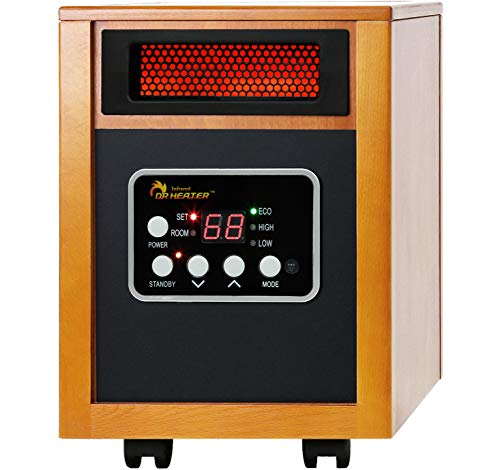
Dr Infrared Heater DR-968 Portable Space Heater, 1500-Watt, Cherry
Included for 'Best Infrared Cabinet Heaters for Large Rooms' because the listing specifies 1500-Watt and Cherry, details this guide uses to compare options.
View on Amazon
shinic Infrared Cabinet Heater, 1500W Space Heater with Remote & Timer
Included for 'Best Infrared Cabinet Heaters for Large Rooms' because the listing specifies 1500W Space Heater with Remote & Timer, details this guide uses to compare options.
View on Amazon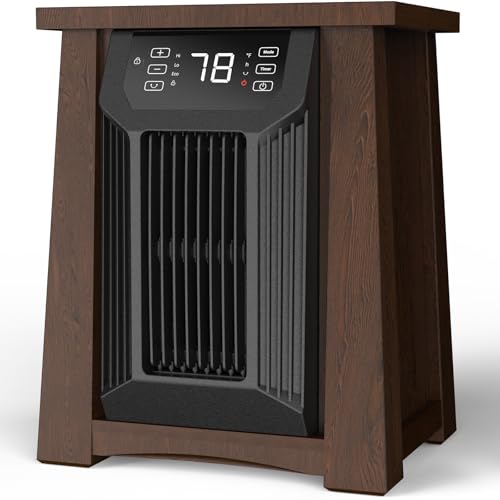
Shinic Oscillating Quartz Infrared Heaters for Indoor Use Large Room, 20 Inch, Luxury Insulated Wooden Cabinet, 1500W Electric Heater with Remote Control, Timer, Filter, Charging Ports, Walnut
Included for 'Best Infrared Cabinet Heaters for Large Rooms' because the listing specifies 20 Inch and Luxury Insulated Wooden Cabinet, details this guide uses to compare options.
View on Amazon
EXNOS 1500W Infrared Space Heater, Chestnut Wood Cabinet with Remote
Included for 'Best Infrared Cabinet Heaters for Large Rooms' because the listing specifies Chestnut Wood Cabinet with Remote, details this guide uses to compare options.
View on AmazonA useful starting estimate is:
- 10 watts per square foot for a well-insulated room with average ceilings.
- 12–15 watts per square foot for older construction, cold climates, exterior rooms, or rooms with high ceilings.
- 15–20 watts per square foot for very drafty spaces or temporary heating in severe cold.
For example, a 600-square-foot living room with average insulation requires approximately 6,000 watts using the 10-watt estimate. A portable 1,500-watt heater can provide only one-quarter of that calculated heat requirement. It can still make the occupied area more comfortable, especially when used for zone heating, but it should not be expected to maintain the whole room at the same temperature as a central heating system.
Two 1,500-watt heaters would draw 3,000 watts. At 120 volts, that is about 25 amps, so they should not share one ordinary 15-amp circuit. Use separate circuits only when the circuit layout is known, and never defeat a breaker or use a lightweight extension cord to run a heater.
What to look for in the best infrared cabinet heaters
Wattage and heat modes
A good large-room cabinet heater should offer a low setting of about 750 watts and a high setting of 1,500 watts. The low setting is useful after the room reaches temperature, while the high setting provides faster warm-up. A thermostat is more valuable than a decorative flame effect because it cycles the heating element instead of running continuously.
Infrared elements warm nearby surfaces and people directly. Many cabinet heaters also use a fan to distribute warm air, creating a hybrid radiant-and-convection design. This combination generally heats a large room more evenly than a purely radiant panel, but the fan adds sound and can circulate dust.
Heating-area claims
Treat manufacturer coverage figures as optimistic maximums. Ask what the rating assumes: an enclosed room, average insulation, normal ceiling height, and a moderate outdoor temperature. For a practical buying decision, reduce the advertised area by roughly 25–40% when the room is drafty, open to other rooms, or has ceilings above 8 feet.
Noise
A fan-assisted cabinet heater is usually quieter than a forced-air furnace but not silent. The relevant question is whether the fan runs continuously or only while the element is heating. For a bedroom or recording space, prioritize a unit with a low-power mode, a low fan setting, and controls that do not beep every time the thermostat cycles.
For an office or gaming room, place the heater several feet away from a microphone or speakers. A heater beside the desk may feel warmer but makes fan noise and heat cycling more noticeable.
Safety features
- Overheat protection: shuts the heater down if internal temperature becomes excessive.
- Tip-over cutoff: disconnects heating if the cabinet is knocked over.
- Cool-touch or insulated exterior: reduces contact-burn risk, though the front grille can still become hot.
- Thermostat control: prevents unnecessary continuous operation.
- Child lock: useful where controls may be changed accidentally.
- UL, ETL, or another recognized safety certification: preferable to an unmarked import with vague compliance claims.
Keep at least three feet of clearance from curtains, bedding, furniture, paper, and clothing. Plug the heater directly into a wall outlet, keep the intake and exhaust clear, and avoid operating it while asleep unless the manufacturer specifically permits that use and the surrounding setup is exceptionally safe.
Cabinet heater types compared
| Type | Typical power | Noise | Room behavior | Choose it when |
|---|---|---|---|---|
| Quartz infrared cabinet | 1,000–1,500 W | Low to moderate | Direct warmth with some air circulation | You want radiant comfort and portable zone heating |
| Infrared cabinet with fan | 1,000–1,500 W | Moderate | Warms the room more evenly | The room is large or has separated seating areas |
| Oil-filled radiator cabinet | 600–1,500 W | Very low | Slow, steady convection; no infrared-focused heat | Quiet operation matters more than rapid warm-up |
| Wall-mounted infrared panel | 500–1,500 W | Nearly silent | Strong directional warmth | Floor space is limited and you can heat one occupied zone |
Real models worth considering
Dr Infrared Heater Portable Space Heater DR-968
The DR-968 is a recognizable full-size cabinet-style infrared heater with a 1,500-watt maximum setting, thermostat control, and fan-assisted operation. It suits a living room, basement seating area, or home office where you want portable zone heating rather than a permanent heating installation. Its main compromise is typical of this category: the fan is audible, and the large coverage claims should be reduced for drafty or open-plan spaces.
Duraflame 5HM7000-NC infrared quartz heater
The Duraflame 5HM7000-NC is a cabinet-style infrared quartz model with a 1,500-watt class output, thermostat control, and a furniture-like enclosure. It is a sensible option when appearance matters in a living area. Use its heater independently from any decorative flame feature, and judge it by its electrical output rather than by the visual size of the cabinet.
Lifesmart infrared cabinet heaters
Lifesmart sells several cabinet-style infrared quartz heaters, including six-element models in the 1,500-watt class. These are generally aimed at zone heating in living rooms, offices, and bedrooms. Check the exact model before buying because the number of heating elements, control layout, remote features, and stated coverage vary across the range.
Energy cost: the number that matters
Electric resistance heaters convert nearly all of their consumed electricity into heat at the point of use. Infrared heating can feel more efficient because it warms people and nearby objects directly, allowing a lower thermostat setting, but a 1,500-watt heater still uses 1.5 kilowatt-hours for every hour it runs continuously.
Use this calculation:
Cost = heater kilowatts × operating hours × electricity price.
At an electricity rate of $0.18 per kilowatt-hour, running a 1,500-watt heater for five hours costs:
1.5 × 5 × $0.18 = $1.35.
If the thermostat cycles the heater on for half of that period, the approximate cost falls to $0.68. Actual consumption depends on insulation, outdoor temperature, thermostat setting, and whether the fan and heating elements operate continuously. A lower 750-watt mode costs half as much per hour, but it also supplies half the heat.
Setup steps for better heat and lower noise
- Measure the room and identify air leaks. Seal obvious drafts around doors and windows before increasing heater power.
- Place the cabinet on a hard, level floor. Avoid thick carpet that can block the intake or make the unit unstable.
- Point the warm-air outlet across the occupied area. Do not aim it directly into a corner or behind a sofa.
- Start at 1,500 watts for 20–30 minutes. Once the room is comfortable, switch to 750 watts or thermostat mode.
- Keep the heater away from the thermostat for central heating. Otherwise, the central system may shut off while the rest of the room remains cold.
- Clean the intake grille periodically. Dust restricts airflow, raises internal temperature, and can increase fan noise.
Bottom line
For most large rooms, the best infrared cabinet heaters are 1,500-watt models with a thermostat, low-power setting, tip-over protection, overheat protection, and a realistic coverage rating. Choose a fan-assisted cabinet when even room circulation matters; choose a quieter radiant-first design when you are heating a desk, sofa, or bed zone. If the room’s calculated heat requirement is several times greater than 1,500 watts, treat the heater as supplemental zone heating rather than expecting one portable cabinet to replace the building’s primary heating system.