Key takeaways
- Rinse off salt, pollen, and bird residue before they dry onto the finish.
- Use mild soap, water, and a soft cloth; avoid abrasive pads on powder coating and plastic.
- Dry metal joints and fasteners after heavy rain, especially where dissimilar metals meet.
- Remove standing water from glass, ceramic, and enclosed storage areas.
- Inspect the coating at the start and end of each season for chips, bubbling, or rust.
- Use a breathable cover rather than tightly wrapping a wet table.
- In freezing climates, store ceramic, glass, and porous stone components where trapped water cannot freeze and expand.
The best outdoor coffee tables for every patio are the ones that leave enough circulation space, match the height of your seating, and use materials suited to your local weather rather than simply looking attractive in a showroom.
Choose the Table Size From Your Seating Layout
Start with the usable space between the seats, not the table dimensions listed by the manufacturer. Measure the open area between sofa fronts, chair arms, and nearby walls. Then reserve at least 18 inches for comfortable legroom and about 24 to 30 inches for a walking route.
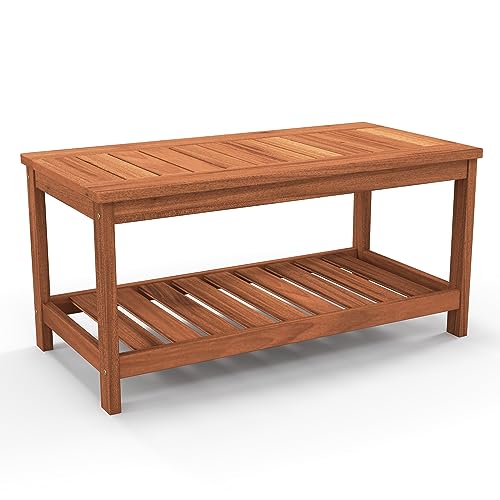
Tangkula Wood Outdoor Coffee Table, 2-Tier Patio Coffee Table with Slatted Hardwood Tabletop & Storage Shelf, Rectangle Wood Table for Deck, Garden, Balcony, Indoor or Outdoor Use (Natural)
Included for 'Best Outdoor Coffee Tables for Every Patio' because the listing specifies Rectangle Wood Table for Deck and Garden, details this guide uses to compare options.
View on Amazon
Signature Design by Ashley Wood Outdoor Coffee Table, Grayish Brown
Included for 'Best Outdoor Coffee Tables for Every Patio' because the listing specifies Grayish Brown, details this guide uses to compare options.
View on Amazon
SERWALL HDPE Outdoor Coffee Table with Umbrella Hole, Black
Included for 'Best Outdoor Coffee Tables for Every Patio' because the listing specifies Black, details this guide uses to compare options.
View on Amazon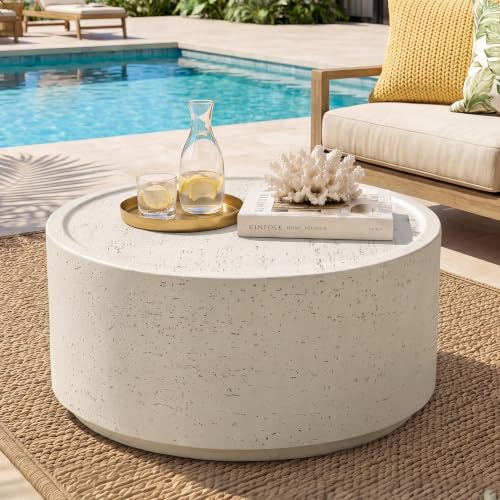
UPHA 28" Round Outdoor Coffee Table, Travertine Look, Off-White
Included for 'Best Outdoor Coffee Tables for Every Patio' because the listing specifies Travertine Look and Off-White, details this guide uses to compare options.
View on AmazonA useful calculation is:
Maximum table length = open seating length minus 36 inches
That 36-inch deduction provides roughly 18 inches of clearance at each end. For example, if the gap between two facing sofas is 84 inches, an outdoor coffee table around 48 inches long leaves 18 inches on both ends. If people must walk behind the seating, increase the surrounding clearance to 30 or 36 inches instead.
| Seating layout | Recommended table shape | Useful size range | Clearance target |
|---|---|---|---|
| Small balcony with two chairs | Round or square | 18–26 inches wide | 18 inches around the table |
| Two lounge chairs facing one another | Round, oval, or narrow rectangle | 30–40 inches wide; 18–24 inches deep | 18 inches for legs |
| Three-seat sofa and two chairs | Rectangle or rounded rectangle | 42–54 inches long; 22–30 inches deep | 18–24 inches on seating sides |
| Large sectional | Rectangle, square, or nesting set | 48–60 inches long; 28–36 inches deep | 18–24 inches inside the sectional |
| Conversation area with frequent traffic | Oval or rounded rectangle | 40–50 inches long; 22–28 inches deep | 30–36 inches on walking sides |
Match the Shape to How People Move
Round tables for compact or flexible seating
Round coffee tables work well when chairs are arranged loosely around a central point. They eliminate sharp corners, make it easier to pull a chair closer, and suit balconies or small decks. A 24-inch round table is enough for drinks and a small tray, while a 32- to 36-inch version can serve a pair of lounge chairs.
The limitation is surface efficiency. A round table wastes more usable edge space than a rectangle when placed in front of a long sofa. Choose one when circulation and softer edges matter more than maximum serving area.
Rectangular tables for sofas and sectionals
Rectangular tables provide the most practical reach for a three-seat sofa or L-shaped sectional. Keep the depth modest: a 24-inch-deep table usually works better than a 36-inch model because people can reach the center without leaning forward.
Look for softened corners if children use the patio or if the table sits along a busy walkway. A rounded rectangle preserves much of the usable surface while reducing the chance of catching a hip or knee on a sharp corner.
Square tables for balanced conversation areas
Square tables suit sectionals that wrap around two sides or four chairs arranged evenly. A 30- to 36-inch square table gives each person similar access. Larger square tables can dominate a small seating group, so check the diagonal measurement as well as the width: a 36-inch square has a diagonal of about 51 inches.
Nesting tables for changing layouts
Nesting tables are useful when the patio serves more than one purpose. Keep the smaller table tucked underneath for everyday use, then separate the pair when guests arrive. They also reduce the commitment of choosing one large table, but inspect the leg design carefully because lightweight nested pieces can shift on uneven pavers.
Compare Outdoor Materials by Climate and Maintenance
| Material | Best use | Typical weight | Maintenance | Main concern |
|---|---|---|---|---|
| Powder-coated aluminum | Rainy, humid, or frequently rearranged patios | 15–35 lb | Wash with mild soap and water | Can dent or blow away in strong wind |
| Steel with exterior coating | Stable tables in sheltered areas | 30–60 lb | Clean chips and touch up exposed metal | Rust if water reaches bare steel |
| Teak or other outdoor hardwood | Warm, natural appearance and heavy construction | 35–80 lb | Clean periodically; oil only for a maintained color | Needs space to dry and may develop silver-gray patina |
| HDPE or recycled plastic | Low-maintenance family patios | 20–55 lb | Soap, water, and occasional soft brushing | Can fade or expand slightly in intense heat |
| Stone, concrete, or ceramic-top construction | Windy locations and permanent seating areas | 60–150+ lb | Wipe spills quickly; follow top-specific care | Hard to move and can crack from impact or freezing water |
For most uncovered patios, powder-coated aluminum and HDPE offer the simplest ownership. Aluminum resists corrosion and is easy to relocate, while HDPE generally feels more substantial and is less likely to dent. In a windy coastal location, a heavier teak, steel, stone, or concrete design may be preferable unless the lighter table has a way to be anchored.
Wood requires the most judgment. Teak can remain outdoors and naturally weather to a gray tone. If you want to preserve its original brown color, expect periodic cleaning and a suitable exterior finish. Do not trap damp cushions, leaves, or a wet cover against the tabletop, since prolonged moisture encourages staining and mildew.
Use This Decision Matrix Before You Buy
| Your situation | Best choice | Why |
|---|---|---|
| Small balcony, limited storage | 24–30 inch round aluminum table | Compact footprint, low weight, and easy repositioning |
| Large sectional on a covered deck | 48–60 inch rectangular wood or aluminum table | Provides enough serving space without constant movement |
| Wind-exposed roof terrace | Heavy stone, concrete, or weighted steel table | Less likely to shift or overturn |
| Children and frequent outdoor meals | Rounded HDPE or powder-coated aluminum table | Easy cleaning and fewer sharp edges |
| Need to store items outside | Table with a ventilated shelf or weather-resistant compartment | Keeps blankets and accessories accessible without sealing in moisture |
| Frequent seasonal rearrangement | 15–30 lb aluminum or nesting table | Practical to move without damaging flooring |
Storage: Helpful, but Only When It Vents
A lower shelf is useful for trays, lanterns, and outdoor games, but it should not become a damp storage locker. Slatted shelves allow rain to drain and air to circulate. Enclosed compartments protect contents better, but they need drainage holes, ventilation, and a lid that does not collect standing water.
Do not store paper goods, electronics, or ordinary indoor cushions in an unsealed patio table. Even a table labeled weather-resistant may allow wind-driven rain through seams. For a hidden ice bucket or cooler, check whether the liner is removable and whether meltwater has a controlled drain. Otherwise, condensation can remain against the tabletop or base.
Check Weight, Stability, and Assembly
Weight should match the patio rather than being treated as an automatic quality indicator. A 20-pound aluminum table is convenient on a balcony but may slide across exposed decking. A 100-pound stone table is stable but can overload a balcony or damage pavers if moved carelessly.
For a lightweight table, look for adjustable feet, a broad base, and a way to add discreet ballast. Avoid placing loose weights where they can become a trip hazard. For heavy tables, verify the route from delivery to the patio, including stairs, gates, and door widths.
During assembly, tighten every fastener only after the frame is aligned. A common problem is locking one leg into position before the other legs are square, which can produce wobble even when all bolts are tight. Place the finished table on the actual patio surface and test it from several sides. Adjustable glides can correct minor unevenness; a twisted frame usually indicates an assembly error or a damaged part.
Maintenance That Extends the Table’s Life
- Rinse off salt, pollen, and bird residue before they dry onto the finish.
- Use mild soap, water, and a soft cloth; avoid abrasive pads on powder coating and plastic.
- Dry metal joints and fasteners after heavy rain, especially where dissimilar metals meet.
- Remove standing water from glass, ceramic, and enclosed storage areas.
- Inspect the coating at the start and end of each season for chips, bubbling, or rust.
- Use a breathable cover rather than tightly wrapping a wet table.
- In freezing climates, store ceramic, glass, and porous stone components where trapped water cannot freeze and expand.
What Should You Spend?
Basic outdoor coffee tables usually cost about $80–$200, with more durable aluminum, HDPE, and hardwood designs commonly around $200–$600. Larger teak, concrete, stone, and premium modular tables can exceed $600. The worthwhile upgrade is usually better construction: corrosion-resistant fasteners, replaceable feet, a stable base, drainage, and a finish designed for outdoor exposure.
For most patios, the best outdoor coffee tables are not the largest or heaviest options. Choose a shape that preserves walking space, a depth that keeps drinks within reach, a material suited to your climate, and a weight you can realistically move or secure. That combination will matter more over several seasons than an extra decorative feature or a few additional inches of tabletop.