Our Top Picks
For most gaming PCs, a 1TB PCIe 4.0 NVMe drive with a DRAM cache, such as the WD Black SN850X or the Samsung 990 Pro, is the safest choice, while the Crucial P310 suits budget builds and handheld PCs and a PCIe 5.0 drive such as the WD Black SN8100 only makes sense if your motherboard has a Gen 5 slot and you want the fastest sequential speeds. In real games, differences between the fast PCIe 4.0 drives are small, so compatibility, cooling and warranty usually matter more than headline numbers.
At a Glance: 1TB Gaming SSDs Compared
| Drive | Best for | Key stated specs (reviewers and makers) | Limits |
|---|---|---|---|
| WD Black SN850X 1TB | All-round gaming pick | PCIe 4.0 x4; sequential read up to 7,300 MB/s and write up to 6,300 MB/s; TLC with DRAM; 600 TBW on the 1TB; five-year warranty; Game Mode; listed as compatible with PS5 storage expansion | Premium over budget drives |
| Samsung 990 Pro 1TB | High sustained performance | PCIe 4.0 x4; reads up to 7,450 MB/s and writes up to 6,900 MB/s; 1GB DDR4 DRAM cache; TLC; 1.4M IOPS; 600 TBW; five-year warranty | Similar real-game feel to the SN850X, with a slightly higher stated peak |
| Crucial T500 1TB | Alternative with DRAM | Listed at 7,300 MB/s read and 6,800 MB/s write with 1GB LPDDR4 cache | Covered by fewer reviews in the roundups surveyed |
| Crucial P310 1TB | Budget and handheld PCs | PCIe 4.0; reads up to 7,100 MB/s and writes up to 6,000 MB/s; QLC NAND; no DRAM, uses host memory buffer; five-year warranty | QLC and no DRAM mean a step down in sustained writes |
| WD Black SN8100 1TB | PCIe 5.0 builds | One roundup lists 14,900 MB/s read | Needs a Gen 5 slot; runs warmer and needs cooling |
| Samsung 9100 Pro | PCIe 5.0 alternative | Named in roundups as a Gen 5 option | Needs a Gen 5 slot; confirm available capacities on the maker page |
Figures are those stated by the makers or by reviewers; sequential speeds are maximum ratings and vary by capacity and test method.
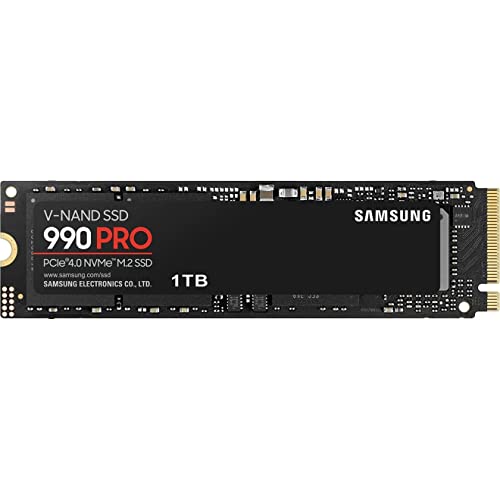
Samsung SSD 990 PRO 1TB, PCIe 4.0 M.2 2280, Up to 7,450 MB/s | NVMe Internal Solid State Hard Drive for High End Computing, Gaming, and Heavy Duty Workstations (MZ-V9P1T0B/AM)
Chosen because it specifies PCIe 4.0 M.2 2280 and Up to 7.
View on Amazon
SIX NVME M.2 SSD PCIe 4.0-1TB m.2 2280 ssd, Read UP to 7350MB/s 1TB for Gaming PS5 Memory Storage Expansion with Heatsink, Internal Solid State Hard Drive PCIe gen 4x4 Nvme for Laptop Desktop pc
Picked as a relevant option in this category.
View on Amazon
Samsung SSD 9100 PRO 1TB, PCIe 5.0x4 M.2 2280, Up to 14,700MB/s | NVMe Internal Solid State Hard Drive best for AI Computing, Gaming, and Heavy Duty Workstations (MZ VAP1T0B/AM)
Chosen because it specifies PCIe 5.0x4 M.2 2280 and Up to 14.
View on AmazonHow to Choose a 1TB Gaming SSD
PCIe 4.0 versus PCIe 5.0
Fast PCIe 4.0 drives already load games quickly, and reviewers note that the real-world gap between the SN850X, 990 Pro and similar drives is small. PCIe 5.0 drives like the WD Black SN8100 list far higher sequential reads, but games rarely use that bandwidth today and these drives typically generate more heat. A Gen 5 slot is also required to reach those speeds; in a Gen 4 slot a Gen 5 drive runs at Gen 4 speeds. Unless you also do heavy video editing or large file transfers, a high-end Gen 4 drive is the value choice.
DRAM cache and NAND type
Drives with a DRAM cache, such as the SN850X and 990 Pro, keep the mapping table in fast memory, which helps consistent performance during heavy writes. DRAM-less drives like the Crucial P310 use a host memory buffer in system RAM instead and are cheaper. The P310 also uses QLC NAND, which stores more bits per cell and generally has lower sustained write performance and endurance than TLC. For a game library that is mostly read, this trade-off is acceptable; for a primary drive that sees heavy writes, TLC with DRAM is the more cautious choice.
Endurance and warranty
Endurance is rated in terabytes written (TBW). The listed 600 TBW on the 1TB SN850X and 990 Pro is far beyond typical gaming use. Both come with five-year warranties, as does the P310. Compare the exact TBW and warranty terms on the maker’s page for the capacity you buy, because ratings differ between models and capacities.
Heatsinks and thermals
Fast NVMe drives can throttle if they overheat. Many motherboards include M.2 heatsinks, and several drives are sold with or without a heatsink version. Check clearance if you buy a heatsink model, particularly in small cases or under a large graphics card. For PS5 storage expansion use, the maker lists the SN850X as compatible, but PS5 requirements include cooling and size limits that you should confirm in Sony’s documentation before buying.
Form factor and compatibility
These drives use the M.2 2280 form factor. Confirm that your motherboard or laptop has a free M.2 slot with NVMe support and that the slot runs at the PCIe generation you want. Some motherboards share lanes between M.2 slots and SATA ports, so using one can disable another. Handheld PCs often have smaller M.2 slots; check the supported length before buying. The Crucial P310 is described by reviewers as a good fit for handheld gaming consoles.
Is 1TB enough?
Modern games can be large, and a 1TB drive fills quickly once you install the operating system and several titles. If you plan to install many large games, consider a 2TB drive or a second SSD. A 1TB drive suits a main drive for a handful of current games or a dedicated drive for a handheld.
DirectStorage and game loading
DirectStorage lets supported games load assets more directly from NVMe storage, and it benefits from a fast NVMe drive. Support varies by game, and not every title uses it, so expect the benefit to differ from game to game. Reviewers generally agree that any quality NVMe drive will beat SATA for loading and installs.
Picks by Budget Tier
Budget: Crucial P310
The P310 offers PCIe 4.0 speeds at a lower tier. QLC and the lack of DRAM mean it is less suited to heavy write workloads, but it works well as a game library drive and in handheld PCs. It is a good fit if you want fast loading without paying for premium features.
Mid-range: WD Black SN850X and Crucial T500
The SN850X is a frequent top pick for gaming PCs in the roundups, with a DRAM cache, TLC NAND, a Game Mode and a five-year warranty. The T500 offers a similar DRAM-equipped design with fewer independent reviews, so compare reviews from trusted sites before choosing.
Premium: Samsung 990 Pro and PCIe 5.0 drives
The 990 Pro lists slightly higher peak speeds than the SN850X and a 1GB DRAM cache, and some roundups name it best overall. PCIe 5.0 drives like the WD Black SN8100 or Samsung 9100 Pro are for users with Gen 5 motherboards who want maximum throughput and have cooling to match.
Fit and Installation Notes
- Slot generation: Check the motherboard manual for which M.2 slot runs at Gen 4 or Gen 5 speeds.
- Cooling: Use the motherboard heatsink or the drive’s own; do not stack incompatible heatsinks.
- Cloning: Use the maker’s migration software if you are moving an existing install.
- Firmware: Update through the maker’s utility, following its instructions.
- Handhelds and consoles: Confirm length, thickness and heatsink limits for the device before buying.
Pick X If … Decision Table
| Pick this | If you … |
|---|---|
| WD Black SN850X | want a proven DRAM-equipped gaming drive and may use it with a PS5 |
| Samsung 990 Pro | want slightly higher stated speeds and a long-established brand |
| Crucial T500 | want another DRAM-equipped option and will compare reviews |
| Crucial P310 | are on a tighter budget or building for a handheld PC |
| WD Black SN8100 or Samsung 9100 Pro | have a Gen 5 slot and want top sequential speeds |
Alternatives Worth Considering
- A 2TB drive: Gives more room for large games at a higher tier.
- A SATA SSD: A fine secondary drive if your system lacks a free M.2 slot, though slower than NVMe.
- An external NVMe enclosure: Useful for expanding handheld or laptop storage when no internal slot is free.
Limits of Spec Sheets
Headline sequential speeds are best-case ratings taken under maker conditions, and they differ by capacity: a 1TB model often lists lower writes than the 2TB version of the same line. Random performance, sustained write behavior after the cache fills and temperatures under load say more about daily experience than a single peak number. Independent reviewers publish those measurements, so read at least one detailed review of the exact drive and capacity before buying, and treat roundups that compile prices and ratings from many sources with some caution because details conflict between them.
Frequently Asked Questions
Is a PCIe 5.0 SSD worth it for gaming?
For most players, not yet. Fast PCIe 4.0 drives load games quickly, and Gen 5 drives generate more heat and need a compatible slot.
Does DRAM matter for a gaming SSD?
DRAM helps with consistent performance during heavy writes. For a mostly-read game library, a DRAM-less drive like the P310 can be acceptable.
Will the SN850X work in a PS5?
Roundups list the SN850X as compatible with PS5 storage expansion. Check Sony’s requirements for heatsinks and size before installing.
What does TBW mean?
TBW is the terabytes written rating for endurance. The 1TB SN850X and 990 Pro are listed at 600 TBW, which is well above typical gaming use.
Will a Gen 5 drive work in a Gen 4 slot?
Yes, but it runs at Gen 4 speeds, so you lose the benefit that makes it more expensive.
Is 1TB enough for a gaming PC?
It is enough for several current games, but large titles fill it quickly. Many buyers choose 2TB or add a second drive.
FAQ
Is 1TB enough?
Is a PCIe 5.0 SSD worth it for gaming?
Does DRAM matter for a gaming SSD?
Will the SN850X work in a PS5?
What does TBW mean?
Will a Gen 5 drive work in a Gen 4 slot?
Is 1TB enough for a gaming PC?
More from Amazon
Programs that pair well with the guide above. Offers and eligibility are set by Amazon and may change.
Free shipping on eligible items, Prime Video and more. Eligible new members can start with a free trial.
Start a Prime free trialAd-free music streaming. Eligible new subscribers can start with a free trial.
Try Music Unlimited freeA Prime membership for ages 18-24 with a trial period. Eligibility is set by Amazon.
See Prime for Young AdultsAudiobooks and podcasts to listen to on the go. Eligible new members can start with a free trial.
Try Audible freeAs an Amazon Associate we earn from qualifying purchases.