Key takeaways
- For hot, high-core CPUs: An AIO provides the extra thermal headroom to stay cool and quiet.
- For best value: Air cooling with quality fans delivers great results for less money.
- For reliability: Air coolers have no pump to fail, making them the ultimate set-and-forget option.
- For a clean look: An AIO frees up space around the socket for a sleeker interior.
- For compact or quiet builds: Both can work, but quiet fans keep noise minimal at a low cost.
What's inside
One of the first big decisions in any PC build is how to cool your CPU: with an AIO liquid cooler or a traditional air cooler using fans and a heatsink. Both keep your processor in check, but they take very different approaches, with distinct trade-offs in performance, noise, price, and installation. Choosing the right one depends on your CPU’s heat output, your case, your budget, and how much you care about looks.
In this comparison we weigh AIO liquid coolers against air cooling built around quality case and CPU fans. Using popular products as reference points, we will help you decide whether the sleek performance of an all-in-one liquid cooler or the reliable simplicity of a good fan-based setup is the better fit for your rig.
As an Amazon Associate we earn from qualifying purchases at no extra cost to you. Product prices and availability are accurate as of the date shown and are subject to change.




🎮 Get More From Your Setup — Free
Prime Gaming gives you free PC games every month, in-game loot, and a free Twitch channel sub — plus fast free shipping on all the gear above. New members get a 30-day free trial.
Watch: Aio Vs Fan: Full Comparison — Video Review
Quick Verdict
For most builds, both options work well, so the choice comes down to priorities. An AIO like the ARCTIC Liquid Freezer III Pro 360 offers superior cooling for hot, high-core-count CPUs and a clean look. Quality air cooling with fans such as the Noctua NF-P12 is cheaper, simpler, and extremely reliable. Choose an AIO for maximum thermals and aesthetics; choose air for value and worry-free longevity.
AIO Liquid Coolers
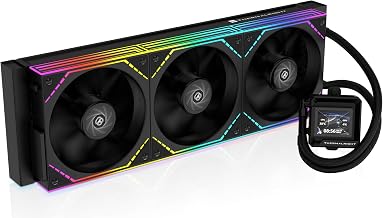
An AIO combines a pump, radiator, and fans into a sealed unit that moves heat away from the CPU using liquid, then dissipates it through a radiator mounted to your case. The ARCTIC Liquid Freezer III Pro 360 is a prime example, using three fans and a large radiator to tame even power-hungry processors with ease.
The appeal is strong cooling and a tidy appearance, since the bulky heatsink is replaced by a compact pump block and neatly mounted radiator. For high-wattage CPUs or overclocked chips that run hot, an AIO provides the thermal headroom to keep clocks high and temperatures low.
The trade-offs are higher cost and a slightly more involved installation, plus a pump that, however rarely, represents a moving part that could eventually fail. Still, modern AIOs are highly reliable and maintenance-free for their lifespan.
Air Cooling with Fans
Air cooling uses a metal heatsink and one or more fans to pull heat off the CPU, supported by case fans that keep fresh air flowing through the chassis. Quiet, high-quality fans like the Noctua NF-P12 or Thermalright ARGB units keep temperatures reasonable while running whisper-quiet.
The biggest advantages are cost, simplicity, and reliability. A good air cooler has no pump or liquid to worry about, installs quickly, and can last the entire life of the PC without maintenance. For mainstream and efficient CPUs, air cooling is more than enough.
The limitations are size and ultimate performance. Large air coolers can be bulky and may clash with tall RAM or compact cases, and they generally cannot match a big AIO on the very hottest chips. For most gamers, though, that ceiling is rarely reached.
Head-to-Head: Which Should You Buy?
- For hot, high-core CPUs: An AIO provides the extra thermal headroom to stay cool and quiet.
- For best value: Air cooling with quality fans delivers great results for less money.
- For reliability: Air coolers have no pump to fail, making them the ultimate set-and-forget option.
- For a clean look: An AIO frees up space around the socket for a sleeker interior.
- For compact or quiet builds: Both can work, but quiet fans keep noise minimal at a low cost.
Frequently Asked Questions
Does an AIO cool better than air?
For high-wattage CPUs, a large AIO typically edges out air cooling. For efficient mainstream chips, a good air cooler keeps pace at a lower price.
Are AIOs louder than fans?
Not necessarily. AIO fans can run quietly, though the pump adds a small amount of noise. Premium case and CPU fans are often extremely quiet.
Is air cooling more reliable?
Generally yes, since it has no pump or liquid. A quality heatsink and fan can run for the life of the PC with no maintenance.
Which should I pick for a mid-range gaming build?
Either works well. Air cooling is the value choice, while an AIO adds headroom and a cleaner look if you prefer that aesthetic.
Final Verdict
Both AIO and air cooling are excellent, and the right pick depends on your CPU and priorities. Choose a large AIO like the ARCTIC Liquid Freezer III Pro for hot chips, maximum headroom, and a sleek interior. Choose quality fans and a good heatsink for unbeatable value and rock-solid reliability. Match the solution to your processor’s heat output and your budget, and your PC will stay cool under any load.