Key takeaways
- Excellent ergonomic shape for larger hands: The pronounced thumb rest reduces contact with the desk and gives your hand a stable place to settle during long sessions. Palm and claw-palm users generally get more support than they would from a symmetrical mouse.
- A genuinely useful button layout: The two side buttons, thumb clutch, wheel click, and tilt inputs provide practical shortcuts without requiring an unwieldy grid of buttons. You can map push-to-talk, melee, reload, copy and paste, media controls, or application shortcuts.
- Flexible wireless options: The 2.4GHz receiver is suitable for serious gaming, while Bluetooth makes the mouse more useful with laptops and non-gaming devices. Wired USB-C operation is available when the battery needs a top-up.
- Long battery life: The original model’s advertised battery life is around 90 hours, while the 35K version is rated for up to 140 hours. Actual runtime varies with RGB brightness, polling settings, wireless mode, and use, but both figures are strong for a feature-rich RGB mouse.
- Versatile scroll wheel: The HyperScroll wheel is one of the Basilisk’s best non-gaming features. Its free-spin mode is fast for documents and web pages, while ratcheted mode offers the precision needed for menus and weapon selection.
- High-end sensor performance: The sensor specifications are more than sufficient for modern gaming. You can tune sensitivity in small increments and save profiles for different games or applications.
- Useful onboard profile storage: The mouse can retain several profiles, allowing basic settings and assignments to travel with it. You may still need Synapse for every advanced feature, but onboard storage reduces dependence on constantly reconfiguring the mouse.
- Charging dock compatibility: Razer’s separate Mouse Dock Pro can provide a tidier charging setup and additional wireless features. It is an extra purchase, but the mouse does not require a proprietary dock to function.
What's inside
The Short Answer
Yes—if you want a premium, right-handed gaming mouse with a thumb rest, many controls, and both 2.4GHz and Bluetooth wireless. The one condition is that you must be comfortable with its relatively large, 112-gram shape; smaller hands, fingertip-grip players, and competitive gamers focused on the lightest possible mouse should look elsewhere.
The Razer Basilisk V3 Pro remains an easy mouse to like in 2026 because it combines comfort and customization better than many gaming mice. It is not a universally perfect pick, though. Its size, price, and feature-heavy design make it more of an all-purpose control center than a stripped-down esports pointer.
As an Amazon Associate we earn from qualifying purchases at no extra cost to you. Product prices and availability are accurate as of the date shown and are subject to change.

What You Actually Get
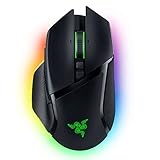
The Basilisk V3 Pro is a right-handed wireless gaming mouse measuring approximately 130.3 x 75.4 x 42.5 mm and weighing about 112 grams without its optional charging dock. That puts it firmly in the medium-to-large category. The sloped body, raised thumb rest, and textured sides are designed for palm and claw-palm grips rather than fingertip use.
Inside is Razer’s Focus Pro optical sensor with tracking up to 30,000 DPI on the standard Basilisk V3 Pro. DPI is far beyond what most people need, but the sensor gives you plenty of adjustment for games, desktop work, and multi-monitor setups. The newer Basilisk V3 Pro 35K raises the sensor ceiling to 35,000 DPI and advertises up to 140 hours of battery life, compared with roughly 90 hours for the original model under favorable lighting and connection conditions.
You get 10 independently programmable controls, including the main clicks, two side buttons, a clutch button near the thumb, a clickable scroll wheel, and additional wheel-tilt inputs. The HyperScroll Tilt Wheel can switch between a notched mode for weapon selection or spreadsheet work and a free-spinning mode for quickly moving through long pages.
Wireless connectivity includes Razer’s 2.4GHz HyperSpeed connection and Bluetooth. The USB receiver is the better choice for gaming because it prioritizes responsiveness, while Bluetooth is convenient for a laptop or secondary device. The mouse also works wired through USB-C while charging. Razer’s Synapse software handles button assignments, sensitivity stages, lighting, profiles, and more detailed settings.
RGB lighting is built into the scroll wheel, logo, and underglow areas, with multiple lighting zones. The original customizable RGB wireless version is often sold around $99.99, while the Basilisk V3 Pro 35K is commonly listed near $129.99. Sale pricing can move either model into a more attractive range, so the exact generation matters before you buy.
Pros
- Excellent ergonomic shape for larger hands: The pronounced thumb rest reduces contact with the desk and gives your hand a stable place to settle during long sessions. Palm and claw-palm users generally get more support than they would from a symmetrical mouse.
- A genuinely useful button layout: The two side buttons, thumb clutch, wheel click, and tilt inputs provide practical shortcuts without requiring an unwieldy grid of buttons. You can map push-to-talk, melee, reload, copy and paste, media controls, or application shortcuts.
- Flexible wireless options: The 2.4GHz receiver is suitable for serious gaming, while Bluetooth makes the mouse more useful with laptops and non-gaming devices. Wired USB-C operation is available when the battery needs a top-up.
- Long battery life: The original model’s advertised battery life is around 90 hours, while the 35K version is rated for up to 140 hours. Actual runtime varies with RGB brightness, polling settings, wireless mode, and use, but both figures are strong for a feature-rich RGB mouse.
- Versatile scroll wheel: The HyperScroll wheel is one of the Basilisk’s best non-gaming features. Its free-spin mode is fast for documents and web pages, while ratcheted mode offers the precision needed for menus and weapon selection.
- High-end sensor performance: The sensor specifications are more than sufficient for modern gaming. You can tune sensitivity in small increments and save profiles for different games or applications.
- Useful onboard profile storage: The mouse can retain several profiles, allowing basic settings and assignments to travel with it. You may still need Synapse for every advanced feature, but onboard storage reduces dependence on constantly reconfiguring the mouse.
- Charging dock compatibility: Razer’s separate Mouse Dock Pro can provide a tidier charging setup and additional wireless features. It is an extra purchase, but the mouse does not require a proprietary dock to function.
Cons
- Too large and heavy for some players: At about 112 grams, it is substantially heavier than many current competitive mice. The broad 75.4-mm body can also feel cumbersome for smaller hands or fingertip grips.
- Premium pricing: Around $100 for the standard version and $130 for the 35K version is a meaningful investment. The price is easier to justify if you will use the extra controls, wireless modes, and ergonomic design; it is harder to justify for basic point-and-click gaming.
- Software is part of the ownership experience: Synapse provides extensive customization, but it can feel busy and more involved than the software used by simpler mice. Users who want to plug in a mouse and avoid accounts, background software, or configuration screens may find it frustrating.
- RGB reduces battery life: The lighting looks good, particularly the underglow, but it consumes power. Turning it down or off is the sensible choice if maximum runtime matters more than visual effects.
- Some controls are grip-dependent: The clutch button is convenient once your thumb naturally reaches it, but not every hand or grip makes it comfortable. The extra inputs can also be pressed accidentally while learning the shape.
- Charging accessories cost extra: The optional dock improves convenience but adds to an already expensive setup. The included cable works, but it does not offer the same desk-friendly experience as dropping the mouse into a dock.
- Not ideal for travel: Its large body, receiver, cable, and optional dock make it less portable than a compact productivity mouse or lightweight gaming model.
Who Should Buy It
Buy the Basilisk V3 Pro if you want a comfortable, right-handed mouse for both gaming and everyday computing. It is particularly well suited to palm and claw-palm users with medium-to-large hands, players who enjoy games with several commands, and anyone who wants a physical clutch button or versatile scroll wheel.
It also makes sense for people replacing several devices with one mouse. The 2.4GHz connection handles gaming, Bluetooth handles a laptop, and the programmable controls can support creative applications, office shortcuts, or productivity workflows. Choose the standard version around $99.99 if 30,000 DPI and roughly 90 hours of rated battery life are enough. Consider the $129.99 35K version if you specifically value its newer sensor and longer advertised runtime.
Who Should Skip It
Skip it if your priority is the lowest possible weight, a symmetrical shape, or the smallest possible shell. Competitive FPS players who prefer 50-to-70-gram mice may notice the Basilisk’s mass during rapid direction changes. Smaller-handed users should also try it before buying if possible, especially if they use fingertip grip.
It is also a poor value if you will use only the left and right clicks. A wired mouse can deliver excellent tracking and responsiveness for much less money, while a basic wireless model may provide the convenience you need without RGB, extensive software, or a clutch button.
Cheaper Alternatives
| Option | Cost | Trade-off |
|---|---|---|
| Razer Basilisk V3 wired | $50–$70 | Keeps the familiar shape, wheel, buttons, and RGB, but requires a cable and offers less wireless flexibility. |
| Logitech G502 HERO wired | $35–$55 | Provides a similarly ergonomic, button-heavy design for less money, but it is heavier and wired. |
| Logitech G305 LIGHTSPEED | $35–$50 | Offers reliable wireless gaming at a low price, but has a simpler shape, fewer controls, no RGB, and a less premium feel. |
| Razer DeathAdder V3 wired | $50–$70 | Usually lighter and excellent for straightforward gaming, but lacks the Basilisk’s thumb clutch, tilt wheel, and broad shortcut selection. |
FAQ
Is the Razer Basilisk V3 Pro good for large hands?
Yes. Its 130.3-mm length and broad 75.4-mm body suit medium-to-large hands, especially with palm or claw-palm grip. Smaller hands may have difficulty reaching the clutch button and side controls without shifting their grip.
What is the difference between the Basilisk V3 Pro and the 35K version?
The 35K version upgrades the sensor from up to 30,000 DPI to 35,000 DPI and raises the advertised battery life from roughly 90 hours to as much as 140 hours. The core shape and control concept remain similar. Most users do not need 35,000 DPI, so the newer model is mainly worth considering for its battery and updated hardware.
Can you use the Basilisk V3 Pro without Razer Synapse?
Yes, basic mouse functions work without Synapse, and onboard profiles can retain selected settings. However, Synapse is the most convenient way to configure advanced button assignments, lighting, sensitivity stages, macros, and application profiles.
Is the Basilisk V3 Pro worth $100 to $130?
It is worth that range if you will use its ergonomic shape, wireless connectivity, extra controls, and long battery life. It is not the best value for a minimalist setup or competitive player seeking a very light mouse. In those cases, a cheaper wired model or lightweight wireless alternative is the better decision.