Key takeaways
- Overall length: from the tip to the end of the handle or pommel.
- Maximum width: including guards, decorative handles, sheaths, or stands already attached.
- Thickness: especially at the spine, handle, or widest sculptural point.
- Weight: use a kitchen scale for pieces under 5 pounds or a bathroom scale for larger items.
What's inside
- Decide These 3 Things First
- Size and Fit: Measure the Whole Piece, Not Just the Blade
- Material: Choose What Touches the Blade Carefully
- Construction and Stability: The Base Matters More Than the Backdrop
- Comfort, Visibility, and Everyday Performance
- Price Tiers: Spend for Weight Capacity and Finish, Not Just Ornament
- Warranty, Returns, and Replacement Parts
- Delivery and Assembly
- Spec Checklist
- Red Flags
- FAQ
Most blade display purchases go wrong for predictable reasons: buyers choose a stand based on a photo, assume every holder fits every blade shape, or overlook where the sharp edge and pointed tip will rest. A display stand should make a collection look intentional, but its first job is to keep the item stable, visible, and protected from scratches, falls, and unnecessary handling.
- Decide These 3 Things First
- Size and Fit: Measure the Whole Piece, Not Just the Blade
- Material: Choose What Touches the Blade Carefully
- Construction and Stability: The Base Matters More Than the Backdrop
- Comfort, Visibility, and Everyday Performance
- Price Tiers: Spend for Weight Capacity and Finish, Not Just Ornament
- Warranty, Returns, and Replacement Parts
- Delivery and Assembly
- Spec Checklist
- Red Flags
- FAQ
If you are researching what to look for in razer blade display options, focus less on decorative wording and more on fit, material contact points, base stability, and how the stand will work in your actual room. A compact acrylic stand can be ideal for a single showpiece on a desk, while a heavier wood display is often better for a larger collectible or a shelf with regular foot traffic. In 2026, even inexpensive display stands can look polished—but only when their size and construction match the piece being displayed.
As an Amazon Associate we earn from qualifying purchases at no extra cost to you. Product prices and availability are accurate as of the date shown and are subject to change.


Decide These 3 Things First
- What exactly are you displaying? Measure the blade’s overall length, widest point, thickness, and weight. Do not use only the listed blade length. A 12-inch collectible with a wide guard or handle may need a stand designed for a 14- to 16-inch overall profile.
- Where will it sit? A desktop stand needs a smaller footprint, usually 3 to 6 inches deep. A shelf display can use a broader 6- to 10-inch base for more stability. Keep valuable pieces away from shelf edges, direct sun, steam, and high-traffic areas.
- Do you want one piece displayed or a collection organized? Single-item stands generally cost $8 to $20 each. Multi-piece racks, wall-mounted displays, and solid wood cases can range from $30 to $150 or more. Buying several individual stands may look cleaner, but a coordinated rack may save space.
Size and Fit: Measure the Whole Piece, Not Just the Blade
Fit is the most important buying factor. The stand must support the item without pinching the blade, covering the design, or allowing the handle-heavy end to tip backward. Before ordering, measure:
- Overall length: from the tip to the end of the handle or pommel.
- Maximum width: including guards, decorative handles, sheaths, or stands already attached.
- Thickness: especially at the spine, handle, or widest sculptural point.
- Weight: use a kitchen scale for pieces under 5 pounds or a bathroom scale for larger items.
For small folding knives and pocketknife collectibles, a stand 2 to 4 inches wide and 2 to 3 inches deep is often sufficient. Full-size fixed-blade pieces commonly need 4 to 8 inches of support width. For a long display item, choose a stand that supports it at two points rather than balancing it in one narrow groove.
Check the slot or cradle opening. A 0.12-inch-wide acrylic slot may suit a slim metal profile but not a thick handle, sheath, or display plaque. If a product listing does not give slot width, base dimensions, and height, consider that a reason to move on.
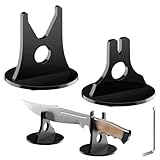
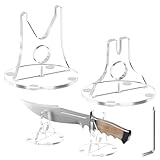
The Cosmos single acrylic stands in black or clear are examples of compact, low-cost desktop options. Their modest $9.99 price makes them practical for small individual pieces, but buyers should still verify the support opening and overall dimensions before ordering multiples.
Material: Choose What Touches the Blade Carefully
Acrylic, wood, metal, and padded composites all have a place in blade displays. The best choice depends on the look you want and the finish you are protecting.
Acrylic is clean, modern, and visually unobtrusive. Clear acrylic lets the item appear to float, while black acrylic creates contrast. Look for material at least 0.12 inch thick for small displays and about 0.18 to 0.24 inch thick for heavier pieces. Thin acrylic can flex, crack at drilled joints, or feel unstable under uneven weight.
Wood offers a warmer, furniture-like appearance and usually provides more weight at the base. Rosewood-tone or wood-color stands, such as the two-piece Yookeer set priced around $24.99, can suit cabins, offices, libraries, and traditional display shelves. Confirm whether the wood is solid, engineered, or veneer. Solid wood is not automatically necessary, but a 0.75-inch-thick wood base is generally more reassuring than a thin decorative panel.
Metal can be durable, but bare metal contact points may scratch finished handles or scabbards. Choose powder-coated metal, silicone-lined hooks, felt pads, or rubber sleeves. Avoid stands where polished metal presses directly against a collectible surface.
For any material, inspect the contact points. Felt, EVA foam, silicone, cork, or soft rubber pads should be neatly applied and securely bonded. A protective pad should cover at least the full area where the blade or handle rests, not merely a tiny dot at the edge.
Construction and Stability: The Base Matters More Than the Backdrop
A display stand can look substantial in a product image and still be easy to knock over. Prioritize a broad base, low center of gravity, clean edges, and secure joints.
For a small desktop piece under 1 pound, look for a base at least 3 inches wide and 2.5 inches deep. For an item weighing 1 to 3 pounds, a 5- to 8-inch-wide base and 4 inches of depth provides a safer starting point. Taller stands need more depth: a 10-inch-tall upright display should generally have a base at least 4 to 6 inches deep unless it is anchored to a wall or a larger backing panel.
Acrylic displays may use slot-together construction, glued seams, or screws. Slot-together designs are easy to ship and assemble, but the panels should fit firmly without wobble. Glued acrylic seams should be smooth and bubble-free. Wood stands should have dowels, screws, or properly fitted joinery rather than loose staples or visible glue smears.
Also examine the underside. Four non-slip feet are preferable to two, especially on glass, lacquered wood, or smooth stone surfaces. Each foot should be at least 0.25 inch wide and made from rubber or silicone rather than hard plastic. If the display will sit on a finished dresser or cabinet, add a thin felt furniture pad beneath the base if one is not included.
Comfort, Visibility, and Everyday Performance
A good display should be easy to enjoy without becoming awkward to dust, move, or return to its stand. Think about sightlines, access, and maintenance before choosing a style.
For desk displays, a viewing angle of roughly 15 to 35 degrees often shows the blade profile well while keeping the center of gravity low. A completely vertical stand can save depth, but it may obscure details and can be less stable for handle-heavy pieces. A stand that raises an item 1 to 3 inches above the surface usually creates enough separation to look deliberate without making it vulnerable.
Clear acrylic is excellent when you want the stand to disappear visually, but it shows dust, fingerprints, and hairline scratches more readily than wood or black acrylic. Plan on wiping it with a microfiber cloth every 1 to 2 weeks. Avoid abrasive paper towels and harsh cleaners; they can cloud acrylic surfaces.
If children, pets, or frequent guests share the space, place the display at least 48 inches above the floor or inside a closed cabinet. A display stand is not a safety device, a lock, or a substitute for secure storage. Keep sharpened items sheathed where appropriate and follow all local rules regarding storage and display.
Price Tiers: Spend for Weight Capacity and Finish, Not Just Ornament
Budget: $8 to $18. This range includes simple single acrylic stands, including options similar to the $9.99 Cosmos designs and the $11.99 noonebutyou acrylic holder. Expect a lightweight base, basic protective pads, and limited adjustment. These are best for small, lightweight pieces displayed on a stable desk or shelf.
Mid-range: $20 to $60. Expect thicker acrylic, heavier wood bases, two-piece sets, better edge finishing, and more deliberate support geometry. The Yookeer two-piece wood-color set at about $24.99 fits this category. This is the practical sweet spot for most home collections because it balances appearance with meaningful stability.
Premium: $60 to $150+. At this level, look for solid hardwood, custom-fit cradles, lockable acrylic cases, wall-mount hardware, UV-filtering panels, or multi-item cabinetry. Premium pricing is worthwhile when the display protects a valuable collection, coordinates with furniture, or needs a more secure enclosed presentation.
Do not pay premium pricing for a stand that still omits its dimensions, material thickness, or weight guidance. Decorative engraving does not compensate for a shallow base or poor contact points.
Warranty, Returns, and Replacement Parts
Display stands are simple products, so warranties are often short or nonexistent. That is not automatically a concern at $10, but return terms matter because fit problems are common. Look for at least a 30-day return window and confirm whether assembled items can be returned.
For stands over $40, it is reasonable to expect clear customer support and replacement availability for cracked acrylic panels, missing screws, damaged feet, or defective hardware. Save the packaging until you confirm that the display is stable and fits your item properly.
Read return details closely for multi-piece sets. A two-pack may need to be returned as a complete set, even if only one stand has a defect. Photograph any shipping damage before removing protective film or discarding the carton.
Delivery and Assembly
Most single acrylic or wood stands arrive in boxes measuring roughly 6 to 14 inches long and weighing less than 2 pounds. Larger cases and wall displays can exceed 10 pounds and may arrive with multiple panels or hardware bags.
For acrylic stands, protective film is common. Remove it slowly from all visible surfaces; leaving film on the edges can make a clear stand look cloudy or blue-tinted. If assembly requires screws, tighten them only until secure. Over-tightening can crack acrylic, strip soft wood, or distort a thin metal bracket.
Set up the stand on the intended surface before placing the collection piece on it. Test for rocking by pressing gently on each corner of the base. Then place the item in the cradle and check it from the front, side, and above. It should not slide, lean, or touch a hard edge at a vulnerable point.
Spec Checklist
| Spec | Budget | Mid | Premium |
|---|---|---|---|
| Typical price | $8–$18 | $20–$60 | $60–$150+ |
| Best use | Small single display | Heavier piece or coordinated set | Valuable collection or enclosed display |
| Base depth | 2.5–4 inches | 4–8 inches | 6–12 inches or wall anchored |
| Material | Thin acrylic or basic composite | Thicker acrylic, wood, lined metal | Solid wood, thick acrylic, cabinet materials |
| Protective contact points | Basic pads | Felt, EVA, silicone, or rubber lining | Custom padded cradles or enclosed support |
| Assembly | Slot fit or none | Simple hardware or fitted parts | Hardware, mounting, or cabinet assembly |
Red Flags
- No listed base dimensions, slot width, or overall stand height.
- Sharp acrylic edges, rough wood splinters, or exposed staples.
- A narrow base paired with a tall upright design.
- Bare metal contact points against finished surfaces.
- Photos that show only lightweight props and never the stand from the side.
- Claims of “universal fit” without a stated weight limit or cradle measurement.
- Wall-mounted designs that include no mounting hardware or weight guidance.
- Clear acrylic sold without protective film or protective feet.
FAQ
Should I choose clear or black acrylic for a blade display stand?
Choose clear acrylic when you want the collection piece to remain the focal point and your space has a clean, modern look. Choose black acrylic when you want stronger contrast, especially for light handles or reflective metal. Black usually hides dust and fine scratches better than clear.
How large should a display stand be?
Start with the object’s full dimensions and weight. For a piece under 1 pound, a 3- to 4-inch base may work. For a 1- to 3-pound item, look for at least 5 inches of base width and 4 inches of depth. Larger or taller items benefit from two support points or wall anchoring.
Will acrylic scratch a blade or handle?
Acrylic can scratch a surface if there is grit between the stand and the item or if the contact edge is rough. Choose stands with felt, silicone, EVA foam, or rubber at contact points, and wipe both the stand and displayed piece before placement.
Are single stands or multi-piece sets better for a collection?
Single stands offer flexibility because you can adjust spacing and use different sizes for different pieces. Multi-piece sets are often more economical and visually consistent. Use a set only if each item has similar dimensions and weight; otherwise, mixed stand sizes will provide safer support.