Key takeaways
- Hair: A quilted surface traps less loose hair than deep fleece, while a smooth coated surface is quickest to vacuum.
- Mud: Removable, machine-washable covers are easier to maintain than permanently fitted liners.
- Water: Hang-dry the cover completely before reinstalling it; trapped moisture can create odors and mildew.
- Odor: Avoid harsh solvents unless the manufacturer permits them, since they can damage waterproof coatings.
- Sand: Shake or vacuum outdoors before washing so grit does not clog the washer or abrade the fabric.
The best car seat covers for large dogs are heavy-duty, waterproof hammock covers with at least 54 inches of usable width, full door-to-door coverage, four or more headrest anchors, seat-gap anchors, and a non-slip lower surface.
Large dogs create different demands from small-dog travel: more weight on the seams, wider turning space, longer claws, and enough movement to expose gaps at the doors or between the front and rear seats. A cover that looks generous in a compact SUV can leave several inches of uncovered upholstery in a full-size truck or three-row vehicle. The right choice depends on your rear-seat width, whether people still need to sit beside the dog, and how much mud or water the cover must contain.

Honest Dog Car Seat Covers, Dog seat Cover with Side Flap for Cars, Trucks, and Suv's - Waterproof & Nonslip Pet Seat Cover for Backseat
Included for 'Best Car Seat Covers for Large Dogs' because the listing specifies Dog seat Cover with Side Flap for Cars and Trucks, details this guide uses to compare options.
View on Amazon
Ruff Liners Back Seat Extender for Dogs - As Seen on Shark Tank
Included for 'Best Car Seat Covers for Large Dogs' because the listing specifies As Seen on Shark Tank, details this guide uses to compare options.
View on Amazon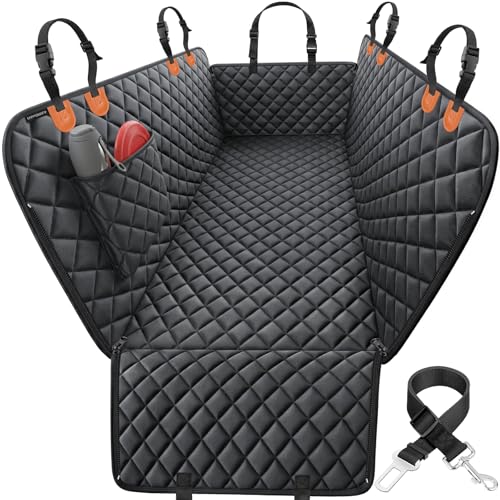
URPOWER Dog Car Seat Cover for Back Seat, 100% Waterproof Hammock for Car
Included for 'Best Car Seat Covers for Large Dogs' because the listing specifies 100% Waterproof Hammock for Car, details this guide uses to compare options.
View on AmazonQuick comparison: which cover suits your vehicle?
| Situation | Cover type to choose | Useful minimum specification | Why it works |
|---|---|---|---|
| One large dog in a two-row SUV or sedan | Full hammock cover | 54–60 inches wide; 56–63 inches deep; four headrest straps | Blocks the footwell and reduces falls during braking |
| Two large dogs in a wide SUV or pickup | Extra-wide bench cover | 60–68 inches wide; reinforced seams; six or more attachment points | Provides room to turn without pulling the cover off the doors |
| Dog plus a passenger | Convertible split hammock or bench cover | 60/40 split compatibility; independent front straps; seat-belt openings | Leaves one seating position usable while covering the dog’s side |
| Three-row SUV with the third row folded | Extended cargo or multi-panel cover | At least 70 inches front-to-back when deployed | Protects the seatbacks and cargo floor as one continuous surface |
| Wet, muddy, or sandy outdoor trips | Waterproof quilted or coated cover with door flaps | Water-resistant outer fabric, sealed or tightly bound seams, 8–12 inch side flaps | Stops moisture from reaching cushions and door panels |
What to measure before buying
Do not use the vehicle’s advertised seating capacity as a substitute for measurements. Measure the rear bench from the inside of one door panel to the other, then measure from the front-seat headrest to the rear edge of the bench. If the cover will function as a hammock, also measure the distance between the front and rear headrests.
For a secure fit, add roughly 2–4 inches to the measured bench width. This gives the side flaps enough material to overlap the upholstery without creating a loose, foldable edge. More excess is not always better: a cover that is 8–10 inches wider than the bench can bunch against the doors, interfere with window controls, and become easier for a dog to dislodge.
Check the rear seat configuration as well. A 60/40 split bench needs a cover with a split opening or enough independent straps to fold one section without removing the entire cover. Fixed hammock designs are less convenient when a passenger regularly uses the rear seat.
Best car seat covers for large dogs: the main options
Best heavy-duty choice: 4Knines Heavy Duty Dog Seat Cover
The 4Knines Heavy Duty Dog Seat Cover is a strong candidate for owners prioritizing thick construction, broad seat coverage, and resistance to claws. Its quilted, layered design is aimed at containing dirt and protecting upholstery, while the hammock-style configuration helps prevent a large dog from sliding into the footwell.
Choose it when the rear bench is within the model’s published dimensions and you want a cover for frequent travel rather than occasional use. The important checks are whether the width reaches both door edges and whether the headrest straps align with your vehicle. A rugged fabric does not compensate for a cover that is too narrow.
Best for flexible configurations: WeatherTech Pet Partition and Seat Protector options
WeatherTech’s pet-protection products are useful for owners who want to combine a rear-seat cover with a partition or a more structured vehicle-specific protection system. Their strength is integration with different vehicle layouts rather than simply maximizing fabric area.
This approach suits a large dog that rides behind a divider, a vehicle with a split-folding rear seat, or an owner who wants easier access to one passenger seat. Before choosing a particular WeatherTech cover, confirm that its design is intended for a bench, cargo area, or individual seating position; these products are not interchangeable.
Best for outdoor travel: Ruffwear Dirtbag Seat Cover
The Ruffwear Dirtbag Seat Cover is designed for dogs that travel after hikes, beach trips, or wet-weather walks. Its value is in straightforward protection and a dog-focused fit rather than maximum padding. It can be a practical option when you want a washable barrier that packs away easily.
For a very large dog, compare its actual coverage with your bench measurements before buying. A compact, packable cover may work well in a smaller vehicle but leave exposed upholstery in a wide SUV. If your dog regularly carries mud or standing water, prioritize door flaps and cleanup access over portability.
Best budget specification: a waterproof hammock cover with reinforced anchors
Generic covers can work well if they meet the necessary specifications: 600-denier or heavier polyester, a waterproof or water-resistant coating, reinforced headrest loops, four seat-gap anchors, a non-slip underside, and openings for human seat belts. Usually costing about $30–$70, they are less expensive than premium covers but vary substantially in stitching and hardware.
Inspect the anchor construction rather than judging thickness by appearance. A strap sewn into a single narrow line of stitching can pull free when a 70-pound dog lunges forward. Wide webbing, box-X stitching, and metal or thick polymer adjusters are preferable.
Hammock coverage versus bench coverage
A hammock cover connects the rear headrests to the front headrests, creating a suspended barrier over the footwell. This is usually the safest layout for a large dog because it reduces the chance of falling forward during hard braking and keeps the dog from stepping directly onto the center console area.
A bench cover lies across the rear seat but leaves the footwell open. It is easier to share with a passenger and often easier to install, but it provides less containment. A large dog can slide off the edge or push the cover into the footwell. For a bench-only design, use a properly fitted vehicle seat belt harness rather than relying on the cover as a restraint.
Convertible covers offer the most flexibility, but their additional zippers and folds create potential leak points. If you regularly transport a wet dog, choose a convertible model with overlapping flaps and place an absorbent towel on top only after the waterproof layer is correctly secured.
Waterproofing: fabric is only half the answer
“Waterproof” often describes the fabric coating, not the finished cover. Moisture can still pass through needle holes, zippers, seams, and the gaps around seat-belt openings. For muddy or soaked dogs, look for a cover with bound seams, a waterproof backing, and raised side flaps that reach the door panels.
A useful test at home is to place the cover over a dry towel, pour a measured cup of water onto the center and another onto a seam, then wait 10 minutes. If the towel remains dry, the barrier is performing adequately for ordinary spills. This is not a laboratory waterproof rating, but it exposes weak seam construction before a wet dog does.
Anchors and restraint: preventing the cover from becoming a hazard
At minimum, use four headrest straps: two at the front and two at the rear. Six or eight attachment points are better for a broad cover or two large dogs. Seat-gap anchors should be pushed firmly between the cushion and backrest, but they should not be mistaken for crash-tested restraint points.
Route the vehicle’s seat belt through the cover’s dedicated openings. For a large dog, pair the cover with a crash-tested harness from a reputable manufacturer rather than attaching a leash to a headrest strap. The cover protects the interior; the harness is responsible for limiting forward movement.
After installation, pull the cover forward and sideways with moderate force. It should remain centered, with no opening larger than a dog’s paw near the doors or footwell. Tighten straps evenly: over-tightening one corner can pull the opposite side off the seat.
Cleaning requirements that matter in daily use
- Hair: A quilted surface traps less loose hair than deep fleece, while a smooth coated surface is quickest to vacuum.
- Mud: Removable, machine-washable covers are easier to maintain than permanently fitted liners.
- Water: Hang-dry the cover completely before reinstalling it; trapped moisture can create odors and mildew.
- Odor: Avoid harsh solvents unless the manufacturer permits them, since they can damage waterproof coatings.
- Sand: Shake or vacuum outdoors before washing so grit does not clog the washer or abrade the fabric.
For frequent use, clean the cover weekly and inspect the strap stitching at the same time. Wash sooner if urine, salt water, or heavily soiled mud has reached the fabric. Keep a second towel or washable liner available for wet trips so the main cover can dry fully.
Final buying checklist
- Measure the bench width, seat depth, and headrest spacing.
- Choose 54–60 inches of width for most single-large-dog setups, or more for unusually wide vehicles.
- Use a hammock design when preventing footwell falls is more important than passenger access.
- Choose a split or convertible cover for 60/40 seats and regular passenger use.
- Prioritize reinforced straps, seat-gap anchors, non-slip backing, and door flaps.
- Confirm seat-belt compatibility and use a separate dog harness for restraint.
- Favor machine-washable construction and fast drying if the dog travels weekly.
For most owners, the best car seat covers for large dogs are not the thickest or most expensive models; they are the ones that match the vehicle’s measured width, keep the hammock tension even, and provide enough waterproof coverage to protect the doors and seat gaps. Measure first, then choose between a full hammock for containment, a split cover for shared seating, or an extended cargo design for a folded three-row layout.