Key takeaways
- Table of Contents 7 sections 9 min read 1 Quick Verdict 2 Side by Side 3 Where Razer Speedflex Cable Wins 4 Where Standard Paracord Cable Wins 5 Cost Over 5 Years 6 Which One for Your Home 6.1 Small…
What's inside
Choosing between a Razer Speedflex cable and a standard paracord cable is less about finding the “best” cable and more about matching the cable to your mouse, desk, and household. Both options are flexible replacements for a worn or damaged wireless-mouse charging cable, but they differ in feel, connector fit, appearance, and value.
The real decision is whether you want the reassurance of a Razer-branded replacement designed around specific mice, or the broad selection and lower pricing of an aftermarket paracord cable. A home office with a compact desk may benefit from the lightest, softest cable possible. A family gaming area may place more value on easy replacement and compatibility. Before buying, confirm the mouse model and connector type; a cable that fits a Viper Ultimate may not fit another Razer mouse, even when both use USB for charging.
As an Amazon Associate we earn from qualifying purchases at no extra cost to you. Product prices and availability are accurate as of the date shown and are subject to change.



Quick Verdict
Choose the Razer Speedflex Cable if you want the closest match to the original cable, a polished appearance, and a straightforward replacement for a compatible Razer mouse. It is the safer choice when exact fit and brand consistency matter more than saving a few dollars.
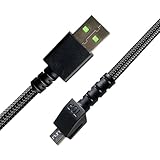
Choose a standard paracord cable if you want maximum flexibility, a soft low-drag feel, or more choices in length and color. A quality paracord cable can cost less and may be easier to route around a monitor stand or compact desk. However, compatibility is less standardized, so check the connector housing and mouse model carefully.
For most home users, the practical difference is modest. Neither cable turns a wireless mouse into a wired performance mouse by itself. The better option is the one that stays out of the way, reaches your charging port comfortably, and does not force a sharp bend behind your desk.
Side by Side
| Factor | Razer Speedflex Cable | Standard Paracord Cable |
|---|---|---|
| Comfort | Flexible and relatively light, with a finished feel suited to Razer mice | Often softer and more cloth-like; excellent for low-drag desk use |
| Durability | Good when used with the intended mouse and connector | Ranges from basic to excellent; stitching and strain relief matter |
| Price range | About $10–$25 for a replacement cable | About $8–$20, with premium custom versions costing more |
| Maintenance | Wipes clean easily; molded ends need little care | Fabric sleeves can collect dust and may need gentle spot cleaning |
| Space needed | Usually available in practical lengths around 1.5–2 meters | Often available in multiple lengths, commonly 1.2–2 meters |
| Look | Clean, uniform, and matched to Razer accessories | More colors and patterns, but appearance varies by maker |
| Resale | Brand-matched accessories may be easier to explain to a buyer | Usually has little separate resale value |
| Compatibility | Best for listed Razer models and their specific connector shape | Must be checked by model, plug shape, and USB type |
| Best for | Simple, brand-consistent replacement in a home office or gaming setup | Low-drag setups, color matching, tight routing, and budget repairs |
Where Razer Speedflex Cable Wins
The biggest advantage of the Razer Speedflex Cable is predictability. When the product listing specifically names your mouse, you are less likely to encounter a connector that is too short, too wide, or angled incorrectly. That matters with mice such as the Razer Naga Pro, Viper Ultimate, Basilisk Ultimate, and DeathAdder V2 Pro, which may use similar-looking but model-specific charging connections.
Speedflex cables also make sense when the cable will remain visible on a carefully arranged desk. Their smooth, finished construction generally looks more uniform beside a Razer mouse, keyboard, and charging dock. In a home office or shared living room, that cleaner appearance can be worth a small price premium.
They are also a sensible choice for users who do not want to compare several aftermarket specifications. A replacement in the $10–$25 range is inexpensive compared with replacing a $70–$150 wireless mouse. If the original cable has developed a kink, lost its outer sleeve, or no longer charges reliably, a compatible Speedflex replacement can restore the setup without changing how the mouse feels in daily use.
For basic charging, the cable does not need high-speed phone-charging capabilities. Most wireless mouse charging arrangements draw modest power through a 5-volt USB connection, so connector fit and cable reliability are more important than a large wattage rating. Do not assume a cable advertised for a phone or laptop will fit a Razer mouse simply because both ends use USB.
Where Standard Paracord Cable Wins
Standard paracord cables are usually the better choice for desk comfort and customization. Their woven sleeves can feel less stiff than a conventional rubber cable, allowing the cable to move smoothly when a mouse is used in wired mode. That is especially useful on a small desk where a cable rubbing against a monitor base or desk edge is noticeable.
Paracord also offers more visual flexibility. Black and white are easy to match with furniture and accessories, while other colors can coordinate with a desk mat or room decor. The Pulsar Gaming Gears Superflex Paracord, Type-C, Black and the Pulsar Gaming Gears Superflex Paracord, Type-C, White are both listed at $8.95, illustrating how aftermarket options can undercut or match many basic replacement cables.
Value is another advantage. The MJKOR Charging Cable for Razer Naga Pro, Viper Ultimate, and Basilisk Ultimate is listed at $9.99, while the Razer USB Charging Cable compatible with several Naga, DeathAdder, Viper, and Basilisk models is listed at $9.98. Those prices are close enough that the buying decision should focus on verified compatibility rather than assuming the cheaper-looking option is automatically better.
The limitation is quality variation. “Paracord” describes the sleeve style, not a universal performance standard. Look for flexible strain relief at both ends, a securely attached connector, and a length appropriate for the desk. A very soft cable can still fail early if it is repeatedly bent at the mouse port or pulled sideways by a monitor stand.
Cost Over 5 Years
Over five years, the purchase price is only part of the calculation. A $10 cable used for the full period costs about $2 per year. A $20 cable that lasts five years costs about $4 per year. Even replacing a $10 cable once during that period brings the total to about $20, or $4 per year.
For a typical home setup, a reasonable five-year budget is therefore $10–$40, depending on whether one cable lasts the entire period or whether a replacement is needed. The lower end covers a basic compatible aftermarket cable. The upper end allows for a branded replacement followed by a second purchase caused by wear, a moved desk, or a change in mouse.
Installation habits have more influence on lifespan than small price differences. Leave a gentle loop near the mouse, avoid pinching the cable under a desk leg, and unplug it by the connector rather than pulling the sleeve. Keep the cable away from pets that chew soft materials. A cable that costs $9.98 can be a better long-term value than a $20 cable if it is routed carefully and fits correctly.
Which One for Your Home
Small apartment
Choose a standard paracord cable if your desk is narrow or doubles as a dining or work surface. A 1.2–1.5-meter cable can reduce excess slack compared with a 2-meter lead, and the flexible sleeve is easier to tuck behind a monitor. Choose the Speedflex option instead if you want a tidy, matching look and your mouse remains at one dedicated desk.
Family with kids or pets
Prioritize secure connectors, a durable strain relief, and easy replacement over the softest possible feel. A listed Razer-compatible cable can simplify reordering, while an inexpensive aftermarket cable may be practical if cords are frequently pulled or damaged. Route the cable away from walkways and keep it out of reach of pets; no fabric-sleeved cable is chew-proof.
Rental
A paracord cable is useful when you cannot permanently alter the room or install a cable-management channel. Its flexibility makes it easier to route along the back edge of a temporary desk using removable clips. Select a neutral black or white cable and avoid extra length that can become a snag hazard.
Long-term home
For a permanent office or gaming room, the Razer Speedflex Cable is a strong default when you own a compatible Razer mouse and want a consistent accessory ecosystem. A standard paracord cable is the better long-term value if you expect to change desk layouts, want a particular color, or use wired mode often.
FAQ
Is a Razer Speedflex Cable better than a paracord cable?
Not universally. Speedflex usually offers predictable compatibility and a polished finish. Paracord often offers a softer feel, more colors, and lower prices. The best choice depends on the exact mouse model and how the cable will be routed.
Will any USB-C paracord cable fit a Razer mouse?
No. USB-C is a connector standard, but the recessed mouse port and surrounding plug housing still have to fit. Some Razer mice also use a proprietary-shaped connection. Buy a cable explicitly listed for your model and verify product photos when possible.
How long should a mouse charging cable be?
For most home desks, 1.5 meters is a useful middle ground. A 1.2-meter cable suits a compact setup, while 2 meters helps when the computer sits on the floor or far from the mouse. Extra length is only helpful if it can be routed without loops underfoot.
Can either cable charge a mouse while I use it?
Generally, yes, if the cable is compatible and connected to a suitable USB power or data port. Charging speed depends on the mouse and power source, not just the sleeve material. If charging is intermittent, inspect the connector and port for looseness or debris before replacing the cable.