Key takeaways
- Prioritize the GPU: At this budget the graphics card determines almost everything about your experience. Aim for an RTX 5060 Ti or better for comfortable 1080p high-refresh gaming, and an RTX 5070 if you want a genuine shot at 1440p. Everything else in the build should serve that card.
- Don’t overspend on the CPU: A modern six- or eight-core chip like a Ryzen 7 8700F, Ryzen 7 9700X, or Core Ultra 7 is more than enough to feed a mid-range GPU. Paying extra for a higher-tier processor at this price point almost always means cutting corners elsewhere.
- Insist on 16GB of DDR5 minimum: 16GB is the floor for 2026 gaming, and 32GB is the sweet spot if you multitask, stream, or keep a browser full of tabs open. Check that the RAM runs in dual channel — single-stick configurations quietly cost you frames.
- Check storage capacity and type: An NVMe SSD is non-negotiable, but 512GB fills up after three or four modern installs. 1TB is the practical minimum, and 2TB is a genuine value add if the price is right. Confirm there’s a spare M.2 slot for later.
- Look at upgrade headroom and the power supply: A standard ATX case, a non-proprietary motherboard, and a PSU with 100–150W of overhead mean you can drop in a better GPU in two years instead of buying a whole new machine. Proprietary designs are the hidden cost of some prebuilts.
What's inside
Building or buying a gaming PC on a strict $1,000 budget has never been more confusing. GPU pricing swings week to week, prebuilt configurations mix strong graphics cards with bottlenecked processors or stingy storage, and marketing copy rarely tells you whether a machine will still hold up two or three years from now. The result is that a lot of buyers overpay for the wrong balance of parts, or underspend and end up disappointed the first time they load a modern title at 1440p.
This guide cuts through that. Below you’ll find our current picks for the best gaming desktops that realistically land at or under the $1,000 mark in 2026, along with a practical buying framework, honest reviews of each system, and answers to the questions we get asked most. Every recommendation here is judged on value for money first — frames per dollar, upgrade headroom, and how much life you’ll get out of the machine before your next spend.
As an Amazon Associate we earn from qualifying purchases at no extra cost to you. Product prices and availability are accurate as of the date shown and are subject to change.


⚡ Save on Your Next PC — Amazon Prime
Prime members get fast free shipping on the systems above, plus early access to Prime Day & Black Friday PC deals. New members get a 30-day free trial.
Watch: Best Gaming PC Under $1000 — Video Review
How to Choose Gaming PC Under $1000
- Prioritize the GPU: At this budget the graphics card determines almost everything about your experience. Aim for an RTX 5060 Ti or better for comfortable 1080p high-refresh gaming, and an RTX 5070 if you want a genuine shot at 1440p. Everything else in the build should serve that card.
- Don’t overspend on the CPU: A modern six- or eight-core chip like a Ryzen 7 8700F, Ryzen 7 9700X, or Core Ultra 7 is more than enough to feed a mid-range GPU. Paying extra for a higher-tier processor at this price point almost always means cutting corners elsewhere.
- Insist on 16GB of DDR5 minimum: 16GB is the floor for 2026 gaming, and 32GB is the sweet spot if you multitask, stream, or keep a browser full of tabs open. Check that the RAM runs in dual channel — single-stick configurations quietly cost you frames.
- Check storage capacity and type: An NVMe SSD is non-negotiable, but 512GB fills up after three or four modern installs. 1TB is the practical minimum, and 2TB is a genuine value add if the price is right. Confirm there’s a spare M.2 slot for later.
- Look at upgrade headroom and the power supply: A standard ATX case, a non-proprietary motherboard, and a PSU with 100–150W of overhead mean you can drop in a better GPU in two years instead of buying a whole new machine. Proprietary designs are the hidden cost of some prebuilts.
The Best Picks Reviewed
MSI Codex Z2 (RTX 5070, 32GB, 2TB)
This is the most complete package on the list: an RTX 5070 paired with a Ryzen 7 8700F, 32GB of DDR5, and a genuinely generous 2TB NVMe drive means there’s nothing you’ll need to immediately upgrade. If your budget stretches to the very top of the $1,000 range, this is the configuration we’d point most buyers toward for confident 1440p gaming.
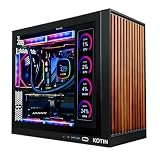
KOTIN Prebuilt Gaming PC (RTX 5070, Ryzen 7 9700X)
KOTIN pairs the same RTX 5070 with the newer Ryzen 7 9700X, which gives it a modest edge in CPU-bound titles and simulation games. The 1TB SSD is the only real compromise, and it’s an easy one to fix later given the standard components and accessible case layout.
Alienware Aurora (RTX 5070, Core Ultra 7 265F)
The Aurora brings better build quality, thermals, and support than most budget prebuilts, and the Core Ultra 7 265F is a capable partner for the RTX 5070. Be aware that Dell’s chassis and power supply are more proprietary than the competition, so factor that in if long-term GPU upgrades matter to you.
MSI Codex Z2 (RTX 5060 Ti, 16GB, 1TB)
The step-down Codex Z2 swaps to an RTX 5060 Ti with 16GB of RAM and a 1TB drive, which lands it comfortably under budget while still delivering excellent 1080p performance at high settings. It’s the smart pick if you want to keep a few hundred dollars in reserve for a monitor or peripherals.
YAWYORE Gaming PC (Ryzen 7 5700X, RTX 5060)
The Ryzen 7 5700X is a previous-generation chip, but it remains a perfectly competent gaming CPU and it lets YAWYORE fit an RTX 5060 in at an aggressive price. Treat this as a solid 1080p machine rather than a 1440p one, and it represents real value at the lower end of the range.
Frequently Asked Questions
Can a $1,000 gaming PC handle 1440p?
Yes, provided you choose carefully. An RTX 5070-equipped system will run most modern titles at 1440p with high settings and upscaling enabled. Systems built around an RTX 5060 or 5060 Ti are better suited to 1080p high-refresh gaming, where they perform extremely well.
Is a prebuilt better value than building it myself in 2026?
For most people at this budget, yes. Prebuilt manufacturers buy components at volume, and the gap between a self-built machine and a well-specced prebuilt has narrowed considerably. Building yourself still wins on part selection and case quality, but the savings are modest.
How much RAM do I actually need for gaming?
16GB is sufficient for gaming alone, but 32GB is increasingly worthwhile if you stream, run Discord and a browser alongside games, or play heavily modded titles. If you’re choosing between 32GB and a slightly better GPU, take the GPU.
What should I upgrade first on a budget prebuilt?
Storage, almost always. A second NVMe drive is inexpensive and immediately useful. After that, RAM if you started at 16GB, and finally the GPU once your card starts struggling — which is why an accessible case and a healthy power supply matter so much.
Final Thoughts
If you want the strongest all-round machine at this budget, the MSI Codex Z2 with the RTX 5070, 32GB of DDR5, and a 2TB SSD is the one we’d buy — it needs nothing added on day one. The KOTIN RTX 5070 build is the close runner-up thanks to its newer Ryzen 7 9700X, and if you’d rather spend less and keep budget aside for a good monitor, the RTX 5060 Ti version of the Codex Z2 delivers outstanding 1080p performance for the money.