Key takeaways
- Prioritize the GPU: Your graphics card determines roughly 70% of your gaming performance. At this budget, aim for an RTX 5060 Ti at minimum and an RTX 5070 if you plan to game at 1440p with ray tracing enabled.
- Match the CPU sensibly: A Ryzen 7 8700F, 9700X, or Core Ultra 7 is more than enough for any current GPU in this range. Don’t overspend on a flagship CPU if it means downgrading your graphics card.
- Insist on 32GB of DDR5: 16GB still works, but modern titles and background apps eat memory fast. If a system ships with 16GB, budget around $60–$80 for a second kit — and check that it’s dual-channel, not a single stick.
- Check storage capacity, not just speed: A 1TB NVMe SSD fills up after roughly six or seven large installs. 2TB is the comfortable sweet spot, and any prebuilt without an extra M.2 slot should be treated as a red flag.
- Look past the spec sheet: Power supply wattage, cooler quality, and case airflow rarely appear in listings but decide whether your PC throttles or upgrades gracefully. When specs are vague, assume the manufacturer cut costs there.
What's inside
Shopping for a gaming PC under $2,000 in 2026 is genuinely confusing. Prebuilt listings bury the details that matter — is that RTX 5070 the desktop version or a laptop chip? Is the 32GB of DDR5 running at a sensible speed, or is it a single stick crippling your frame rates? Meanwhile, marketing copy leans on RGB lighting and “VR-Ready” badges while staying quiet about the power supply, the cooler, and whether the case has enough airflow to survive a summer afternoon of Cyberpunk.
This guide cuts through that. We’ve focused on builds that deliver real value at their price, with an emphasis on GPU-to-price ratio, CPU pairing that won’t bottleneck you, and enough storage and memory to avoid an immediate upgrade. Below you’ll find our current picks, a practical buying checklist, short expert reviews of the top five machines, and answers to the questions we get asked most often.
As an Amazon Associate we earn from qualifying purchases at no extra cost to you. Product prices and availability are accurate as of the date shown and are subject to change.



⚡ Save on Your Next PC — Amazon Prime
Prime members get fast free shipping on the systems above, plus early access to Prime Day & Black Friday PC deals. New members get a 30-day free trial.
Watch: Best Gaming PC Under $2000 — Video Review
How to Choose Gaming PC Under $2000
- Prioritize the GPU: Your graphics card determines roughly 70% of your gaming performance. At this budget, aim for an RTX 5060 Ti at minimum and an RTX 5070 if you plan to game at 1440p with ray tracing enabled.
- Match the CPU sensibly: A Ryzen 7 8700F, 9700X, or Core Ultra 7 is more than enough for any current GPU in this range. Don’t overspend on a flagship CPU if it means downgrading your graphics card.
- Insist on 32GB of DDR5: 16GB still works, but modern titles and background apps eat memory fast. If a system ships with 16GB, budget around $60–$80 for a second kit — and check that it’s dual-channel, not a single stick.
- Check storage capacity, not just speed: A 1TB NVMe SSD fills up after roughly six or seven large installs. 2TB is the comfortable sweet spot, and any prebuilt without an extra M.2 slot should be treated as a red flag.
- Look past the spec sheet: Power supply wattage, cooler quality, and case airflow rarely appear in listings but decide whether your PC throttles or upgrades gracefully. When specs are vague, assume the manufacturer cut costs there.
The Best Picks Reviewed
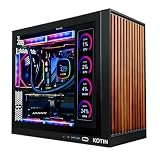
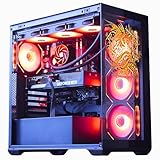
KOTIN Prebuilt Gaming PC — RTX 5070, Ryzen 7 9700X
This is the value benchmark of the group: an RTX 5070 paired with the Zen 5 Ryzen 7 9700X, 32GB of DDR5, and a 1TB SSD is a genuinely balanced 1440p build with no obvious weak link. The only thing we’d change is doubling the storage, which is an inexpensive fix down the line.
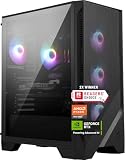
MSI Codex Z2 — RTX 5070, R7-8700F
MSI’s Codex Z2 pairs the same RTX 5070 with a 2TB NVMe drive and 32GB of DDR5, making it the most complete out-of-the-box configuration here — you won’t need to touch it for years. You’re paying a modest premium over boutique builders for MSI’s warranty support and proper thermal engineering, and for most buyers that’s money well spent.
Alienware Aurora — RTX 5070, Core Ultra 7 265F
The Aurora is the pick for buyers who want a polished, well-cooled machine with real customer support behind it, and the Core Ultra 7 265F is a strong performer in both games and productivity work. Just be aware you’re paying for the chassis and the brand, so verify the RAM and storage configuration carefully before ordering.
KOTIN Gaming PC — RTX 5060 Ti, Ryzen 7 8700F
Stepping down to the RTX 5060 Ti saves meaningful money while still handling 1080p ultra and 1440p high comfortably in most titles. The 16GB of DDR5 is the compromise here, so treat a memory upgrade as part of the purchase price rather than an optional extra.
YAWYORE Gaming PC — RTX 5060, Ryzen 7 5700X
The budget entry of the group, this build leans on the older but still capable Ryzen 7 5700X and an RTX 5060 for solid 1080p high-refresh gaming. It’s the right call if you’re on a tighter budget and gaming on a 1080p monitor, but 1440p players should stretch for one of the RTX 5070 systems.
Frequently Asked Questions
Is $2,000 enough for a 4K gaming PC in 2026?
For 4K at 60fps with upscaling enabled, yes — an RTX 5070 system will get you there in most titles. For native 4K at high refresh rates without DLSS, you’ll need to move up to a higher tier of GPU and a larger budget.
Should I buy a prebuilt or build it myself?
Building yourself typically saves 10–20% and gives you full control over component quality. Prebuilts win on warranty coverage, immediate availability, and not having to troubleshoot a system that won’t POST — a fair trade if you value your time.
Do I need 32GB of RAM for gaming?
For gaming alone, 16GB is still sufficient in 2026, but 32GB has become the practical standard once you factor in Discord, browsers, and streaming software running alongside your game. It’s a cheap upgrade that meaningfully improves consistency in 1% lows.
How long will one of these systems stay current?
Expect three to four years of comfortable high-settings gaming, and longer if you’re willing to drop to medium presets or lean on upscaling. Choosing a system with a quality power supply and a spare M.2 slot extends that window considerably.
Final Thoughts
If you want the strongest performance per dollar, the KOTIN RTX 5070 with Ryzen 7 9700X is the clear value leader and the one we’d buy with our own money. Buyers who prefer a fully-specced machine with brand-name support should look at the MSI Codex Z2 for its 2TB drive and solid thermals, while anyone gaming primarily at 1080p can save meaningfully with the KOTIN RTX 5060 Ti build and put the difference toward a better monitor.