Key takeaways
- Set realistic GPU expectations: Under $800 you will almost always get integrated graphics, not a dedicated RTX card. Radeon 780M-class and Vega 8 iGPUs handle CS2, Valorant, League, Rocket League, Fortnite (Performance mode), Minecraft and most indie titles at 1080p — but AAA releases will need reduced resolution and low settings.
- Prioritize the CPU generation, not the headline clock speed: “Up to 4.9GHz” sounds impressive, but an 8-core/16-thread Ryzen 7 will outperform a vaguely labelled “Core processor (up to 3.40GHz)” in every gaming scenario. When a listing won’t name the exact chip, treat that as a red flag.
- Insist on 16GB RAM minimum, and prefer DDR5: Integrated graphics steal system memory for video duties, so 8GB is genuinely crippling here. 16GB is the floor; 24GB of DDR5 is a meaningful upgrade because faster memory directly boosts iGPU frame rates.
- Check storage type and upgradeability: A 512GB NVMe SSD is standard and adequate, but modern games are enormous. Look for a spare M.2 slot or an accessible drive bay so you can add storage later rather than replacing the whole machine.
- Don’t ignore the panel and thermals: A 1920×1080 IPS screen is the sweet spot — sharp enough to look good, undemanding enough for an iGPU to drive. Thin, fanless-feeling chassis often throttle under sustained load, so a slightly thicker laptop with real ventilation will hold higher frame rates over a long session.
What's inside
Shopping for a gaming laptop under $800 in 2026 is genuinely confusing. Listings are packed with vague spec sheets, unfamiliar brand names, and processors described only as “Core processor (up to 3.40GHz)” — which tells you almost nothing about real-world frame rates. Meanwhile, the machines that actually carry a dedicated GPU tend to sit well above this budget, leaving buyers unsure whether an integrated-graphics laptop can handle modern games at all.
This guide cuts through that noise. Below you’ll find realistic picks that stay inside the $800 ceiling, an honest explanation of what integrated graphics can and can’t do, and the specific specs that matter most at this price. The short version: at this budget you’re buying an esports and indie-game machine with strong everyday productivity chops — and if you choose carefully, that’s a genuinely good deal.
As an Amazon Associate we earn from qualifying purchases at no extra cost to you. Product prices and availability are accurate as of the date shown and are subject to change.





⚡ Save on Your Next PC — Amazon Prime
Prime members get fast free shipping on the systems above, plus early access to Prime Day & Black Friday PC deals. New members get a 30-day free trial.
Watch: Best Gaming Laptop Under $800 — Video Review
How to Choose Gaming Laptop Under $800
- Set realistic GPU expectations: Under $800 you will almost always get integrated graphics, not a dedicated RTX card. Radeon 780M-class and Vega 8 iGPUs handle CS2, Valorant, League, Rocket League, Fortnite (Performance mode), Minecraft and most indie titles at 1080p — but AAA releases will need reduced resolution and low settings.
- Prioritize the CPU generation, not the headline clock speed: “Up to 4.9GHz” sounds impressive, but an 8-core/16-thread Ryzen 7 will outperform a vaguely labelled “Core processor (up to 3.40GHz)” in every gaming scenario. When a listing won’t name the exact chip, treat that as a red flag.
- Insist on 16GB RAM minimum, and prefer DDR5: Integrated graphics steal system memory for video duties, so 8GB is genuinely crippling here. 16GB is the floor; 24GB of DDR5 is a meaningful upgrade because faster memory directly boosts iGPU frame rates.
- Check storage type and upgradeability: A 512GB NVMe SSD is standard and adequate, but modern games are enormous. Look for a spare M.2 slot or an accessible drive bay so you can add storage later rather than replacing the whole machine.
- Don’t ignore the panel and thermals: A 1920×1080 IPS screen is the sweet spot — sharp enough to look good, undemanding enough for an iGPU to drive. Thin, fanless-feeling chassis often throttle under sustained load, so a slightly thicker laptop with real ventilation will hold higher frame rates over a long session.
The Best Picks Reviewed
KAIGERR 2026 Gaming Laptop (Ryzen 7 H255, 24GB DDR5)
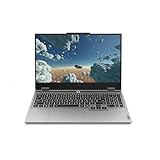
This is the strongest all-round pick in the group: an 8-core/16-thread Ryzen 7 H255 boosting to 4.9GHz, paired with 24GB of DDR5 and a 16-inch display that gives you noticeably more usable screen than the usual 15.6-inch panels. The extra DDR5 bandwidth is doing real work for the Radeon Vega graphics, and the backlit keyboard plus WiFi 6 round out a package that feels a class above its price.
Ryzen 7 H255 Gaming Laptop (24GB DDR5, 512GB NVMe)
Effectively the same silicon recipe as the KAIGERR — Ryzen 7 H255, 24GB DDR5, 512GB NVMe — in a more conventional chassis, so it’s worth buying whichever of the two is cheaper on the day. Expect comfortably playable 1080p esports performance and enough multi-threaded muscle for streaming, editing, or heavy multitasking between sessions.
NIMO 15.6″ IPS FHD Light Gaming Laptop (Ryzen 5 6600H)
The Ryzen 5 6600H is a proper H-series mobile chip rather than a low-power U-series part, which means higher sustained clocks and better thermal headroom during long gaming sessions. Combined with a genuine IPS FHD panel — a spec many rivals quietly omit — this is the pick for buyers who care most about consistent frame pacing and colour accuracy.
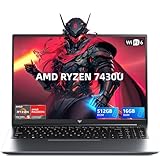
Light Gaming Laptop (AMD Ryzen 7430U, 16GB / 512GB)
The Ryzen 7430U is a power-efficient U-series processor, so this one trades peak gaming performance for excellent battery life and a cooler, quieter chassis. It’s the sensible choice for a student or commuter who plays lighter titles and needs the machine to survive a full day of classes or meetings unplugged.
Tunhail 15.6″ Laptop (16GB RAM, 512GB, Win 11 Pro)
Bundling Windows 11 Pro at this price is unusual and genuinely useful if you need BitLocker, Remote Desktop, or domain features for work or school. Gaming performance from the unspecified “Core processor” is entry-level, so treat this as a capable productivity laptop that handles casual and older titles rather than a dedicated gaming rig.
Frequently Asked Questions
Can a laptop under $800 really run modern games?
Yes, with caveats. Esports titles like Valorant, CS2, League of Legends and Rocket League run comfortably at 1080p, and most indie and older AAA games are fine at medium settings. Current-generation AAA releases will require 720p and low presets, if they’re playable at all.
Is 16GB of RAM enough, or should I pay more for 24GB?
16GB is workable, but integrated graphics share system memory, so 24GB of DDR5 gives you both a larger buffer and higher memory bandwidth — which translates directly into better iGPU frame rates. If the price gap is small, the 24GB DDR5 models are the better buy.
Why do some listings just say “Core processor (up to 3.40GHz)”?
It usually means an older or entry-level chip that the seller would rather not name explicitly. Clock speed alone doesn’t determine gaming performance — core count, architecture and generation matter far more — so favour listings that state the exact model, like the Ryzen 7 H255 or Ryzen 5 6600H.
Should I save up for a laptop with a dedicated GPU instead?
If AAA gaming at high settings is your priority, yes — stretching to an entry-level RTX machine is the better long-term investment. But if you mainly play esports, indie or older titles and also need a capable everyday laptop, these sub-$800 machines deliver far better value per dollar.
Final Thoughts
For most buyers, the KAIGERR 2026 Gaming Laptop is the clear pick here — its Ryzen 7 H255, 24GB of DDR5 and larger 16-inch panel make it the most complete package under $800, with the equivalent Ryzen 7 H255 / 24GB DDR5 model an equally good alternative whenever it undercuts on price. If sustained gaming performance and screen quality matter more than raw specs, the NIMO Ryzen 5 6600H is the smarter buy thanks to its true H-series chip and IPS display.