Key takeaways
- GPU tier over GPU generation: A previous-gen RTX 4070 frequently outperforms a current-gen RTX 5050 or a power-limited 5060. Look up the TGP (total graphics power) rating — anything under 100W will throttle noticeably in demanding titles, regardless of the model number.
- Display resolution vs. refresh rate: At this budget, a 165Hz FHD or WUXGA panel is the sweet spot. QHD looks superb but forces you into upscaling for modern AAA games; 16:10 aspect ratios (1920×1200) give you meaningful extra vertical space for browsing and work.
- Cooling determines real-world speed: Sustained clocks matter more than boost clocks. Thicker chassis with dual-fan, multi-heatpipe designs consistently deliver better frametimes than slim ultraportables running identical silicon. Read thermal throttling tests before you buy.
- Storage is the easiest upgrade, RAM is the cheapest: A 512GB SSD fills up after four or five modern installs. Check whether the laptop has a second M.2 slot and whether the RAM is socketed rather than soldered — this can add two years to a machine’s useful life for under $100.
- Budget for the total cost: Factor in a decent mouse, a cooling pad if you game at a desk, and possibly a 240W power brick replacement. A $1450 laptop that needs $150 of accessories isn’t really a $1450 laptop.
What's inside
Shopping for a gaming laptop under $1500 in 2026 means navigating a market that has never been more crowded — or more confusing. NVIDIA’s RTX 50-series has trickled down into mid-range machines, but the badge on the lid tells you far less than it used to: an RTX 5060 in a thin chassis with a 90W power limit can lose to a well-cooled RTX 4070 from the previous generation. Meanwhile, manufacturers quietly cut corners on RAM configuration, panel quality, and SSD capacity to hit that magic price point.
This guide cuts through the spec-sheet noise. We’ve focused on machines that actually stay under $1500 at typical street prices — not inflated MSRPs that only exist during a sale — and we’ve weighted our picks toward sustained performance, display quality, and upgrade headroom rather than headline numbers. Below you’ll find our top recommendations, a practical buying framework, and answers to the questions we get asked most.
As an Amazon Associate we earn from qualifying purchases at no extra cost to you. Product prices and availability are accurate as of the date shown and are subject to change.


⚡ Save on Your Next PC — Amazon Prime
Prime members get fast free shipping on the systems above, plus early access to Prime Day & Black Friday PC deals. New members get a 30-day free trial.
Watch: Best Gaming Laptop Under $1500 — Video Review
How to Choose Gaming Laptop Under $1500
- GPU tier over GPU generation: A previous-gen RTX 4070 frequently outperforms a current-gen RTX 5050 or a power-limited 5060. Look up the TGP (total graphics power) rating — anything under 100W will throttle noticeably in demanding titles, regardless of the model number.
- Display resolution vs. refresh rate: At this budget, a 165Hz FHD or WUXGA panel is the sweet spot. QHD looks superb but forces you into upscaling for modern AAA games; 16:10 aspect ratios (1920×1200) give you meaningful extra vertical space for browsing and work.
- Cooling determines real-world speed: Sustained clocks matter more than boost clocks. Thicker chassis with dual-fan, multi-heatpipe designs consistently deliver better frametimes than slim ultraportables running identical silicon. Read thermal throttling tests before you buy.
- Storage is the easiest upgrade, RAM is the cheapest: A 512GB SSD fills up after four or five modern installs. Check whether the laptop has a second M.2 slot and whether the RAM is socketed rather than soldered — this can add two years to a machine’s useful life for under $100.
- Budget for the total cost: Factor in a decent mouse, a cooling pad if you game at a desk, and possibly a 240W power brick replacement. A $1450 laptop that needs $150 of accessories isn’t really a $1450 laptop.
The Best Picks Reviewed
ASUS ROG Strix G16 (2025)
The Strix G16 remains the most balanced option in this bracket, pairing an RTX 5060 with Intel’s 14650HX — a genuinely high-core-count CPU that keeps 1% lows respectable in CPU-heavy titles like simulation and strategy games. The 165Hz 16:10 panel and Wi-Fi 7 are welcome, and ASUS’s cooling design means the GPU actually holds its rated clocks during extended sessions.
MSI Katana 15
The Katana 15 is the value pick for anyone who prioritises raw GPU horsepower, since an RTX 4070 still comfortably out-renders most 50-series cards available at this price. The QHD 165Hz display is a genuine step up in sharpness, though the 13620H CPU is the weaker link if you play heavily CPU-bound esports titles at very high framerates.
GIGABYTE Gaming A16
GIGABYTE’s A16 undercuts most RTX 5060 machines while offering the same 1920×1200 WUXGA 165Hz panel and a full 1TB of storage, which matters more than it sounds when a single modern install can exceed 150GB. Build quality is plainer than the ASUS, but the thermals are solid and there’s little compromise where it counts.
Lenovo LOQ 15.6″
The LOQ is the sensible choice for buyers who want RTX 5060 performance without paying for premium chassis materials, and the Ryzen 7 250 handles gaming duties competently while running cooler than comparable Intel HX parts. The 512GB SSD is the main compromise, so plan on a second drive within the first year.
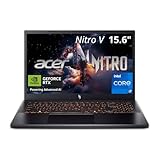
Acer Nitro V 15
The Nitro V is our entry-level recommendation, and the RTX 5050 with 8GB of GDDR7 is perfectly capable of 1080p high settings in most current titles with DLSS enabled. The i5-13420H limits headroom for future GPU-heavy releases, but for players spending most of their time in esports titles this is the smartest way to spend well under the cap.
Frequently Asked Questions
Is 16GB of RAM still enough for gaming in 2026?
For pure gaming, yes — 16GB remains sufficient for the overwhelming majority of titles, though a handful of open-world releases now recommend 32GB. If your laptop has two SODIMM slots, upgrading later costs very little and is the single most cost-effective improvement you can make.
Should I wait for a better GPU at this price?
Mid-range mobile GPUs update on a roughly 18-month cadence, and prices in this bracket have been stable rather than falling. If you need a machine now, buying now is reasonable; the exception is if a major sale event is within a few weeks.
Does display resolution or refresh rate matter more?
Refresh rate, for most players. A 165Hz FHD or WUXGA panel delivers a more consistently smooth experience on this class of hardware than a QHD panel you’ll end up upscaling to anyway. Choose QHD only if you also use the machine for content work.
How long will a $1500 gaming laptop stay relevant?
Expect three to four years of comfortable 1080p high-settings gaming, extending further if you’re willing to use upscaling and drop to medium presets. Machines with upgradeable RAM and a spare M.2 slot tend to age considerably better.
Final Thoughts
If you want the most complete package under $1500, the ASUS ROG Strix G16 is the machine we’d buy — its CPU, panel, cooling and connectivity are all a tier above the competition. Buyers chasing maximum frames per dollar should look hard at the MSI Katana 15, where the RTX 4070 still delivers performance that newer mid-tier cards struggle to match, while the GIGABYTE Gaming A16 splits the difference with current-gen hardware, a 1TB SSD, and a price that leaves room in the budget for accessories.