Key takeaways
- Table of Contents 7 sections 10 min read 1 Quick Verdict 2 Side by Side 3 Where Razer HyperSpeed Wireless Wins 4 Where Bluetooth Gaming Latency Wins 5 Cost Over 5 Years 6 Which One for Your Home 6.1 Small…
What's inside
When choosing between Razer HyperSpeed wireless and Bluetooth, the real decision is not simply whether you want a cable. It is whether your home setup needs gaming-first responsiveness or everyday convenience. HyperSpeed uses a dedicated 2.4GHz USB transmitter, while Bluetooth shares a general-purpose wireless connection with phones, tablets, laptops, and other nearby devices.
That difference matters most in competitive games, fast camera movement, rhythm games, and voice chat. It matters less for turn-based games, streaming video, casual play, or a headset used mainly around the house. The best choice also depends on available USB ports, console compatibility, battery habits, and whether you want one device to move easily between rooms.
As an Amazon Associate we earn from qualifying purchases at no extra cost to you. Product prices and availability are accurate as of the date shown and are subject to change.


For 2026 buyers, both technologies are mature. The question is where each one fits your home and your tolerance for small delays, connection steps, and extra hardware.
Quick Verdict
Choose Razer HyperSpeed wireless when gaming latency is your priority. Its dedicated 2.4GHz connection is designed to send mouse, keyboard, or headset data quickly and consistently to a USB receiver. It is usually the better choice for shooters, racing games, competitive multiplayer, and desktop setups where a receiver can remain plugged in.
Choose Bluetooth when flexibility, low cost, and device compatibility matter more than the absolute fastest response. Bluetooth avoids a proprietary dongle, works naturally with many laptops, phones, tablets, and smart TVs, and can be convenient in a small home. Its latency is more variable, especially when the computer is busy or several wireless devices are nearby.
In practical terms, HyperSpeed often feels close to a wired gaming connection, while Bluetooth can feel perfectly acceptable for ordinary play but less immediate during rapid inputs. Neither option is automatically better for every room or every player.
Side by Side
| Factor | Razer HyperSpeed Wireless | Bluetooth Gaming |
|---|---|---|
| Comfort | No cable drag; receiver must stay within roughly 6 to 10 feet for an uncomplicated setup | No cable or receiver; easy to move between devices, though pairing can add friction |
| Latency | Typically the better choice for low and consistent gaming response | Usually higher and more variable; commonly acceptable for casual play and video |
| Durability | Good, but the small USB receiver is easy to misplace or damage | Fewer external parts, but the device battery and Bluetooth radio remain failure points |
| Price range | About $60 to $150 for common mice and headsets | About $25 to $150, depending on audio, microphone, and gaming features |
| Maintenance | Charge the device, update firmware when needed, and protect the receiver | Charge the device and occasionally remove old pairings or reconnect it |
| Space needed | One USB-A or USB-C port plus a receiver, often 1 to 2 inches of clearance | No dedicated port, though a charging cable still needs storage |
| Look | Clean desk appearance, with a small receiver that may be visible | Cleanest minimalist appearance because no receiver is attached |
| Resale | Strong when the original receiver and extension adapter are included | Broad compatibility can help resale, but older Bluetooth standards may age faster |
| Best for | Competitive PC gaming, low-latency audio, and permanent desk setups | Portable use, shared homes, laptops, tablets, and casual gaming |
Where Razer HyperSpeed Wireless Wins
HyperSpeed’s main advantage is consistency. The USB receiver creates a dedicated link between the gaming device and the computer or console. Unlike Bluetooth, it is not primarily designed to juggle a wide range of low-power accessories and general-purpose connections. That focused design helps reduce the pauses and timing variation that can become noticeable when you make rapid mouse movements or react to an opponent.
For a mouse, this can be especially important. The Razer Basilisk V3 X HyperSpeed Customizable Wireless Gaming Mouse, Black, priced at $59.99, is an example of the value point available with a dedicated gaming receiver. A mouse also has relatively low power demands, so it can be a practical choice for a desk where gaming performance matters more than phone-friendly portability.
HyperSpeed is also attractive for wireless headsets. The Razer BlackShark V3 X HyperSpeed Wireless PC Gaming Headset, Black, priced at $89.99, fits a setup where game audio, microphone communication, and positional cues need to arrive together. A dedicated receiver can avoid the audio delay or profile switching sometimes associated with Bluetooth headsets.
Another benefit is predictable behavior. Once the receiver is paired, the device usually reconnects when the computer wakes or the headset is switched on. You do not need to open Bluetooth settings every time you move between a desktop and a tablet. Some Razer products also support multiple connection modes, but buyers should check the exact model rather than assume every HyperSpeed device includes Bluetooth.
The tradeoff is hardware. A receiver occupies a port and can be lost. A desktop tower under a desk may also shield a 2.4GHz signal, so a short USB extension cable can improve placement. Keep the receiver near the front or side of the desk, rather than behind a metal computer case or several feet away.
Where Bluetooth Gaming Latency Wins
Bluetooth wins on convenience. Most laptops, tablets, phones, and many televisions already include Bluetooth, so there is no extra receiver to carry. That makes it useful in a multipurpose home where one headset moves from a PC to a phone, or where a controller is stored in a drawer between gaming sessions.
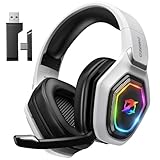
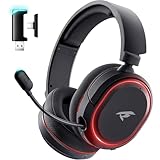
It can also lower the entry price. The Ozeino Wireless Gaming Headset for PS5, PC, Switch, advertised with lossless audio and 40-hour battery life, is listed at $29.99. A Wireless Gaming Headset for PC, PS5, PS4, Mac, and Switch with 7.1 surround sound and a 100-hour battery is listed at $35.97. These prices illustrate why Bluetooth-oriented or multi-mode budget headsets can appeal to families equipping more than one room, though buyers should verify whether a particular model uses Bluetooth, a 2.4GHz dongle, or both.
Bluetooth is also a good match for slower-paced games, cloud gaming on a tablet, story-driven titles, and video. If the device is ten feet away on a sofa and you are not competing in a timing-sensitive match, the convenience may outweigh a modest delay. Bluetooth also leaves every USB port available for storage drives, webcams, charging, or a wired controller.
Its weaknesses are less predictable latency and more complicated audio behavior. A headset may switch between profiles when its microphone is activated, reducing audio quality or changing delay. Nearby wireless traffic, an older Bluetooth version, operating-system settings, and the computer’s workload can all affect the experience. Bluetooth performance is therefore less about a single number and more about the complete device combination.
Cost Over 5 Years
The five-year ownership cost is usually close between the two technologies. An entry-level HyperSpeed mouse at $59.99 may cost less over five years than buying two inexpensive mice after battery or switch failures. A headset in the $90 range, such as the BlackShark V3 X HyperSpeed, may also be economical if its fit, microphone, and receiver continue to suit your setup.
Budget Bluetooth headsets priced around $30 to $36 reduce the initial risk. Buying one for a child or a secondary room can make sense, particularly when a 40- to 100-hour battery reduces charging frequency. However, built-in lithium-ion batteries gradually lose capacity. If a headset lasts three to five years, a replacement may be more realistic than a battery repair.
Allow approximately $0 to $15 over five years for a replacement USB extension cable or receiver storage solution, and $10 to $30 for a spare charging cable or replacement cable if the original is lost. These are planning ranges, not guaranteed expenses. HyperSpeed’s potential extra cost is the receiver; Bluetooth’s potential extra cost is replacing a lower-priced device sooner. Keep the receiver with the product packaging if resale matters.
Which One for Your Home
Small apartment
Bluetooth is attractive when your desk doubles as a dining table or media station. It avoids a receiver and makes it easier to move a headset between a laptop, phone, and television. Choose HyperSpeed instead if the apartment’s main purpose is competitive PC gaming. A receiver placed within 6 to 10 feet of the device should be easy to manage in a compact room.
Family with kids or pets
Bluetooth reduces the number of small parts that can disappear under furniture. It is convenient for shared tablets and laptops, but pairing confusion may be frustrating when several family members use similar devices. HyperSpeed can be the better dedicated-desk solution if the receiver stays plugged into a computer and the headset or mouse is stored in one known place after use.
Rental
Renters generally benefit from portable equipment that does not require a permanent setup. Bluetooth is ideal for moving between rooms or taking a headset to another home. If a gaming desk is already established, HyperSpeed still works well; use a USB extension rather than rearranging furniture to accommodate the receiver.
Long-term home
For a permanent gaming room, prioritize the connection you will use most. HyperSpeed is the stronger long-term choice for a PC gaming desk, particularly when response consistency matters. Bluetooth may be better in a flexible media room where the same headset serves a television, laptop, and phone. A dual-mode product can offer the best compromise, but confirm its exact modes, console support, and whether Bluetooth is available at the same time as HyperSpeed.
FAQ
Is Razer HyperSpeed faster than Bluetooth?
Usually, yes. HyperSpeed is designed around a dedicated 2.4GHz gaming connection and generally provides lower, more consistent input and audio delay. Bluetooth can be responsive enough for casual gaming, but latency varies by device, Bluetooth version, software, and wireless interference.
Does Bluetooth work for competitive gaming?
It can work, but it is not the safest choice for serious competitive play. A small timing difference may be unimportant in a strategy game and distracting in a shooter or rhythm game. For competitive gaming, use HyperSpeed or a wired connection whenever your equipment supports it.
Does HyperSpeed need a USB port?
Yes. The receiver normally uses a USB-A or USB-C port, either directly or through an included adapter. Plan for roughly 1 to 2 inches of clearance around the receiver, and use a short extension cable if the computer case blocks the signal.
Can I use one headset with both HyperSpeed and Bluetooth?
Some models support both, but the feature is not universal. Check the product specifications for simultaneous connections, console compatibility, microphone behavior, and battery life in each mode. If you regularly switch between a gaming PC and phone, dual-mode support can be more useful than choosing based on latency alone.