Key takeaways
- 70 hours is the rating with the RGB logo and scroll wheel lighting left on at a moderate brightness.
- 100 hours is the rating with lighting disabled entirely, running purely on the HyperSpeed 2.4GHz connection.
What's inside
The Razer Viper Ultimate is still one of the lightest ambidextrous wireless gaming mice you can buy in 2026, weighing 74g with the sensor, battery, and HyperSpeed radio all built into a 126.7 x 57.6 x 37.8mm shell. That combination of low weight and symmetrical shape is why it stuck around in competitive FPS setups long after Razer released newer Viper models, and it’s worth understanding exactly how its battery, switches, and dock actually perform now that the mouse has a few years of hardware cycles behind it.
What the 74g weight actually means in practice
74g sits in the same bracket as most flagship wireless mice released between 2020 and 2024, but the number alone doesn’t tell you how it feels. The Viper Ultimate distributes that weight evenly because it’s ambidextrous and has no honeycomb shell or removable weights, unlike some rivals. That means the balance point sits closer to the center of the mouse rather than toward the palm, which matters more for flick-heavy aim styles than the raw gram count does.
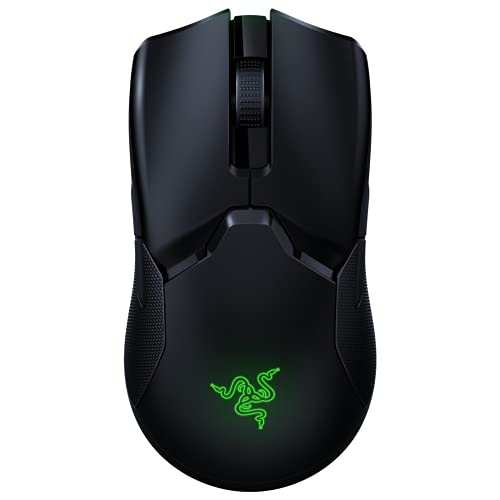
Razer Viper Ultimate Lightweight Wireless Gaming Mouse: Fastest Gaming Switches - 20K DPI Optical Sensor - Chroma Lighting - 8 Programmable Buttons - 70 Hr Battery - Classic Black
Included for 'Razer Viper Ultimate Explained: Wireless Performance, Weight, and Battery Life' because the listing specifies 20K DPI Optical Sensor and Chroma Lighting, details this guide uses to compare options.
View on Amazon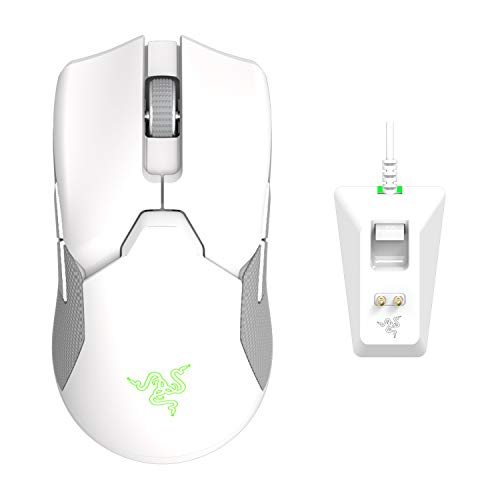
Razer Viper Ultimate Lightweight Wireless Gaming Mouse & RGB Charging Dock: Hyperspeed Wireless Technology - 20K DPI Optical Sensor - 74g Lightweight - 70 Hr Battery - Mercury White
Included for 'Razer Viper Ultimate Explained: Wireless Performance, Weight, and Battery Life' because the listing specifies 20K DPI Optical Sensor and 74g Lightweight, details this guide uses to compare options.
View on AmazonRazer Viper Ultimate Lightweight Wireless Mouse
Included for 'Razer Viper Ultimate Explained: Wireless Performance, Weight, and Battery Life' as a relevant option in this category; details come from the product listing.
View on Amazon
Razer Viper V4 Pro Wireless Esports Gaming Mouse, 49g,180Hr Battery, Black
Included for 'Razer Viper Ultimate Explained: Wireless Performance, Weight, and Battery Life' because the listing specifies 49g and 180Hr Battery, details this guide uses to compare options.
View on AmazonThe 126.7mm length and 57.6mm width put it in the “medium” category for hand size, roughly comparable to a Logitech G Pro X Superlight or a Razer Naga Pro without the side button panel attached. If you have a hand length under 17cm, fingertip grip will feel natural; above 19cm, most users end up in a claw or relaxed palm grip because the 37.8mm height leaves little arch support.
HyperSpeed battery life: 70 hours vs 100 hours explained
Razer lists two battery figures for the Viper Ultimate because they come from two different test conditions, and this is where most buying confusion starts:
- 70 hours is the rating with the RGB logo and scroll wheel lighting left on at a moderate brightness.
- 100 hours is the rating with lighting disabled entirely, running purely on the HyperSpeed 2.4GHz connection.
The math behind that gap comes down to LED draw. A single-zone RGB mouse logo typically pulls somewhere in the 15-25mW range depending on brightness and color, while the internal optical sensor and radio together draw roughly 80-120mW during active tracking at typical 1000Hz polling. Cutting the lighting removes a meaningful chunk of the constant background draw, which is why Razer’s own numbers show close to a 30% runtime increase rather than a marginal one.
In real-world use after a few years of battery aging, expect both numbers to drop. Li-ion and Li-poly cells in mice like this lose roughly 10-20% of rated capacity after 300-500 full charge cycles, which is a realistic count for someone using the mouse daily for two to three years. That puts a well-used Viper Ultimate closer to:
| Condition | Rated runtime (new) | Realistic runtime (2-3 years, daily use) |
|---|---|---|
| RGB on, HyperSpeed active | 70 hours | ~50-58 hours |
| RGB off, HyperSpeed active | 100 hours | ~78-88 hours |
| Bluetooth mode (if used instead of dock) | Not officially rated for this model | N/A – Viper Ultimate is HyperSpeed/wired only |
If you’re trying to plan around a specific play schedule, the calculation is simple: take your average weekly hours of use, divide by the realistic runtime figure, and that gives you how often you’ll need to dock the mouse. Someone playing 15 hours a week with RGB off would recharge roughly once every five to six weeks, which is why most owners just leave the charging dock as a permanent desk fixture rather than tracking battery percentage closely.
The charging dock: still worth using years later?
The Viper Ultimate’s charging dock does two things: it charges the mouse via a pogo-pin connection, and it acts as the HyperSpeed USB receiver when connected to your PC. This dual role is why the dock matters more than it does on mice that charge over a simple USB-C cable.
After years of use, the two most common issues are:
- Inconsistent charging contact — dust or oxidation on the pogo pins causes the mouse to sit in the dock without topping up. Wiping the contact points on both the dock and the base of the mouse with a dry microfiber cloth resolves this in most cases, since it’s almost always a contact issue rather than a failed charging circuit.
- HyperSpeed dropout or increased latency — this is more often caused by 2.4GHz interference from nearby Wi-Fi routers, USB 3.0 hubs, or other wireless peripherals than by hardware wear. Moving the dock away from USB 3.0 ports and other wireless dongles, or switching your router to the 5GHz band, typically restores a stable connection.
The optical switches underneath the main buttons are the more durable part of the equation. Razer rates them for roughly 70 million clicks, and because they use a light beam instead of physical metal contacts, they don’t suffer from the double-click or chatter issues that mechanical switches develop after heavy use. Reports of switch failure on this mouse are uncommon even several years in, which is part of why it’s still recommended as a budget-conscious alternative to newer Viper releases if you find one in good condition.
How it compares to newer Viper models and the Naga Pro
Razer’s lineup has moved on to models with higher polling rates and updated sensors, but the Viper Ultimate’s core spec class — sub-75g weight, ambidextrous shape, optical switches, HyperSpeed wireless — hasn’t been meaningfully surpassed for the symmetrical shooter crowd. The decision usually comes down to a few concrete factors:
| If you… | Choose |
|---|---|
| Need an ambidextrous, click-focused mouse under 75g for FPS games | Viper Ultimate (or its current-generation successor if buying new) |
| Want swappable side button plates for MMO or MOBA keybinds | Razer Naga Pro wireless gaming mouse |
| Play mainly right-handed and want thumb rest contouring | A right-handed shape from Razer’s current lineup rather than the Viper Ultimate |
| Already own a Viper Ultimate in working condition | Keep it — clean the dock contacts and disable RGB for the 100-hour rating |
The Naga Pro is worth mentioning here because it shares the same HyperSpeed wireless system and optical switch technology, but it targets a different use case entirely: it ships with three magnetic side plates (2, 6, and 12 buttons) so it can shift between an MMO macro layout and a stripped-down FPS configuration. If your search for a Viper Ultimate is really about finding a do-everything wireless mouse rather than a lightweight FPS-specific one, the Naga Pro is the more flexible pick, at the cost of extra weight — it’s noticeably heavier than the Viper Ultimate’s 74g once a side plate is attached.
Is it still worth buying in 2026?
If you can find a Viper Ultimate at a lower price point than Razer’s current-generation equivalents (used units or clearance stock typically land in the $50-$90 range compared to $100-$150 for newer flagship wireless mice), it remains a solid pick specifically for ambidextrous grip users who prioritize low weight and click latency over higher polling rates. The tradeoffs are a lack of onboard profile storage compared to some newer models and no Bluetooth fallback mode, so it depends entirely on the dock and HyperSpeed dongle for wireless use. For most players who already have one working well, there’s little reason to upgrade based on spec sheets alone.