Our Top Picks


Bare drywall and hard floors turn a gaming room into an echo chamber. Every sound bounces between parallel walls, so voice chat picks up a hollow ring, stream audio sounds thin, and a single clap seems to hang in the air. The fix is not always more foam. Sometimes the room does not need less sound energy — it needs that energy spread evenly. That is what an acoustic diffuser does.
The distinction matters. Absorbers soak up sound energy: foam panels, bass traps, and thick curtains convert reflections into heat and make a room quieter and deader. Diffusers scatter sound waves in many directions instead, evening out reflections without removing the life from the room. A diffuser breaks up the sharp echo that bounces straight back at your ears and replaces it with a spread-out wash of sound that the brain reads as spacious rather than echoey. Most gaming rooms benefit from both — some absorption at the closest reflection points and diffusion on the rear wall — but this guide covers diffusers only: five panels spanning wood QRD, EVA waffle, and PVC geometric tiles.
As an Amazon Associate, we earn from qualifying purchases.
How to Choose an Acoustic Diffuser for a Gaming Room
Pattern type decides how sound spreads. A quadratic residue diffuser (QRD) uses wells of varying depth to scatter sound evenly. A one-dimensional QRD scatters in a single plane, usually horizontally, which suits a side wall. A two-dimensional QRD scatters in both planes at once, which suits a rear wall where reflections arrive from every direction. Geometric panels — pyramids, hexagons, repeating 3D shapes — break up reflections with angled faces rather than tuned wells: less precise than a QRD but far lighter and easier to cover a large wall with. Waffle-pattern EVA panels are a molded grid of wells in soft foam, for midrange scatter at the lowest weight.
Depth sets the low end. A diffuser can only scatter wavelengths that fit inside its wells, so deeper panels reach lower frequencies. The 2.8-inch wood panel here lists a working range starting at 410 Hz, covering voices and most game audio. One-inch PVC tiles and two-inch EVA waffles work higher up, on the midrange and treble reflections behind flutter echo and harshness. A boomy low end needs bass traps, not diffusers.
Coverage is simple math. Measure the wall area you want to treat, then compare it with the coverage per panel or per pack: 4 square feet for a 24 by 24 inch wood panel, 27 to 32 square feet for a 12-pack of 19.7-inch PVC tiles. Start with the rear wall behind your listening position, and add panels until the flutter echo fades. Eight to sixteen square feet is a good start for a small room.
Material sets the weight and the mounting. Wood panels are rigid, paintable, and heavy at around 9 pounds each, needing a sawtooth hanger or anchor screws into a stud. PVC tiles weigh under a pound per panel, shrug off moisture, and go up with adhesive or double-sided tape. EVA foam is the lightest option and the easiest to cut — renters should lean toward adhesive-mounted PVC or foam.
Placement comes before quantity. Put diffusion on the rear wall first, then the side walls where sound first hits. Leave some bare wall and some absorption in the mix — diffusers do not absorb or block sound.
1. BXI Wood Sound Diffuser 2D QRD

The BXI 2D QRD is the most capable single panel here, and the best choice if you want one serious diffuser rather than a wall of tiles. Its two-dimensional quadratic residue pattern scatters sound both horizontally and vertically, handling reflections from any angle — exactly the situation on a rear wall. The listing gives a working range of 410 Hz to 24,571 Hz, covering voices, game audio, and the upper harmonics that make a room sound harsh.
Each panel is a solid wood slab, 24 by 24 inches and 2.8 inches deep, covering 4 square feet and weighing 9.3 pounds. The wood is paintable. Mounting is by sawtooth hanger or anchor screws — at this weight, drive the anchors into a stud rather than trusting drywall alone. One panel treats a focused area, such as the wall behind a streaming microphone; a row of two or four treats the whole rear wall. The trade-off is cost per square foot: budget for several if you want full coverage.
Specs
- Material: Wood (paintable)
- Size: 24 x 24 x 2.8 inches
- Coverage: 4 sq ft per panel
- Weight: 9.3 lb
- Pattern: 2D QRD (scatters horizontally and vertically)
- Frequency range: 410 Hz to 24,571 Hz
- Mounting: Sawtooth hanger or anchor screws
2. BXI Wood Sound Diffuser 1D QRD

The 1D version of the BXI wood diffuser is the same size, the same wood, and nearly the same weight as the 2D panel above — 24 by 24 by 2.8 inches and 9 pounds — but its wells run in one direction, so it scatters sound horizontally. That makes it the better pick for a side wall or the wall behind a desk, where reflections arrive mostly from one direction and you want them spread sideways. A 1D panel on each side wall with a 2D panel on the rear wall is a classic layout.
Like the 2D panel, it is paintable wood, covers 4 square feet, and mounts the same way. The honest note here is availability: this listing is harder to confirm than the 2D panel, so check that it is in stock before ordering. If it is unavailable when you check, the 2D panel above is the direct fallback — it does everything the 1D panel does, in two planes instead of one.
Specs
- Material: Wood (paintable)
- Size: 24 x 24 x 2.8 inches
- Coverage: 4 sq ft per panel
- Weight: 9 lb
- Pattern: 1D QRD (horizontal scatter)
- Mounting: Sawtooth hanger or anchor screws
3. Foroomaco Waffle Acoustic Diffuser Panels, 4-Pack Black
The Foroomaco waffle kit is the lightest and most forgiving diffuser here, and the best pick for renters or anyone who wants to try diffusion without drilling. Four EVA foam panels, each 12 by 12 inches and 2 inches thick, combine into a 24 by 24 inch block covering 4 square feet. The waffle pattern is a genuine QRD-style grid of wells molded into the foam, so it scatters midrange reflections rather than simply looking textured. The whole pack weighs just 1.2 pounds, mounts with adhesive, and can be cut to fit around outlets or a monitor arm.
Black EVA foam reads as deliberate wall decor on a dark gaming wall. The trade-offs come with foam: the wells are shallower than a wood QRD, so the low end is more limited, and the textured surface collects dust, so plan on an occasional wipe-down. The panels stand 2 inches proud of the wall, per the listing.
Specs
- Material: EVA foam
- Size: 12 x 12 x 2 inches per panel (4 panels)
- Coverage: 24 x 24 inches total (4 sq ft)
- Weight: 1.2 lb per pack
- Pattern: Waffle QRD
- Color: Black
- Mounting: Adhesive
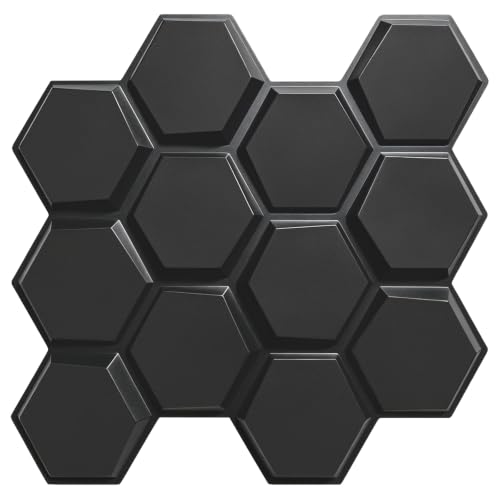
4. TroyStudio Hexagon Acoustic Sound Diffuser Panels, 12-Pack Black
The TroyStudio Hexagon panels are the style pick of this guide: a repeating hexagon pattern in black PVC that reads as modern wall art and happens to scatter sound. Each panel is 19.7 by 19.7 inches and 0.9 inches thick, and the 12-pack covers 27.12 square feet — enough to treat a full rear wall or a wide section of side wall in one box. At 0.44 pounds per panel, the tiles mount with adhesive or double-sided tape, and the PVC is waterproof and non-toxic, so humidity is not a concern.
The six-sided cells break reflections into a spread of angles, effective on midrange and treble echo while keeping the wall visually flat. They do not absorb sound, so pair them with some absorption if the room is very live. As with the BXI 1D panel, confirm the listing is in stock before ordering — this is a newer listing with a thinner paper trail than the long-running TroyStudio geometric panels below.
Specs
- Material: PVC plastic
- Size: 19.7 x 19.7 x 0.9 inches per panel (12 panels)
- Coverage: 27.12 sq ft
- Weight: 0.44 lb per panel
- Pattern: Hexagon 3D geometric
- Color: Black
- Mounting: Adhesive or double-sided tape
5. TroyStudio Acoustic Sound Diffuser Panels, 12-Pack White
The TroyStudio 19.7-inch geometric panels cover more wall per box than anything else here: twelve 19.7 by 19.7 by 1 inch tiles, 32.34 square feet in total, at 0.69 pounds per panel. The 3D geometric pattern — listed as the Clutter design — is a repeating field of angled faces, and the white finish brightens a dark gaming room. PVC shrugs off moisture and takes paint.
Mounting is construction adhesive or double-sided tape — no studs or anchors needed. This is the longest-running listing in the guide, first available in August 2018 and confirmed not discontinued. The limitation is depth: at one inch thick, these tiles work on midrange and treble reflections rather than the lower frequencies a deep wood QRD reaches. For the flutter echo that plagues most gaming rooms, that is the right range.
Specs
- Material: PVC plastic
- Size: 19.7 x 19.7 x 1 inches per panel (12 panels)
- Coverage: 32.34 sq ft
- Weight: 0.69 lb per panel
- Pattern: 3D geometric (Clutter)
- Color: White
- Mounting: Construction adhesive or double-sided tape
Comparison
| Panel | Material | Coverage | Panel Size | Weight | Best For |
|---|---|---|---|---|---|
| BXI 2D QRD | Wood | 4 sq ft | 24 x 24 x 2.8 in | 9.3 lb | Best single-panel performance |
| BXI 1D QRD | Wood | 4 sq ft | 24 x 24 x 2.8 in | 9 lb | Targeted side-wall scatter |
| Foroomaco Waffle | EVA foam | 4 sq ft | 12 x 12 x 2 in | 1.2 lb per pack | Lightweight, renter-friendly |
| TroyStudio Hexagon | PVC | 27.12 sq ft | 19.7 x 19.7 x 0.9 in | 0.44 lb per panel | Style plus coverage |
| TroyStudio 19.7 Geometric | PVC | 32.34 sq ft | 19.7 x 19.7 x 1 in | 0.69 lb per panel | Largest wall coverage |
FAQ
Do acoustic diffusers block sound?
No. Diffusers scatter reflections inside the room; they do not absorb sound energy and they do not block sound from passing through a wall. Blocking sound takes mass and isolation, a different project entirely. Diffusers improve the sound inside the room; pair them with some absorption for the best result.
Where should I put diffusers in a gaming room?
Start with the rear wall behind your listening position, where reflections bounce straight back toward you and your microphone. Side walls come next, at the points where sound first hits. Treat the wall behind a streaming microphone too. Leave some bare wall in the mix, and keep absorption at the closest reflection points.
How many diffuser panels do I need?
Measure the wall area you want to treat, then divide by the coverage per panel or per pack. A single 24 by 24 inch wood panel covers 4 square feet, while a 12-pack of 19.7-inch PVC tiles covers 27 to 32 square feet. For a small gaming room, eight to sixteen square feet on the rear wall is a sensible starting point. Add more if a hand-clap still rings back after the first round.
Can I paint acoustic diffuser panels?
The wood panels here are paintable per their listings: the BXI wood panels take paint or stain, and the TroyStudio 19.7-inch geometric tiles can be coated to match the wall. Use light coats so paint does not fill the wells. The EVA foam Foroomaco panels are different — the listing does not mention painting, so leave them black.
Conclusion
For most gaming rooms, the BXI 2D QRD is the strongest single panel: real wood, a tuned two-dimensional pattern, and a working range that starts at 410 Hz. Add the 1D version on the side walls for the full wood-QRD layout. The Foroomaco waffle kit is the easiest way to start — light, adhesive-mounted, and renter-friendly — while the TroyStudio Hexagon and 19.7-inch geometric panels cover the most wall per box, the Hexagon for looks and the 19.7-inch set for sheer coverage. Whichever you choose, remember the pairing: diffusion scatters the echo, absorption soaks up the rest, and a room with both sounds alive without sounding hollow.
FAQ
Do acoustic diffusers block sound?
Where should I put diffusers in a gaming room?
How many diffuser panels do I need?
Can I paint acoustic diffuser panels?
More from Amazon
Programs that pair well with the guide above. Offers and eligibility are set by Amazon and may change.
Free shipping on eligible items, Prime Video and more. Eligible new members can start with a free trial.
Start a Prime free trialAd-free music streaming. Eligible new subscribers can start with a free trial.
Try Music Unlimited freeA Prime membership for ages 18-24 with a trial period. Eligibility is set by Amazon.
See Prime for Young AdultsAudiobooks and podcasts to listen to on the go. Eligible new members can start with a free trial.
Try Audible freeAs an Amazon Associate we earn from qualifying purchases.