Key takeaways
- A specification-based review of the Razer BlackWidow V3 TKL with Yellow switches, covering typing tradeoffs, Chroma, Synapse controls and desk fit.
What's inside
- A compact BlackWidow with a specific typing personality
- The specifications that shape the decision
- Yellow switches favor smooth travel over confirmation
- Tenkeyless fit: measure the desk, then consider the work
- Useful customization, with software boundaries
- Construction claims and the remaining checks
- Verdict
- A compact BlackWidow with a specific typing personality
- The specifications that shape the decision
- Yellow switches favor smooth travel over confirmation
- Tenkeyless fit: measure the desk, then consider the work
- Useful customization, with software boundaries
- Construction claims and the remaining checks
- Verdict
This review analyzes published product information. We have not performed hands-on testing of this unit.
As an Amazon Associate, we earn from qualifying purchases.
A compact BlackWidow with a specific typing personality
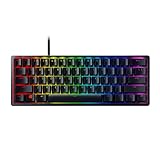
The Razer BlackWidow V3 TKL with Yellow mechanical switches is aimed at buyers who want a tenkeyless layout and smooth key travel without a tactile bump. Those two choices matter more to its everyday suitability than the lighting: the smaller layout changes how you arrange your desk, while the switches determine whether you get the physical feedback you prefer when typing.
This review analyzes the supplied retailer specifications rather than hands-on testing. It covers the Classic Black, Yellow-switch V3 TKL specifically, not another BlackWidow generation or switch variant. Its strongest case is for someone who wants a compact gaming-and-typing keyboard and is comfortable relying on Razer software for advanced input features. Buyers seeking pronounced tactile feedback should look elsewhere.
The specifications that shape the decision
| Model and configuration | Razer BlackWidow V3 TKL, Yellow mechanical switches |
|---|---|
| Layout | Tenkeyless |
| Switch feel | Linear travel without tactile feedback; sound dampeners |
| Actuation point | Listed at 1.2 mm |
| Lighting | Individually backlit Chroma keys; 16.8 million supported colors |
| Remapping | Razer Hypershift key and key-combination remapping |
| Directional input feature | Snap Tap through Synapse 4; disabled by default |
| Construction and endurance | Metal top plate; advertised endurance up to 80 million clicks |
| Listed dimensions | 14.26 × 6.1 × 1.62 inches |
| Listed weight | 1.85 pounds |
| Connection details | Interface, cable length and cable detachability not specified in the supplied evidence |
Yellow switches favor smooth travel over confirmation
The defining feature here is the Yellow switch. Razer describes a 1.2 mm actuation point, no tactile feedback and integrated sound dampeners. That combination suggests a keyboard for users who prefer uninterrupted travel rather than a bump marking the input. The actuation figure identifies where a press registers; it does not establish the force needed to press the key or the complete travel distance. Neither of those details is supplied.
For typing, the tradeoff is feedback rather than a simple faster-or-slower verdict. A writer who uses a tactile bump as confirmation may find this configuration less informative under the fingers. Someone who dislikes that interruption may prefer the smoother action. The early actuation point also makes deliberate finger placement worth considering if you tend to rest heavily on keys, although accidental-input behavior cannot be established from the specification alone.
The dampeners are a useful design detail for buyers concerned about sound, but they are not evidence that the whole keyboard is silent. The listing provides no acoustic measurements, and it does not establish how stabilizers, keycaps or bottoming out affect the result. Treat reduced switch noise as a manufacturer design claim, not a guarantee of suitability for a shared office or an open microphone.
Tenkeyless fit: measure the desk, then consider the work
The TKL layout omits a dedicated number pad. That can be a sensible compromise for a desk where mouse placement matters more than frequent numeric entry. It potentially lets you position the mouse closer to the keyboard than a number-pad-equipped layout would, but whether that improves comfort depends on your seating position and preferred spacing.
Use the listed 14.26-inch width and 6.1-inch depth to check your available surface rather than assuming that compact means it will fit every tray. The listing also gives a height of 1.62 inches, but does not explain adjustable typing angles or wrist-support provision. Those are unresolved points for anyone particularly sensitive to keyboard height. For broader layout and switch-selection considerations, see our gaming keyboard typing guide.
Useful customization, with software boundaries
Razer Hypershift is the listed route to remapping keys and keypress combinations for more complex commands. That makes customization a meaningful part of the product’s appeal, particularly if you want different command access for games and regular applications. However, the evidence does not describe profile capacity, onboard storage or whether customized mappings remain available on a computer without the relevant software. Do not assume portability of settings.
Snap Tap has a clearer software dependency: the listing specifies Razer Synapse 4. It gives priority to the most recent input within an assigned pair of keys and starts disabled. This is an optional input-handling feature, not a change to the Yellow switches’ physical actuation point. Before making it part of your setup, confirm software support on your computer and whether your intended game or competition permits that behavior.
Chroma provides individually backlit keys with a listed palette of 16.8 million colors. The seller also describes synchronization with supported games, Razer hardware, Philips Hue and partner equipment. That is useful for an existing lighting setup, but broad ecosystem support does not confirm compatibility with every device you own. Check specific integrations rather than treating the feature as universal.
Construction claims and the remaining checks
The metal top plate and advertised endurance of up to 80 million clicks support the keyboard’s durability positioning. Neither establishes real-world service life, resistance to spills or how easy repairs will be. The supplied evidence does not specify keycap material or hot-swap support, so this is not a configuration to choose on the assumption that switch replacement is straightforward.
Connection information is another important omission. Confirm the interface, cable arrangement and platform requirements before purchase, particularly for a docking-station setup or a computer with limited ports. These gaps do not demonstrate defects; they limit what can responsibly be promised from this listing.
Verdict
The BlackWidow V3 TKL Yellow-switch configuration makes sense for buyers who want smooth, non-tactile inputs, a number-pad-free footprint and Razer customization. Its main compromises are the missing numeric pad, lack of tactile confirmation and unresolved connection and settings-storage details. Choose it for that combination, not for an assumed promise of silent typing or universally available software features.
Sources: Supplied retailer listing for the Razer BlackWidow V3 TKL Yellow-switch configuration.
Check the exact product and current offer on Amazon