Key takeaways
- Competitive FPS players: 1080p at 240Hz or higher
- All-round gamers: 1440p at 144-180Hz for the best balance
- Immersion and single-player focus: 1440p or higher with strong HDR
What's inside
Choosing a gaming monitor in 2026 can feel overwhelming because the spec sheets are dense and the marketing is loud. Refresh rates now stretch past 240Hz, panel types have multiplied, and dual-mode displays promise QHD and blazing frame rates from the same screen. Cut through the noise and the decision really comes down to a handful of factors that actually change how your games look and feel.
This guide walks you through the specs that matter, the trade-offs between panel types, and how to match a monitor to your GPU and the games you play most. Along the way we will point to real examples across price tiers so you can see how the theory maps onto displays you can actually buy today.
As an Amazon Associate we earn from qualifying purchases at no extra cost to you. Product prices and availability are accurate as of the date shown and are subject to change.




⚡ Save on Your Next PC — Amazon Prime
Prime members get fast free shipping on the systems above, plus early access to Prime Day & Black Friday PC deals. New members get a 30-day free trial.
Watch: How To Choose A Gaming Monitor — Video Review
Refresh Rate vs Resolution: Where to Spend
The core tension in every monitor purchase is refresh rate versus resolution. A higher refresh rate makes motion smoother and gives competitive players an edge, while higher resolution makes everything sharper and more immersive. If you play fast shooters, prioritize refresh rate: something like the Dell 27 240Hz Gaming Monitor (SE2726HG) or the SANSUI 27 Inch Curved 240Hz keeps FHD but pushes frames hard. If you play story-driven or strategy games, a QHD panel like the Samsung Odyssey G5 (G51F) at 180Hz gives you a sharper, roomier picture.
- Competitive FPS players: 1080p at 240Hz or higher
- All-round gamers: 1440p at 144-180Hz for the best balance
- Immersion and single-player focus: 1440p or higher with strong HDR
Understanding Panel Types
Panel technology decides your colors, viewing angles, and contrast. IPS panels, like the one in the Dell SE2726HG, deliver accurate color and wide viewing angles that suit both gaming and creative work. QD-OLED panels, such as the Samsung Odyssey OLED G6 (G61SH), offer near-instant response times and perfect blacks for the most striking image, at a higher price. VA and curved panels like the SANSUI 32 Inch Curved 240Hz trade some viewing-angle consistency for deep contrast and an enveloping feel.
- IPS: best color accuracy and angles, great all-rounder
- QD-OLED/OLED: best contrast and response time, premium pricing
- VA/Curved: strong contrast and immersion, ideal for single-player
Match the Monitor to Your GPU
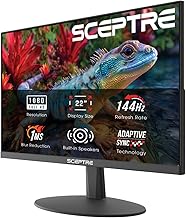
There is no point buying a 240Hz display if your graphics card can only push 90 frames in the games you play. Be honest about your hardware. A mid-range GPU pairs beautifully with a 1080p 144-180Hz panel like the Sceptre 22-Inch 144Hz, letting you hit the refresh ceiling in most titles. A high-end card justifies a 1440p 240Hz or OLED panel, where it can actually feed those extra frames. Adaptive sync tech such as AMD FreeSync, present on the Samsung Odyssey G5 and Dell SE2726HG, smooths out the gap when your frame rate dips.
Size, Curvature, and Desk Space
Screen size should match your viewing distance and desk depth. A 24 to 27-inch screen is the sweet spot for most setups, close enough to take in the whole frame without moving your head. Curved panels like the Samsung Essential S3 (S36GD) 1800R or the SANSUI 27 Inch 1500R wrap the image slightly toward you, which many players find more immersive and easier on the eyes during long sessions. Larger 32-inch curves suit deeper desks and single-player immersion.
- Shallow desk or dual-monitor setup: 22-24 inches
- Most gamers: 27 inches
- Immersion-first, deeper desk: 32 inches, ideally curved
Connectivity and Extras Worth Checking
Before you buy, confirm the monitor has the ports your system needs. DisplayPort 1.4 is the safest route to high refresh rates, while dual HDMI inputs, found on models like the Dell SE2726HG, make it easy to hook up a console alongside your PC. Little touches matter too: height-adjustable stands, black-equalizer modes for spotting enemies in shadows, and low-blue-light settings for eye comfort all improve daily use more than raw numbers suggest.
Frequently Asked Questions
Is 1440p worth it over 1080p in 2026?
For most gamers with a mid-range or better GPU, yes. QHD looks noticeably sharper and gives you more desktop space, and panels like the Samsung Odyssey G5 keep a high 180Hz refresh so you rarely have to choose between clarity and smoothness.
Do I need a curved monitor?
Curved screens are a preference, not a requirement. They add immersion on larger single-player-focused displays like a 32-inch 1500R panel, but for competitive play many pros still prefer flat screens for consistent geometry across the image.
What refresh rate should I aim for?
144Hz is the practical minimum for a modern gaming monitor and feels dramatically smoother than 60Hz. Push to 240Hz only if you play competitive shooters and have a GPU capable of feeding those frames, otherwise the extra cost is wasted.
Does HDR matter on budget monitors?
Entry-level HDR10 support, like the badge on many SANSUI and Samsung models, adds only mild improvement because budget panels lack the brightness for true HDR impact. Treat it as a nice bonus rather than a deciding factor at this price.
Conclusion
The right gaming monitor is the one that matches your GPU, your favorite games, and your desk, not the one with the biggest number on the box. Decide whether refresh rate or resolution matters more to you, pick a panel type that fits your priorities, and confirm the ports and stand suit your space. Get those fundamentals right and any of the displays referenced here will serve you well for years.