Key takeaways
- Fully modular lets you connect only the cables you need, which dramatically cleans up airflow and makes the build easier. Worth it for most people.
- Semi-modular hardwires the essential 24-pin and CPU cables while letting you add the rest, a fine budget compromise.
- Non-modular saves a little money but leaves you stuffing unused cables somewhere, hurting airflow in small cases.
What's inside
- Watch: What PSU Do I Need for Gaming? (2026 Guide) — Video Review
- Start With Total System Wattage, Then Add Headroom
- Understand 80 PLUS Efficiency Ratings
- Match the Connectors to Your Graphics Card
- Choose Modular for Cleaner, Cooler Builds
- Don’t Ignore Warranty and Build Quality
- Tips
- Related Guides
- Frequently Asked Questions
- Conclusion
- Related Articles
- Related Guides
The power supply is the least glamorous part of a gaming PC and the one people most love to cut corners on, which is exactly why it causes so many avoidable problems. A PSU that’s too small, too cheap, or missing the right connectors can cause random shutdowns under load, refuse to power a new graphics card, or in the worst case take other components down with it when it fails. Getting this choice right once means never thinking about it again for a decade.
- Watch: What PSU Do I Need for Gaming? (2026 Guide) — Video Review
- Start With Total System Wattage, Then Add Headroom
- Understand 80 PLUS Efficiency Ratings
- Match the Connectors to Your Graphics Card
- Choose Modular for Cleaner, Cooler Builds
- Don’t Ignore Warranty and Build Quality
- Tips
- Related Guides
- Frequently Asked Questions
- Conclusion
- Related Articles
- Related Guides
This guide explains how to size a power supply for a 2026 gaming build, what the efficiency ratings and ATX 3.1 labels actually mean, and which connectors your GPU needs. By the end you’ll be able to look at any spec sheet and know whether a unit is a confident buy or a corner-cut you’ll regret. The picks below are quality units at the wattages most gaming builds land on.
As an Amazon Associate we earn from qualifying purchases at no extra cost to you. Product prices and availability are accurate as of the date shown and are subject to change.




⚡ Save on Your Next PC — Amazon Prime
Prime members get fast free shipping on the systems above, plus early access to Prime Day & Black Friday PC deals. New members get a 30-day free trial.
Watch: What PSU Do I Need for Gaming? (2026 Guide) — Video Review
Start With Total System Wattage, Then Add Headroom
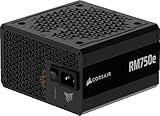
Add up the rated draw of your two hungriest parts, the CPU and GPU, then pad the total with roughly 30 percent of headroom for spikes, other components, and future upgrades. A mainstream RTX 5060 or 5070 build is comfortable on a quality 650-750W unit, which is why something like the CORSAIR RM750e or the MSI MAG A750GL is such a common recommendation. Step up to a high-end card and heavy multitasking and an 850-1000W unit like the CORSAIR RM850e or be quiet! Pure Power 13 M 1000W gives you room to grow without swapping the PSU later.
Understand 80 PLUS Efficiency Ratings
The 80 PLUS badge (Bronze, Gold, Platinum) tells you how much wall power actually reaches your components versus how much is wasted as heat. Gold is the sweet spot for most gamers: noticeably more efficient than Bronze, without the price premium of Platinum. Higher efficiency means less heat, quieter fans, and a slightly lower electric bill over years of use. It is not a measure of how much power the unit can deliver, only how cleanly it delivers it.
Match the Connectors to Your Graphics Card
This is where modern builds trip up. Current GPUs increasingly use the 12V-2×6 connector (the refined successor to 12VHPWR), and you want a native cable rather than a pile of adapters. Look for ATX 3.1 and PCIe 5.1 compliance on the box, like the units listed above advertise, because those standards are built to handle the sharp power spikes that today’s graphics cards demand. A native, properly seated cable is far less likely to overheat than a daisy-chained adapter setup.
Choose Modular for Cleaner, Cooler Builds
- Fully modular lets you connect only the cables you need, which dramatically cleans up airflow and makes the build easier. Worth it for most people.
- Semi-modular hardwires the essential 24-pin and CPU cables while letting you add the rest, a fine budget compromise.
- Non-modular saves a little money but leaves you stuffing unused cables somewhere, hurting airflow in small cases.
Don’t Ignore Warranty and Build Quality
A power supply’s warranty is a direct signal of how much the manufacturer trusts it. Reputable gaming units now ship with 7 to 10 year warranties, and that longevity matters because a good PSU will happily outlive two or three GPU upgrades. Features like 105C-rated capacitors and low-noise or zero-RPM fan modes are the marks of a unit engineered to last rather than to hit a price point.
Tips
- Never buy the cheapest unbranded PSU to save twenty dollars; it is the one component whose failure can damage everything else.
- Buy slightly more wattage than you need today so a future GPU upgrade doesn’t force a PSU replacement too.
- Use the native 12V-2×6 cable that came in the box and push it in until it clicks fully home.
- Check your case’s PSU clearance, since some 1000W units are physically longer and crowd the drive cages.
Frequently Asked Questions
Is a higher-wattage PSU less efficient at low loads?
Modern units are most efficient around 40-60 percent load, so a slightly oversized PSU running your everyday tasks in that band is actually ideal, not wasteful.
What does ATX 3.1 mean and do I need it?
ATX 3.1 is the current standard designed around modern GPU power spikes and the 12V-2×6 connector. For a new 2026 build it’s the connector you want, so yes, prioritize it.
Can one PSU really damage my whole PC?
A failing low-quality unit can send unstable voltage or a surge downstream. High-quality supplies include protection circuits precisely to prevent this, which is why brand and warranty matter so much.
How do I know how many watts my exact build needs?
Add your CPU and GPU rated power, then multiply the total by about 1.3. Online PSU calculators do this automatically if you enter your specific parts.
Conclusion
Sizing a power supply comes down to three things: enough wattage with headroom, a trustworthy efficiency rating, and the right modern connectors for your graphics card. Buy quality once from a reputable brand with a long warranty and you’ll never think about it again, even as you swap GPUs over the years. The units above cover the wattages most gaming builds need and check every box that actually matters.