4 Best Starter Keyboards for New Gamers (November 2026)
Four starter keyboards for new gamers compared: quiet membrane, mecha-membrane and first mechanical picks with spill resistance, wrist rests and simple controls.
The first gaming keyboard is rarely bought for speed. It is bought because the free board that came with a PC feels mushy, misses inputs when three keys are held at once, or lights up nothing in a dark room. The real decision is how much learning curve you want on day one: a soft, quiet board that behaves like the keyboard you already know, or a first mechanical board that asks a little more of your fingers and rewards you with crisper feedback.
This guide is for first-time buyers, parents kitting out a child’s first setup, and laptop players moving to a desk. Every pick below was chosen from the names and specifications on its Amazon product page, with priority given to forgiving switches, spill protection, included wrist support and controls that work without a software degree.
Quick Picks
As an Amazon Associate we earn from qualifying purchases.
Product
Best for
Key spec from title
SteelSeries Apex 3
Quiet rooms and shared spaces
Whisper Quiet switches with IP32 water resistance
Razer Ornata V3
A clicky feel without going mechanical
Low-profile mecha-membrane switches, magnetic wrist rest
Corsair K55 RGB PRO
Beginners who want macro keys early
Six dedicated macro keys, IP42 spill resistance
Logitech G413 SE
A first true mechanical keyboard
Tactile mechanical switches with PBT keycaps
How to Choose
Start With the Switch Feel You Already Like
Switch type decides how a board feels under your fingers, and there is no wrong first answer. Membrane keys are soft, quiet and familiar if you have only used laptop or office keyboards. Mecha-membrane designs add a clicky, tactile snap on top of that soft base. True mechanical switches feel firmer and more precise, with a clear bump or travel you can learn to read. If you type homework or work documents on the same desk, lean membrane or mecha-membrane; if the board is purely for play, a tactile mechanical switch teaches good habits early.
Spill Resistance Matters More Than Lighting Zones
First setups live next to drinks, snacks and younger siblings, so a stated water or dust resistance rating is worth more than extra RGB zones. The Apex 3 lists IP32 water resistance and the K55 RGB PRO lists IP42 dust and spill resistance; both ratings describe protection against everyday accidents, not a licence to pour a drink over the keys. Boards without a rating can still be well built, but when two keyboards cost you the same decision effort, the one that survives a knocked-over glass of water is the safer first buy.
Check Anti-Ghosting and Rollover Before RGB
Gaming keyboards earn their name when several keys register at once: running diagonally while crouching and reloading is already a four-key problem. Listings express this as anti-ghosting or key rollover, and the wording varies from gaming-grade anti-ghosting on the Apex 3 to a stated six-key rollover on the G413 SE. For a starter board, look for anti-ghosting around the WASD cluster at minimum. Per-key lighting and animated effects look great in photos, but they never rescue a missed jump in a platformer.
Layout, Wrist Rests and Media Keys Shape Daily Comfort
All four picks here are full-size boards with number pads, which suits schoolwork and strategy games alike, and three of them include a wrist rest or palm rest in the box. Dedicated or backlit media keys sound minor until you are muting a call or skipping a track mid-match without alt-tabbing. Also check what the listing says about software: some boards need a companion app for macros and lighting, while simpler boards keep every control on the keys themselves. Beginners usually finish setting up the second kind.
The 4 Best Options
SteelSeries Apex 3
Top Pick
SteelSeries Apex 3
Best for: New players in shared rooms who need quiet keys and spill protection.
Switches: Whisper Quiet gaming switches, rated for over 20 million keypresses
SteelSeries sells the Apex 3 as a first step into gaming keyboards, and the listing backs that up with beginner-friendly hardware rather than stripped-back basics. Its Whisper Quiet switches keep late-night sessions from carrying through a bedroom wall, the IP32 water resistance shrugs off the spills that happen around new setups, and the included magnetic wrist rest gives your palms a proper landing spot from day one. Ten-zone RGB lighting and gaming-grade anti-ghosting cover the fun and the function without demanding any configuration before the first match.
Razer Ornata V3
Runner-Up
Razer Ornata V3
Best for: Beginners who want a clicky, tactile feel but are not ready for full mechanical switches.
The Ornata V3 is the bridge board: its mecha-membrane switches fuse the snappy, clicky feedback of a mechanical switch with the soft, cushioned landing of a membrane one, so first-time buyers get character without a harsh bottom-out. Slim low-profile keycaps and shorter switches encourage a flatter, more natural hand position, and the magnetic soft-touch wrist rest supports longer sessions while you are still building playing stamina. UV-coated keycaps resist the shine and fading that show up on starter boards first, and the design is spill-resistant with backlit media keys.
Corsair K55 RGB PRO
Corsair K55 RGB PRO
Best for: New gamers who play strategy or MMO titles and want one-press commands early.
Switches: Quiet, responsive membrane keys
Macro keys: Six dedicated macro keys with Elgato Stream Deck integration
Lighting: Five-zone dynamic RGB backlighting via iCUE
The K55 RGB PRO is the starter board for players who already know they want macros. Six dedicated macro keys sit in their own column, ready for building shortcuts or streaming commands through iCUE or Elgato Stream Deck software, long before most beginners outgrow a basic board. The quiet membrane keys keep the learning curve gentle, the IP42 rating guards against dust and spills, and the detachable palm rest plus dedicated media and volume keys round out a desk-friendly package. Five-zone dynamic RGB backlighting gives you colour to play with without per-key complexity.
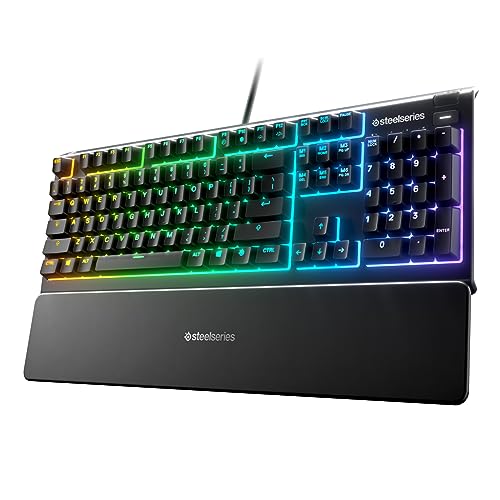
Logitech G413 SE
Logitech G413 SE
Best for: Beginners who type a lot and want one durable mechanical board to grow with.
The G413 SE is the pick for starting directly on mechanical switches and skipping the membrane stage entirely. Its tactile mechanical switches give a crisp, readable bump on every press, while PBT keycaps resist the heat and wear that make cheaper caps shiny within a year. A black-brushed aluminium top case keeps the board rigid when you are hammering movement keys, and white LED backlighting stays clean and readable instead of rainbow. Twelve function-key media controls are printed on the board itself, so nothing essential hides inside software.
Which One Fits Your Situation
You Play in a Bedroom Other People Can Hear
Pick the SteelSeries Apex 3. Its Whisper Quiet switches are the listing feature that matters most here, and the IP32 rating plus magnetic wrist rest make it an easy board to live with while you learn. It is also the most forgiving choice if your setup shares space with homework, siblings or thin walls.
You Are Upgrading From a Laptop Keyboard
Choose the Razer Ornata V3. The low-profile keys and short switch travel feel closer to the laptop board your fingers already know, while the mecha-membrane click adds the feedback laptop keys lack. The magnetic wrist rest helps correct the flat wrist angle laptop typing teaches, which pays off in longer sessions.
Your First Games Are Strategy, Sims or MMOs
Take the Corsair K55 RGB PRO. The six dedicated macro keys give you room to bind build orders, item wheels or push-to-talk from week one, and the quiet membrane action will not fight you while you learn. Its IP42 spill resistance is also the strongest stated protection in this guide.
You Want One Keyboard for School and Play
Go with the Logitech G413 SE. Tactile switches and PBT keycaps suit long typing sessions as much as gaming, the full-size layout keeps the number pad for spreadsheets and maths homework, and the aluminium top case shrugs off daily bag-free desk life. It is the least playful-looking pick and the easiest to justify to parents.
Common Mistakes
Buying a loud clicky mechanical board for a shared room, then playing less because of the noise it makes.
Chasing per-key RGB and macro software before checking basics like anti-ghosting, layout and wrist support.
Ignoring spill resistance on a first setup, where drinks and snacks sit closest to the keyboard.
Choosing a compact layout first, then missing the number pad and arrow key spacing for schoolwork.
Assuming a starter keyboard must be replaced within months; durable keycaps and a rigid case extend its life for years.
Frequently Asked Questions
Is a membrane keyboard good enough for a first gaming keyboard?
Yes, for most new players it is the sensible start. Membrane boards like the Apex 3 and K55 RGB PRO are quiet, forgiving and include gaming features such as anti-ghosting and macro keys. You can always move to mechanical switches later once you know which switch feel you prefer, instead of guessing on your first purchase.
What is a mecha-membrane switch?
It is a hybrid design that pairs a membrane’s soft, cushioned press with a mechanical-style click and tactile snap. The Razer Ornata V3 uses it to give beginners audible, satisfying feedback without the firm bottom-out of a true mechanical switch. Think of it as a middle step between an office keyboard and a gaming mechanical board.
Do I need software to use a starter keyboard?
Not for the basics. Every board here types and plays straight out of the box, and the G413 SE keeps its media controls on function keys. Software such as iCUE, Synapse or SteelSeries GG only becomes necessary when you want to record macros, remap keys or build custom lighting effects, which can wait until you have played for a while.
How long should a starter keyboard last?
Listings give partial clues: the Apex 3 rates its switches for over 20 million keypresses, and the G413 SE uses PBT keycaps that resist shine and wear. In practice, spill protection, a rigid case and keycaps that do not fade decide whether a first board still feels good after a couple of years of daily use.
R
Razer Gaming Series Editorial Team
We compare specs, materials and verified owner reviews before a product earns a spot. Rankings are never paid.
FAQ
Is a membrane keyboard good enough for a first gaming keyboard?
Yes, for most new players it is the sensible start. Membrane boards like the Apex 3 and K55 RGB PRO are quiet, forgiving and include gaming features such as anti-ghosting and macro keys. You can always move to mechanical switches later once you know which switch feel you prefer, instead of guessing on your first purchase.
What is a mecha-membrane switch?
It is a hybrid design that pairs a membrane’s soft, cushioned press with a mechanical-style click and tactile snap. The Razer Ornata V3 uses it to give beginners audible, satisfying feedback without the firm bottom-out of a true mechanical switch. Think of it as a middle step between an office keyboard and a gaming mechanical board.
Do I need software to use a starter keyboard?
Not for the basics. Every board here types and plays straight out of the box, and the G413 SE keeps its media controls on function keys. Software such as iCUE, Synapse or SteelSeries GG only becomes necessary when you want to record macros, remap keys or build custom lighting effects, which can wait until you have played for a while.
How long should a starter keyboard last?
Listings give partial clues: the Apex 3 rates its switches for over 20 million keypresses, and the G413 SE uses PBT keycaps that resist shine and wear. In practice, spill protection, a rigid case and keycaps that do not fade decide whether a first board still feels good after a couple of years of daily use.
Affiliate disclosure. As an Amazon Associate we earn from qualifying purchases at no extra cost to you. Prices accurate as of the date shown.
Compare the best Bluetooth gaming keyboards from ASUS, SteelSeries, Razer, Corsair and Logitech G, with tri-mode connections, switch types and battery life explained.
Find the best wireless phone headsets for hands-free calls. Compare five Bluetooth headsets with call microphones, long talk time, and comfortable all-day fits.
Find the best wired headsets for PS5 with clear chat, Tempest 3D Audio support, and long-session comfort. Compare wired picks for the DualSense controller.
'The best chairs for gaming and have back problems sorted: adjustable lumbar support, ergonomic backrests and seat-depth controls for comfortable sessions.'
The best keyboards for developers combine quiet typing, programmable keys and comfort. See five boards built for long coding sessions and multi-device setups.
Compare the best Nintendo Switch 2 TV docks for big-screen play — cradle, hub, and travel picks with 4K output, charging, and per-generation fit compared.
Compare 5 studio monitor speakers for gaming desks: flat, accurate near-field pairs from KRK, JBL, Edifier, PreSonus, and Mackie, with inputs and desk fit.



 Logitech G413 SE