Key takeaways
- Socket compatibility: Confirm the cooler ships with a bracket for your platform, whether that is AMD AM5/AM4 or Intel LGA1700/1851, before you buy.
- Air vs liquid: Air towers are simpler and maintenance-free, while AIO liquid units move heat away from the socket and often look cleaner in a windowed case.
- Case clearance: Measure the height inside your chassis for air coolers and the radiator space at the top or front for liquid units to avoid a return.
- Noise under load: Look at rated fan RPM and dB figures; slower, larger fans generally move the same air far more quietly than small high-speed spinners.
- Thermal headroom: Match the cooler’s dissipation capacity to your CPU’s power draw, giving yourself margin if you plan to overclock or run heavy workloads.
What's inside
Keeping a modern processor cool is no longer a luxury reserved for extreme overclockers. As we move through 2026, chips from both AMD and Intel push higher boost clocks and pack more cores than ever, which means the stock cooler in the box often struggles to keep temperatures in check under sustained gaming or rendering loads. A capable aftermarket CPU cooler is the single easiest upgrade for quieter operation, more stable clocks, and a longer-lasting build.
This roundup gathers the CPU coolers worth your money in 2026, spanning affordable dual-tower air coolers, whisper-quiet enthusiast blocks, and screen-equipped liquid units that double as a centerpiece. Whether you are cooling a modest six-core CPU or a flagship sixteen-core monster, there is an option here that balances thermal headroom, noise, and price for your particular case and socket.
As an Amazon Associate we earn from qualifying purchases at no extra cost to you. Product prices and availability are accurate as of the date shown and are subject to change.


⚡ Save on Your Next PC — Amazon Prime
Prime members get fast free shipping on the systems above, plus early access to Prime Day & Black Friday PC deals. New members get a 30-day free trial.
Watch: Best CPU Cooler 2026 — Video Review
How to Choose a CPU Cooler
- Socket compatibility: Confirm the cooler ships with a bracket for your platform, whether that is AMD AM5/AM4 or Intel LGA1700/1851, before you buy.
- Air vs liquid: Air towers are simpler and maintenance-free, while AIO liquid units move heat away from the socket and often look cleaner in a windowed case.
- Case clearance: Measure the height inside your chassis for air coolers and the radiator space at the top or front for liquid units to avoid a return.
- Noise under load: Look at rated fan RPM and dB figures; slower, larger fans generally move the same air far more quietly than small high-speed spinners.
- Thermal headroom: Match the cooler’s dissipation capacity to your CPU’s power draw, giving yourself margin if you plan to overclock or run heavy workloads.
The Best CPU Coolers Reviewed
Thermalright Levita Vision 360
This 360mm liquid cooler pairs serious cooling capacity with a 6.67-inch curved magnetic screen at 2400×1080, making it a genuine showpiece. Its building-block splicing fans push strong airflow, and support for AM4, AM5, and Intel LGA1700/1851 covers virtually every mainstream build heading into 2026.
Thermalright Peerless Assassin 120 SE
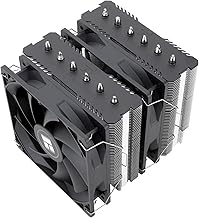
For anyone chasing the best value in air cooling, the Peerless Assassin 120 SE remains hard to beat. Its six AGHP heat pipes and dual 120mm PWM fans deliver cooling that rivals units costing far more, all while staying quiet at its 1550 RPM ceiling.
Noctua NH-D15 chromax.Black
Noctua’s flagship dual-tower cooler is an enthusiast staple for good reason. At 168mm it packs enormous surface area, runs remarkably quietly, and the all-black chromax finish finally lets it disappear into a stealthy build without sacrificing the brand’s legendary reliability.
CORSAIR Nautilus 360 RS ARGB
Corsair’s Nautilus 360 RS is a clean, low-noise AIO with a direct motherboard connection that simplifies cable management and daisy-chaining. The ARGB lighting is tasteful rather than gaudy, and the 360mm radiator gives high-core-count chips plenty of thermal breathing room.
be quiet! Dark Rock Pro 5
True to the brand name, the Dark Rock Pro 5 prioritizes silence, using seven copper heat pipes and a pair of near-silent fans to tame hot CPUs without a whisper. It is the pick for a quiet productivity workstation that still needs to handle heavy sustained loads.
Frequently Asked Questions
Is air or liquid cooling better in 2026?
Both are excellent. High-end air coolers match many 240mm and even 360mm AIOs on raw performance, while liquid units better relocate heat and often suit tight or heavily populated cases. Choose based on clearance, noise goals, and aesthetics.
Do I need a 360mm cooler for a gaming PC?
Not necessarily. A quality dual-tower air cooler or a 240mm AIO handles most gaming chips comfortably. A 360mm unit is worth it for flagship processors, heavy overclocking, or if you want the lowest possible noise floor.
Will these coolers fit my case?
Check two numbers: cooler height for air units against your case’s clearance spec, and radiator length for AIOs against your top or front mounting area. Both are listed in every case and cooler datasheet.
Do I need to apply thermal paste?
Most coolers arrive with paste pre-applied or included in the box, so first-time installs are covered. If you remount later, a fresh pea-sized application of quality paste restores full contact.
Final Thoughts
The right CPU cooler transforms a build, dropping temperatures, silencing fan roar, and unlocking the clocks your processor was designed to reach. For pure value the Thermalright Peerless Assassin 120 SE is unbeatable, the Noctua NH-D15 chromax.Black rewards enthusiasts who want quiet air cooling, and the screen-equipped liquid units bring flair alongside serious performance. Match the cooler to your socket, case, and noise expectations, and your 2026 build will stay cool and composed for years.