Our Short List of 3

- Best for: a beginner, student, or traveller who wants a light, trusted-brand keyboard with touch-responsive keys and a large sound library, and who is happy to add a stand and pedal later.
- 61 touch-responsive piano-style keys
- 400 tones and 77 rhythms
- LCD display and Dance Music Mode
- USB-MIDI connectivity and Chordana Play app support

- Best for: a beginner taking lessons, a parent buying for a child who needs structure, or any player who wants the keyboard itself to help teach.
- 61 touch-responsive keys
- 410 voices, 150 styles, and 122 built-in songs
- Lesson function with quiz mode and Smart Chord
- Recording function and Portable Grand button
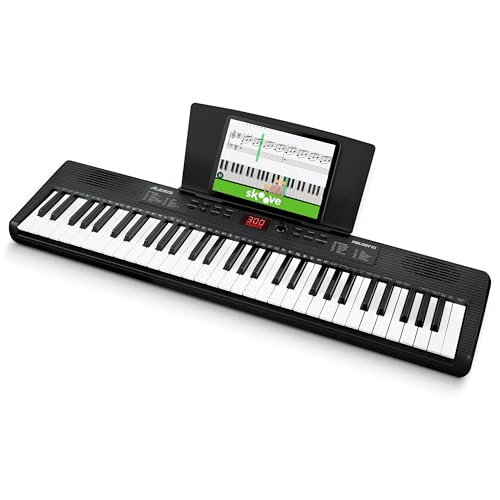
- Best for: a beginner who wants the widest choice of sounds and rhythms in a light, simple keyboard, and who is comfortable learning with app lessons.
- 61 keys with built-in speakers
- 300 sounds and 300 accompaniment rhythms
- Layer mode, split mode, metronome, and record mode
- Tablet and sheet music stand included
All 4 Picks at a Glance
| Product | Specs | Action |
|---|---|---|
| 1. Casio Casiotone CT-S200 — Best Overall Portable Keyboard |
| Check price on Amazon |
| 2. Yamaha PSR-E283 — Best Lesson Features |
| Check price on Amazon |
| 3. Alesis Melody 61 MK4 — Best Sound Library for the Money |
| Check price on Amazon |
 4. RockJam RJ5061 Kit — Best Complete Starter Kit |
| Check price on Amazon |
Our Top Picks
- Yamaha 61-Key Portable Keyboard for Beginners with Learning61-Key12.5 x 37 x 4.1 inches8.8 poundsCheck on Amazon
- RockJam RJ5061 61 Key Keyboard Piano Kit withFull-Size11.2 x 36.8 x 3.1 inches7.3 poundsCheck on Amazon
Learning to play the piano or the electronic keyboard does not have to start with a large instrument or a complicated setup. For many beginners, the smartest first step is a compact, portable musical keyboard with full-size keys, built-in speakers, and enough built-in sounds to keep practice interesting. That is exactly what this guide covers. Every instrument below is a musical keyboard, meaning a piano-style instrument you play with your hands to make music, not a computer accessory. Each one has 61 keys, built-in speakers, a headphone jack for quiet practice, and a sound library large enough to carry a new player through the first year of lessons.
A 61-key range covers most beginner and intermediate repertoire, from simple melodies and chords to two-handed pieces with a left-hand accompaniment. Built-in rhythms let a new player practise keeping time with a backing band, and a portable keyboard that travels to lessons gets played far more often than one that stays in a corner.
Disclosure: As an Amazon Associate, we earn from qualifying purchases.
This guide compares the Casio Casiotone CT-S200, the Yamaha PSR-E283, the Alesis Melody 61 MK4, and the RockJam RJ5061 kit. All four are 61-key portable keyboards aimed squarely at beginners, yet they differ in tones, learning tools, weight, and included accessories.
How to Choose a Musical Keyboard on a Modest Budget
A modest budget still buys a capable instrument when the money goes to the features that matter for learning.
Key count, key size, and touch response
For a first instrument, 61 full-size keys is the sweet spot. It is wide enough for two-handed playing, scales, and most beginner pieces, while the instrument stays light enough to carry and small enough to fit on a desk or a folding stand. Full-size keys matter because the finger spacing, the reach of an octave, and the feel of chords transfer directly to a piano later.
Touch response, sometimes called touch sensitivity, means the keyboard plays louder when you press a key harder and softer when you press gently. It is one of the most important features for learning expression, because dynamics are part of music from the very first lesson. A keyboard without touch response plays every note at the same volume, which teaches flat, mechanical playing. The Casio CT-S200 and the Yamaha PSR-E283 both offer touch-responsive keys. The Alesis Melody 61 MK4 and the RockJam RJ5061 use a simpler key action, which is acceptable for a very first instrument or a younger child, but it is a real trade-off to understand before buying.
Tones, rhythms, and polyphony
Tones are the built-in instrument sounds, such as grand piano, electric piano, organ, strings, and guitar. Rhythms are the accompaniment patterns, such as rock, jazz, waltz, and Latin styles, that play drums and bass behind you. Polyphony is the number of notes the keyboard can sound at once. A 32-note polyphony is workable for simple pieces, while 48 or 64 notes give more headroom when a sustained chord overlaps with a melody and a rhythm track, so check the figure in the comparison table before deciding.
Speakers, headphones, and lesson tools
Built-in speakers make a keyboard ready to play the moment it is switched on, with no extra equipment. A headphone jack is almost essential too, because it lets a beginner practise early in the morning or late at night without disturbing anyone. A first keyboard should also help a new player learn, not just make sound. Look for a built-in lesson function that breaks a song into left-hand and right-hand parts, a quiz mode that pauses until the correct note is played, and compatibility with a learning app on a phone or tablet. The Yamaha PSR-E283 includes a lesson function with a quiz mode, and the RockJam and Alesis kits bundle access to lesson apps and include note stickers that label the keys for the first weeks.
Power, weight, and what is in the box
A keyboard that runs on batteries as well as mains power can be played anywhere, from a garden to a classroom with no spare socket. A keyboard around seven pounds can be carried in one hand, while a heavier instrument tends to stay in one place. Some keyboards ship as a bare instrument with a music rest and a power adapter, while others arrive as a complete kit with an adjustable stand, a bench, headphones, and a sustain pedal. A kit costs more in total, but buying the accessories separately often costs more again. If this is a first instrument or a gift, a complete kit removes every excuse not to start playing on day one. If the player already owns a stand and headphones, a keyboard-only package is the sensible choice. USB-MIDI connectivity is also worth having, because it opens up recording software, virtual instruments, and lesson apps as the player grows.
Top Picks: The Best Keyboards Under 150 Music for Beginners
1. Casio Casiotone CT-S200 — Best Overall Portable Keyboard
- Best for: a beginner, student, or traveller who wants a light, trusted-brand keyboard with touch-responsive keys and a large sound library, and who is happy to add a stand and pedal later.
- 61 touch-responsive piano-style keys
- 400 tones and 77 rhythms
- LCD display and Dance Music Mode
- USB-MIDI connectivity and Chordana Play app support
a beginner, student, or traveller who wants a light, trusted-brand keyboard with touch-responsive keys and a large sound library, and who is happy to add a stand and pedal later.
The Casio Casiotone CT-S200 is the most portable keyboard in this guide and the easiest recommendation for a beginner who wants a trusted brand name in a light, colourful instrument. It has 61 touch-responsive piano-style keys, 400 built-in tones, 77 rhythms, and an LCD display that shows the selected tone, rhythm, and tempo. A built-in carrying handle and a weight of around seven pounds make it genuinely easy to take to a lesson or a friend’s house, and it can run on batteries as well as mains power.
The 400 tones cover grand piano, electric piano, organ, strings, brass, and a wide range of synth sounds, and a dedicated Dance Music Mode lets a player build grooves by pressing keys to trigger drum and bass patterns. The keyboard includes a music rest and a power supply in the box, connects to a computer or tablet over USB-MIDI, and works with the free Chordana Play app for lessons and practice.
Key specifications:
Pros: light and genuinely portable with a built-in handle; touch-responsive keys help a beginner learn dynamics early; very large tone library for the size and weight; Dance Music Mode keeps younger players engaged; USB-MIDI and app support for lessons and recording.
Cons: no sustain pedal included in the basic package; speaker output is modest compared with larger keyboards; the compact control panel can feel crowded at first.
2. Yamaha PSR-E283 — Best Lesson Features
- Best for: a beginner taking lessons, a parent buying for a child who needs structure, or any player who wants the keyboard itself to help teach.
- 61 touch-responsive keys
- 410 voices, 150 styles, and 122 built-in songs
- Lesson function with quiz mode and Smart Chord
- Recording function and Portable Grand button
a beginner taking lessons, a parent buying for a child who needs structure, or any player who wants the keyboard itself to help teach.
The Yamaha PSR-E283 is the strongest teaching instrument in this guide. It has 61 touch-responsive keys, 410 voices, 150 accompaniment styles, 122 built-in songs, and a lesson function that includes a quiz mode. The quiz mode plays a note and asks the player to find it on the keyboard, which turns ear training into a game and builds note recognition faster than passive practice alone. A Smart Chord function lets a beginner play full chords with a single finger, so accompaniment sounds complete from the first week.
Yamaha’s piano voices are the highlight here. The Portable Grand button instantly calls up a clean grand piano sound, and the 410 voices cover pianos, organs, strings, guitars, and world instruments with the polish that has made Yamaha a default recommendation for music teachers. The 150 styles and 122 built-in songs give a beginner real pieces to learn, with separate left-hand and right-hand lesson parts. The PSR-E283 also records a performance so it can be played back and reviewed, runs on batteries or mains power, and includes a music rest and a power adapter in the box.
Key specifications:
Pros: lesson function and quiz mode actively teach note reading and listening; Smart Chord makes accompaniment accessible from the first week; strong piano voices and a wide style library; built-in recording for reviewing practice; auxiliary input for playing along with songs.
Cons: no Bluetooth connectivity; no sustain pedal included in the basic package; the style and song library takes time to explore fully.
3. Alesis Melody 61 MK4 — Best Sound Library for the Money
- Best for: a beginner who wants the widest choice of sounds and rhythms in a light, simple keyboard, and who is comfortable learning with app lessons.
- 61 keys with built-in speakers
- 300 sounds and 300 accompaniment rhythms
- Layer mode, split mode, metronome, and record mode
- Tablet and sheet music stand included
a beginner who wants the widest choice of sounds and rhythms in a light, simple keyboard, and who is comfortable learning with app lessons.
The Alesis Melody 61 MK4 packs an unusually large sound library into a straightforward beginner keyboard. It has 61 keys, 300 built-in sounds, 300 accompaniment rhythms, layer and split modes, a metronome, and a record mode for hearing a practice performance back. Layer mode stacks two sounds, such as piano and strings, while split mode puts a bass sound under the left hand and a lead sound under the right, which gives a single keyboard the feel of a small band.
The included tablet and sheet music stand holds a phone or tablet at eye level for lesson apps. The keyboard weighs around six and a half pounds, so it is easy to move around the house, and it can run on six AA batteries for playing away from a socket. Included lessons through the Skoove and Melodics apps add structure for a self-taught player, and the USB-MIDI connection allows the keyboard to work with recording software on a computer.
Key specifications:
Pros: very large sound and rhythm library for a beginner keyboard; layer and split modes add versatility beyond simple playing; light and easy to carry, with battery power for playing anywhere; included stand for a tablet or sheet music; app lessons included for self-taught players.
Cons: keys are not touch-responsive, so dynamics must come from volume control; speaker sound is functional rather than rich at higher volume; the bundled lesson apps require a separate device.
4. RockJam RJ5061 Kit — Best Complete Starter Kit
- Best for: a gift buyer, a parent, or an adult beginner who wants a complete ready-to-play setup in a single box.
- 61 full-size keys with pitch bend wheel
- 200 tones and 200 rhythms
- LED display and teaching modes
- Complete kit: adjustable stand, padded bench, headphones, note stickers
a gift buyer, a parent, or an adult beginner who wants a complete ready-to-play setup in a single box.
The RockJam RJ5061 is the only complete kit in this guide, and that is its whole appeal. The box contains the 61-key keyboard, an adjustable X-style stand, a padded bench, over-ear headphones, note stickers, and access to Simply Piano lessons. A beginner can unbox it, set the stand to a comfortable height, sit on the bench, put the stickers on the keys, and start the first lesson without buying anything else or waiting for extra deliveries.
The keyboard itself has 61 full-size keys, 200 tones, 200 rhythms, a pitch bend wheel, an LED display, and teaching modes that guide a new player through songs. The pitch bend wheel is a feature the other picks in this guide do not offer, and it lets a player bend notes the way a guitarist bends a string, which is fun for lead playing and for exploring synth sounds. The 200 tones and 200 rhythms are fewer than the Casio or Yamaha offer, but they cover the essentials for a first year of practice.
Key specifications:
Pros: complete kit means nothing else to buy before the first practice; pitch bend wheel adds expressive playing the other picks lack; note stickers and Simply Piano access help a total beginner start fast; very large owner community, so help and tutorials are easy to find; stand and bench included, which saves a separate purchase.
Cons: keys are not touch-responsive; fewer built-in tones than the Casio or Yamaha picks; the stand and bench add bulk, so the kit is less portable than a keyboard alone.
Comparison Table
| Keyboard | Keys | Touch Response | Tones / Voices | Rhythms / Styles | Lesson Tools | In the Box |
|---|---|---|---|---|---|---|
| Casio Casiotone CT-S200 | 61 | Yes | 400 tones | 77 rhythms | Chordana Play app, Dance Music Mode | Keyboard, music rest, power supply |
| Yamaha PSR-E283 | 61 | Yes | 410 voices | 150 styles | Lesson function, quiz mode, Smart Chord | Keyboard, music rest, power adapter |
| Alesis Melody 61 MK4 | 61 | No | 300 sounds | 300 rhythms | Skoove and Melodics app lessons | Keyboard, tablet and sheet music stand |
| RockJam RJ5061 Kit | 61 | No | 200 tones | 200 rhythms | Teaching modes, Simply Piano access | Keyboard, stand, bench, headphones, note stickers |
Frequently Asked Questions
Is 61 keys enough for a beginner?
Yes, for most beginners 61 keys is plenty. It covers five octaves, which is enough for scales, chords, two-handed pieces, and most beginner and intermediate repertoire. A full 88-key piano is wider and heavier, and it is worth considering later, once a player is committed and needs the extra range for advanced pieces. Starting on 61 keys keeps the instrument light and portable.
Do I need touch-responsive keys on a first keyboard?
Touch response is worth having if the budget allows, because it teaches dynamics from the first lesson. A player who can only play at one volume will struggle to make music sound expressive, and relearning dynamics later is harder than learning them from the start. If expressive playing is the goal, choose the Casio CT-S200 or the Yamaha PSR-E283.
What is the difference between tones, voices, and styles?
Tones and voices are the same idea under different brand names: the built-in instrument sounds, such as piano, organ, strings, and guitar. Styles and rhythms are the accompaniment patterns that play drums, bass, and chords behind you while you play the melody. A large tone library gives variety, while a large style library gives backing tracks to practise timing and accompaniment.
Can these keyboards connect to a computer or tablet?
Yes, all four keyboards in this guide offer USB connectivity for connecting to a computer or tablet, which allows them to work with lesson apps and recording software. The Casio CT-S200 works with the Chordana Play app, the Yamaha PSR-E283 supports USB connection for lessons and recording, the Alesis Melody 61 MK4 includes Skoove and Melodics lessons, and the RockJam RJ5061 includes Simply Piano access.
Should I buy a keyboard-only package or a complete kit?
Buy a complete kit if this is a first instrument, a gift, or a setup for a child, because the stand, bench, and headphones are all needed and buying them separately usually adds up to more. The RockJam RJ5061 is the kit pick in this guide. Buy a keyboard-only package if the player already owns a stand and headphones, or if portability matters more than having everything in one box. The Casio CT-S200 is the most portable choice, and a stand can be added later.
Conclusion
The best keyboards under 150 music beginners can buy are the ones that make the first year of practice easy, enjoyable, and structured. The Casio Casiotone CT-S200 is the best all-round choice for a portable, touch-responsive keyboard with a large tone library. The Yamaha PSR-E283 is the best choice for a player who wants the keyboard itself to teach, with its lesson function, quiz mode, and Smart Chord. The Alesis Melody 61 MK4 is the best choice for variety, with 300 sounds and 300 rhythms in a light, simple instrument. The RockJam RJ5061 is the best choice for a complete starter kit, with a stand, bench, headphones, and lessons in a single box.
Whichever pick fits the player, the right next step is the same: set the keyboard up where it will be seen every day, start with short, regular sessions rather than occasional long ones. A modest, well-chosen musical keyboard, played a little every day, will teach more in a year than an expensive instrument that stays in its box. Choose the pick that matches the player in front of you, and let the music start.
FAQ
Is 61 keys enough for a beginner?
Do I need touch-responsive keys on a first keyboard?
What is the difference between tones, voices, and styles?
Can these keyboards connect to a computer or tablet?
Should I buy a keyboard-only package or a complete kit?
More from Amazon
Programs that pair well with the guide above. Offers and eligibility are set by Amazon and may change.
Free shipping on eligible items, Prime Video and more. Eligible new members can start with a free trial.
Start a Prime free trialAd-free music streaming. Eligible new subscribers can start with a free trial.
Try Music Unlimited freeA Prime membership for ages 18-24 with a trial period. Eligibility is set by Amazon.
See Prime for Young AdultsAudiobooks and podcasts to listen to on the go. Eligible new members can start with a free trial.
Try Audible freeAs an Amazon Associate we earn from qualifying purchases.