Key takeaways
- Refresh Rate: For FPS, prioritize 240Hz or higher if your PC can push those frames. 144Hz is solid for casual ranked play, while 240Hz to 300Hz gives a real advantage in tracking and reaction time.
- Response Time & Motion Clarity: Look for 1ms GtG or MPRT with minimal ghosting and good overdrive tuning. A fast IPS panel with effective blur reduction keeps enemies sharp during rapid pans.
- Adaptive Sync: AMD FreeSync Premium or G-Sync Compatible support prevents tearing without adding lag. It is essential if your frame rate fluctuates between 120 and 240 fps.
- Resolution and Size: 1080p on 24.5 inches offers maximum frames and visibility for esports. 27-inch 1080p is more immersive, while 27-inch 1440p adds sharpness but requires more GPU power to maintain high refresh rates.
- Panel Tech and Ergonomics: IPS provides the best color and viewing angles for most players, while VA offers higher contrast. Check for height, tilt, and swivel adjustments plus HDMI 2.0/DisplayPort 1.4 inputs for high-refresh support.
What's inside
In competitive FPS titles like Valorant, Call of Duty, and Apex Legends, your monitor matters as much as your mouse. In 2026, 144Hz is the baseline, but 240Hz and even 300Hz displays have become mainstream for serious players, delivering noticeably smoother motion, clearer enemy tracking, and lower input lag when paired with a capable GPU. The right panel helps you spot targets faster and stay locked on during fast flicks and peeks.
We compared and compared the most relevant 1080p and 1440p gaming monitors for FPS performance this year, focusing on refresh rate, response time, motion clarity, and adaptive sync support. Whether you want pure competitive speed on a 24.5-inch esports panel or a more immersive 27-inch setup that still holds up in ranked play, these are the best gaming monitors for FPS right now.
As an Amazon Associate we earn from qualifying purchases at no extra cost to you.





⚡ Save on Your Next PC — Amazon Prime
Prime members get fast free shipping on the systems above, plus early access to Prime Day & Black Friday PC deals. New members get a 30-day free trial.
Watch: Best Gaming Monitor for FPS — Video Review
How to Choose
- Refresh Rate: For FPS, prioritize 240Hz or higher if your PC can push those frames. 144Hz is solid for casual ranked play, while 240Hz to 300Hz gives a real advantage in tracking and reaction time.
- Response Time & Motion Clarity: Look for 1ms GtG or MPRT with minimal ghosting and good overdrive tuning. A fast IPS panel with effective blur reduction keeps enemies sharp during rapid pans.
- Adaptive Sync: AMD FreeSync Premium or G-Sync Compatible support prevents tearing without adding lag. It is essential if your frame rate fluctuates between 120 and 240 fps.
- Resolution and Size: 1080p on 24.5 inches offers maximum frames and visibility for esports. 27-inch 1080p is more immersive, while 27-inch 1440p adds sharpness but requires more GPU power to maintain high refresh rates.
- Panel Tech and Ergonomics: IPS provides the best color and viewing angles for most players, while VA offers higher contrast. Check for height, tilt, and swivel adjustments plus HDMI 2.0/DisplayPort 1.4 inputs for high-refresh support.
The Best Picks Reviewed
SANSUI 24.5-Inch 300Hz Gaming Monitor
Built for pure competitive play, this 24.5-inch FHD panel hits up to 300Hz with 240Hz compatibility for lower-end systems. The Fast IPS-level response keeps motion crisp at 1ms-class, so strafing targets stay defined and close-range tracking feels more connected. At 1080p, it is much easier to sustain 240+ fps in Valorant and Overwatch 2 compared to 1440p, and the smaller 24.5-inch form factor keeps the entire screen in your field of view without excessive head movement. Ideal if every millisecond counts.
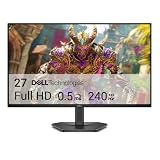
Dell SE2726HG 27-Inch 240Hz Gaming Monitor
The Dell SE2726HG brings 240Hz to a 27-inch FHD IPS display with AMD FreeSync Premium and DisplayPort 1.4 support. You get wide 178-degree viewing angles, consistent color, and TÜV-certified low blue light for longer sessions. The 240Hz refresh paired with 1080p is a sweet spot for FPS players who want a larger screen but still prioritize high frame rates over 1440p sharpness. Tilt adjustment and reliable Dell build quality make it an easy daily driver for ranked and casual play.
SANSUI 27-Inch Curved 240Hz Gaming Monitor
This 27-inch curved option uses a 1500R VA panel with 240Hz, 1ms MPRT, and an impressive 4000:1 contrast ratio with 130% sRGB coverage and HDR support. The curve adds immersion without hurting FPS visibility, and the VA contrast helps spot enemies in dark corners on maps like Search and Destroy. FreeSync keeps tearing in check, and the included HDMI and DisplayPort cables plus a sturdy metal stand mean you can hit 240Hz out of the box. A strong pick if you want immersion and speed in one package.
Samsung 27-Inch Odyssey G5 (G51F) QHD Gaming Monitor
If you prefer sharpness alongside speed, the Odyssey G5 G51F delivers QHD 2560×1440 at up to 180Hz on a 27-inch panel. The extra pixel density makes distant targets easier to identify in battle royale titles, while the higher refresh still feels fluid for competitive play. It is more demanding on your GPU than 1080p 240Hz models, so pair it with a mid-range or better graphics card to maintain 140+ fps. Best for players who split time between FPS and story-driven or tactical games where image clarity matters.
GIGABYTE GS25F2A 24.5-Inch SuperSpeed IPS Gaming Monitor
The GIGABYTE GS25F2A focuses on esports essentials: a 24.5-inch FHD SuperSpeed IPS panel with up to 200Hz-class refresh, 1ms response, and FreeSync support. IPS ensures accurate colors and fast pixel transitions with minimal smearing, which helps with recoil control and micro-adjustments. The compact size and thin bezels are ideal for dual-monitor setups or small desks where you want your crosshair centered and everything within eye scan range. A no-nonsense competitive choice that nails the fundamentals.
Frequently Asked Questions
Is 240Hz really worth it over 144Hz for FPS games?
Yes, if your system can consistently deliver over 180 fps. Going from 144Hz to 240Hz reduces frame persistence from 6.9ms to 4.1ms, which makes enemy movement smoother and tracking slightly easier. Most players notice improved clarity in fast strafe duels, though the jump is smaller than 60Hz to 144Hz.
Should I choose 1080p or 1440p for competitive FPS?
1080p is still king for pure performance because it is easier to drive at 240Hz to 300Hz, lowering input lag and keeping motion sharp. Choose 1440p if you have a powerful GPU and value sharper distant detail, but expect to trade some peak frame rate unless you lower settings.
Are curved monitors good for FPS?
A gentle 1500R curve on a 27-inch display can be comfortable and immersive without distorting aim. For hyper-competitive players, flat 24.5-inch panels are usually preferred for minimal distortion and full-screen awareness, while curved 27-inch models are fine for most ranked players.
What response time and panel type should I look for?
Aim for 1ms GtG or 1ms MPRT with a well-tuned overdrive. Fast IPS is the safest all-rounder for FPS with good color and speed, while modern VA has improved greatly in response and offers better contrast. Always enable FreeSync or G-Sync Compatible to avoid tearing.
Final Thoughts
For outright competitive advantage, the SANSUI 24.5-Inch 300Hz Gaming Monitor is hard to beat on speed and focus, while the Dell SE2726HG 27-Inch 240Hz Gaming Monitor offers the best balance of size, IPS clarity, and 240Hz fluidity for most FPS players. If you want higher resolution without sacrificing too much smoothness, the Samsung Odyssey G5 QHD is the versatile alternative that bridges esports and immersion.