Key takeaways
- 40mm TriForce drivers split the driver into separate zones for highs/mids and lows, which gives tighter footstep and gunshot detail in competitive FPS titles. They’re used in most of Razer’s esports-focused headsets.
- 50mm TriForce drivers add more low-end headroom, so explosions, music, and movie dialogue feel fuller. They show up in the higher-end multiplatform sets aimed at mixed gaming/media use.
What's inside
- Step 1: Match driver size to how you actually listen
- Step 2: Work out your real comfort budget, not just the weight number
- Step 3: Pick pad material based on glasses and climate, not looks
- Step 4: Confirm your wireless protocol actually works with your platform
- Decision matrix: putting it together
- What price range gets you what
- Quick pre-purchase checklist
Match the headset to three things, in this order: your platform’s wireless protocol, your session length (which decides driver size and clamp force), and whether you wear glasses (which decides pad material). Get those three right and the rest of the spec sheet is just preference.
- Step 1: Match driver size to how you actually listen
- Step 2: Work out your real comfort budget, not just the weight number
- Step 3: Pick pad material based on glasses and climate, not looks
- Step 4: Confirm your wireless protocol actually works with your platform
- Decision matrix: putting it together
- What price range gets you what
- Quick pre-purchase checklist
Step 1: Match driver size to how you actually listen
Razer’s TriForce drivers come in 40mm and 50mm versions, and the difference isn’t just “bigger is better.” It’s a tuning choice.

Razer BlackShark V2 X Gaming Headset: 7.1 Surround Sound - 50mm Drivers - Memory Foam Cushion - For PC, PS4, PS5, Switch - 3.5mm Audio Jack - Black
Included for 'Razer Gaming Headset Buying Guide: Drivers, Fit, and Wireless Explained' because the listing specifies 50mm Drivers and Memory Foam Cushion, details this guide uses to compare options.
View on Amazon
Razer BlackShark V3 X HyperSpeed Wireless PC Gaming Headset, Black
Included for 'Razer Gaming Headset Buying Guide: Drivers, Fit, and Wireless Explained' because the listing specifies Black, details this guide uses to compare options.
View on Amazon
Razer BlackShark V3 Pro Wireless ANC Gaming Headset for PC, Black
Included for 'Razer Gaming Headset Buying Guide: Drivers, Fit, and Wireless Explained' because the listing specifies Black, details this guide uses to compare options.
View on Amazon
Razer Kraken V4 Pro Wireless Gaming Headset w/OLED Control Hub
Included for 'Razer Gaming Headset Buying Guide: Drivers, Fit, and Wireless Explained' as a relevant option in this category; details come from the product listing.
View on Amazon- 40mm TriForce drivers split the driver into separate zones for highs/mids and lows, which gives tighter footstep and gunshot detail in competitive FPS titles. They’re used in most of Razer’s esports-focused headsets.
- 50mm TriForce drivers add more low-end headroom, so explosions, music, and movie dialogue feel fuller. They show up in the higher-end multiplatform sets aimed at mixed gaming/media use.
If 80%+ of your time is ranked matches, the 40mm tuning will actually serve you better despite the smaller number on the spec sheet. If you split time between gaming, Spotify, and Netflix, the 50mm driver’s bass extension is worth the trade.
Step 2: Work out your real comfort budget, not just the weight number
Weight alone doesn’t predict comfort, clamp force does. A 340g headset with low clamp force can be more comfortable than a 300g headset clamping hard on your temples. Here’s the actual math gamers skip:
Clamp force on Razer headsets generally sits in the 4.5N to 6N range (newtons of inward pressure measured at the ear cups). Below 5N, the headset feels loose during fast head turns but won’t create pressure headaches. Above 5.5N, it stays locked during movement but will start causing temple soreness past the 2-hour mark for most head shapes, and that soreness compounds roughly linearly, so a 4-hour session with a 5.8N headset will hurt noticeably more than double a 2-hour session, not just twice as much.
Combine that with weight using this rough framework:
| Weight range | Clamp force | Realistic comfortable session |
|---|---|---|
| 300-315g | 4.5-5.0N | 5-6+ hours |
| 315-330g | 5.0-5.5N | 3-4 hours |
| 330-345g | 5.3-6.0N | 2-3 hours |
If you game in blocks under 2 hours, any of these ranges will feel fine and you can prioritize sound signature instead. If you’re doing 4+ hour sessions regularly, stay in the first row and don’t let a flashy driver spec talk you out of it.
Step 3: Pick pad material based on glasses and climate, not looks
Razer ships two main pad types across its lineup, and this decision matters more than most buyers expect.
- Memory foam pads seal tightly against the head, which boosts passive noise isolation and bass response. The trade-off is heat retention; expect noticeably warmer ears past 90 minutes in a warm room, and they create a pressure point for glasses arms since there’s no give.
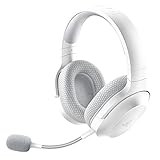
- FlowKnit (or similar breathable fabric) pads trade a bit of bass seal and isolation for airflow. They run measurably cooler over long sessions and the fabric has enough flex to avoid pinching glasses arms the way dense foam does.
Decision rule: if you wear glasses or game in a room without AC, go FlowKnit even if it means a slightly thinner bass response. If you’re in a cool room, prioritize isolation (competitive play, shared living spaces), and don’t wear glasses, memory foam is the better pick.
Step 4: Confirm your wireless protocol actually works with your platform
This is where most buyers lose money, buying a headset whose wireless mode is locked out on their main platform.
Razer uses two different wireless systems and they are not interchangeable:
- HyperSpeed 2.4GHz uses a USB dongle and a proprietary low-latency link. Measured latency sits around 25-40ms round trip in Razer’s own figures for this class of connection, which is low enough that most players can’t distinguish it from a wired connection in gameplay.
- Bluetooth (typically 5.0-5.3 on current Razer headsets) is dongle-free and works with phones/tablets, but standard Bluetooth audio codecs add roughly 100-200ms of latency depending on codec, which is audible as a slight lip-sync delay in video and a real disadvantage in fast-paced shooters.
Worked example: at 144Hz, one frame is about 6.9ms. A 150ms Bluetooth delay is the equivalent of hearing a footstep roughly 21 frames late. On HyperSpeed at 30ms, that’s about 4 frames late. That gap is why competitive players treat Bluetooth as a “watching Netflix on the couch” mode, not a ranked-match mode.
Platform compatibility: what actually connects where
| Platform | HyperSpeed 2.4GHz dongle | Bluetooth | Wired (3.5mm/USB) |
|---|---|---|---|
| PC (Windows) | Yes, full support | Yes | Yes |
| PlayStation 5 | Yes, on dongle models labeled PS compatible | No (Sony blocks standard BT audio) | Yes |
| Xbox Series X/S | Only on headsets with Xbox-licensed dongle variants | No native BT audio support | Yes, via controller 3.5mm jack |
| Nintendo Switch | Rare, check model-specific support | Switch 2 adds limited BT audio support | Yes |
| Mobile/Tablet | No | Yes | Yes, with 3.5mm adapter |
The practical takeaway: if PlayStation or Xbox is your main platform, don’t buy based on a headset’s Bluetooth spec, check specifically for a console-licensed 2.4GHz dongle or just plan to go wired. Generic “wireless” marketing copy on a box doesn’t tell you which consoles that wireless mode actually unlocks.
Decision matrix: putting it together
| Your situation | Driver | Pad | Connection |
|---|---|---|---|
| Competitive FPS, PC, short sessions | 40mm TriForce | Memory foam | HyperSpeed 2.4GHz |
| Mixed gaming/movies/music | 50mm TriForce | Either, foam if cool room | HyperSpeed or wired |
| 4+ hour sessions, any genre | Either | FlowKnit | HyperSpeed 2.4GHz |
| Glasses wearer | Either | FlowKnit | Either |
| Console-primary (PS5/Xbox) | Either | Either | Console-licensed 2.4GHz dongle or wired |
| Mobile/tablet secondary use | Either | Either | Bluetooth acceptable (non-competitive) |
What price range gets you what
Entry-level wired or Bluetooth Razer headsets usually run $50-$100 and cover basic driver quality without HyperSpeed or premium pad swaps. Mid-range HyperSpeed models with swappable pads and 40mm/50mm TriForce drivers typically land in the $100-$180 range. Flagship wireless sets with extended battery life, premium DACs, and spatial audio processing usually run $180-$250. You don’t need the top tier to get HyperSpeed latency or FlowKnit pads; those features show up starting in the mid-range.
Quick pre-purchase checklist
- Confirm the exact wireless mode (HyperSpeed vs Bluetooth) your main platform supports before checking out
- If sessions regularly exceed 3 hours, filter by clamp force and weight first, driver size second
- Glasses wearers should default to FlowKnit or similar fabric pads regardless of other specs
- Don’t rely on Bluetooth for competitive timing-sensitive games; treat it as a casual/media mode only
- Check for a console-licensed dongle variant specifically if you’re on PS5 or Xbox, not just a “wireless” label