Key takeaways
- Polycarbonate: Usually the softest common plate option, with a lower-pitched sound and more noticeable flex.
- FR4: A balanced material that is less rigid than aluminum and often gives a slightly textured, less metallic sound.
- Aluminum: Stiffer and more controlled, with a sharper attack and a more solid feel.
- Brass: Very stiff and heavy, often emphasizing a bright, firm bottom-out rather than a cushioned one.
- Steel: Stiff and resonant; it can feel energetic but may transmit more vibration into the case.
The best gasket mount keyboards for gaming are the Keychron Q1 Max for wireless flexibility, the MonsGeek M1W for value and customization, the GMMK Pro for a dense premium build, and the NuPhy Halo75 V2 for a compact gaming-and-work setup.
Gasket mounting suspends the plate and PCB with strips or tabs of compressible material instead of fastening the plate rigidly to the case. That can reduce sharp bottom-out impact, add controlled key flex, and produce a deeper sound. It does not automatically make a keyboard faster: gaming performance still depends mainly on switch actuation, firmware, polling, rollover, and connection stability.

Redragon K745 PRO Wireless 108-Key Gasket RGB Gaming Keyboard, 4 Hotkeys
Included for 'Best Gasket Mount Keyboards for Gaming' because the listing specifies 4 Hotkeys, details this guide uses to compare options.
View on Amazon
Redragon K719 PRO Wireless 95-Key Gasket Gaming Keyboard, TFT Screen & Knob
Included for 'Best Gasket Mount Keyboards for Gaming' because the listing specifies TFT Screen & Knob, details this guide uses to compare options.
View on Amazon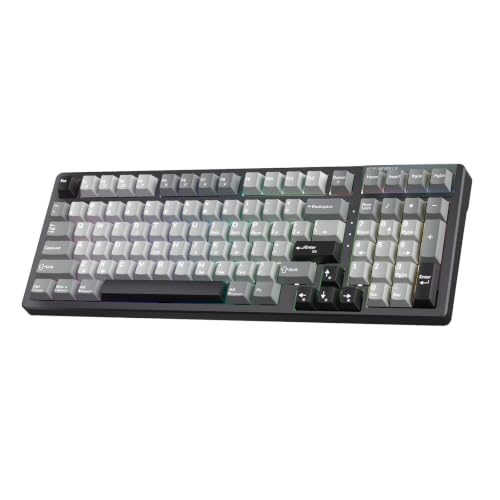
KEMOVE K98E Mechanical Gaming Keyboard | Gasket Mount, QMK/VIA, Gray
Included for 'Best Gasket Mount Keyboards for Gaming' because the listing specifies Gasket Mount and QMK/VIA, details this guide uses to compare options.
View on AmazonQuick comparison: the best gasket mount keyboards
| Keyboard | Layout | Connection | Mount and plate traits | Best for | Typical market range |
|---|---|---|---|---|---|
| Keychron Q1 Max | 75% | 2.4 GHz, Bluetooth, USB-C | Gasket mount; aluminum case; hot-swappable PCB | Wireless gaming and broad customization | Usually $180–$220 |
| MonsGeek M1W | 75% | 2.4 GHz, Bluetooth, USB-C | Gasket mount; aluminum case; hot-swappable PCB | Value-focused enthusiasts | Usually $100–$150 |
| Glorious GMMK Pro | 75% | USB-C | Gasket mount; CNC aluminum case; replaceable plates | Heavy, solid desk setups | Usually $130–$200, depending on configuration |
| NuPhy Halo75 V2 | 75% | 2.4 GHz, Bluetooth, USB-C | Gasket-style construction; hot-swappable PCB | Compact gaming, office use, and portability | Usually $120–$160 |
| Keychron Q2 Max | 65% | 2.4 GHz, Bluetooth, USB-C | Gasket mount; aluminum case; hot-swappable PCB | Players who want arrow keys without a function row | Usually $180–$220 |
Prices vary with keycaps, switches, regional availability, and sales. These keyboards are not identical internally, so “gasket mount” should be treated as a starting point rather than a complete quality rating.
How gasket materials change the typing and gaming feel
Poron foam
Poron is a common choice because it compresses easily and rebounds gradually. It usually produces a softer bottom-out and a slightly muted sound. On a keyboard with a stiff aluminum plate, Poron gaskets can add useful cushioning without making the board feel unstable.
Silicone
Silicone gaskets are generally denser and more elastic. They can feel more controlled and less mushy than very soft foam, while still isolating the plate from the case. Silicone is a good match for users who want some flex but prefer a more planted gaming feel.
EPDM and rubber
Rubber-like materials such as EPDM can provide strong isolation and durability. Their actual feel depends heavily on thickness, hardness, and how tightly the case compresses them. A nominally soft gasket can feel stiff if the case leaves almost no room for movement.
The important specification is not only the gasket material. Gasket location, compression, plate thickness, case tolerances, and whether the plate is cut around the alphanumeric area all influence flex. Two keyboards labeled “gasket mount” can therefore feel completely different.
Plate flexibility: soft is not always better for games
The plate holds the switches in position. A flexible plate allows more movement when you press keys, while a stiff plate keeps every keystroke crisp and consistent. For gaming, moderate flex is usually the safer target.
- Polycarbonate: Usually the softest common plate option, with a lower-pitched sound and more noticeable flex.
- FR4: A balanced material that is less rigid than aluminum and often gives a slightly textured, less metallic sound.
- Aluminum: Stiffer and more controlled, with a sharper attack and a more solid feel.
- Brass: Very stiff and heavy, often emphasizing a bright, firm bottom-out rather than a cushioned one.
- Steel: Stiff and resonant; it can feel energetic but may transmit more vibration into the case.
For rapid movement keys such as W, A, S, and D, excessive flex can feel less precise if the board bottoms out unevenly. If you prefer a softer board, choose a moderate-flex plate and medium-force linear switches rather than stacking an extremely soft plate, very soft gaskets, and light switches together.
Sound profile: what creates the difference
Gasket mounting commonly lowers case vibration, but sound still comes mostly from the switch, keycap, plate, and internal cavity. A deep sound is not necessarily quieter, and a quiet keyboard is not necessarily soft.
- Linear switches with thick PBT keycaps: Often produce a smooth, lower-pitched sound with fewer scratchy interruptions.
- Tactile switches: Add a noticeable bump and a sharper sound at the point of actuation.
- Clicky switches: Add a deliberate click jacket and are usually the least suitable choice for shared spaces.
- Case foam: Reduces hollow resonance, but too much foam can remove character and make the board feel acoustically flat.
- Polycarbonate plates: Usually soften the attack compared with aluminum or brass.
- Long-pole switches: Often create a more pronounced, higher-energy bottom-out, even inside a muted gasket case.
Do not choose a keyboard solely because a product page calls it “thocky.” Sound is affected by desk material, keycap thickness, switch lubrication, stabilizer tuning, and room acoustics.
Switch compatibility matters more than the gasket label
Most recommended custom-style gasket keyboards use hot-swappable PCBs compatible with MX-style three- or five-pin switches. That covers the majority of modern mechanical switches, including many linear, tactile, and clicky options. Check the exact PCB before buying: some sockets accept five-pin switches directly, while others require clipping the extra plastic legs.
For gaming, start with these practical ranges:
| Switch preference | Useful starting specification | Why it works |
|---|---|---|
| Light linear | 40–50 gf operating force | Quick repeated presses and low fatigue, but easier to actuate accidentally |
| Medium linear | 50–60 gf operating force | Good balance of speed, control, and resistance to accidental presses |
| Light tactile | 45–55 gf operating force | Provides confirmation without a very heavy bump |
| Heavy tactile | 60 gf or more | Strong key-position feedback, but potentially more tiring in long sessions |
A hot-swap socket makes experimentation easy, but it does not make every switch compatible. Hall-effect switches require a compatible magnetic-sensing PCB and cannot simply be inserted into a conventional MX hot-swap board. If adjustable actuation or rapid-trigger features are your priority, look for a purpose-built Hall-effect keyboard rather than a conventional gasket board.
Which keyboard should you choose?
| Your situation | Best fit | Reason |
|---|---|---|
| You use wireless peripherals and want a full enthusiast feature set | Keychron Q1 Max | Offers 2.4 GHz wireless, Bluetooth, a 75% layout, and extensive customization. |
| You want the lowest-cost route to an aluminum gasket board | MonsGeek M1W | Combines a substantial case, wireless options, and hot-swap support at a lower typical price. |
| You prioritize weight and a dense, premium desk feel | GMMK Pro | Its aluminum construction and replaceable plate options support a more rigid, planted setup. |
| You move between gaming and laptop use | NuPhy Halo75 V2 | Its compact format and multi-mode connectivity suit portable setups. |
| You rarely use the function row | Keychron Q2 Max | The 65% layout retains arrow keys while freeing desk space. |
Build quality checks that specifications miss
Before buying, inspect the details that determine whether the board remains pleasant after months of use:
- Stabilizers: Large keys should not rattle, tick, or bind when pressed near an edge.
- Gasket seating: Gaskets should remain captured during assembly instead of sliding out of position.
- Plate clearance: The plate should not scrape the case when you press hard near the edges.
- PCB support: A gasket board with too few support points can flex unevenly, especially under the space bar and modifier keys.
- Wireless behavior: Check whether the 2.4 GHz receiver has a stable location and whether wired mode supports the advertised polling rate.
- Firmware: Remapping support, macro behavior, and reliable keymap software matter more than decorative lighting for gaming.
As a simple wireless planning example, a 1,000 mAh battery contains roughly 3.7 Wh at a nominal 3.7 V. If a keyboard averages 0.37 W with moderate lighting, its ideal runtime is about 10 hours: 3.7 Wh ÷ 0.37 W = 10 hours. Real runtime will be lower because of conversion losses, wireless overhead, and brightness changes. Turning off RGB can produce a much larger gain than choosing between two similar gasket materials.
Final verdict
Choose the Keychron Q1 Max if you want the most versatile all-rounder, the MonsGeek M1W for value, the GMMK Pro for a heavy premium build, and the NuPhy Halo75 V2 for compact multi-device use. Whichever model you select, match the plate stiffness and switch force to your playing style: a moderate-flex gasket board with compatible hot-swap sockets is usually more useful than the softest possible build.