Key takeaways
- Image sharpness: 4K packs roughly twice the pixels of 1440p for crisper detail, while 1440p still looks sharp at typical desktop sizes.
- GPU demand: 1440p is far easier to drive at high frame rates, whereas 4K requires a powerful, expensive graphics card for smooth play.
- Refresh rate: 1440p panels commonly hit very high refresh rates affordably, while high-refresh 4K displays cost more and stress the GPU harder.
- Price: 1440p monitors and the GPUs to run them cost less overall, whereas a 4K setup raises both the monitor and graphics budget.
- Best use-case: 1440p favors competitive and fast-paced gaming, while 4K rewards immersive single-player titles, media, and productivity.
- Scaling & text: 4K offers superb text clarity and desktop space, while 1440p keeps scaling simple and native-friendly.
What's inside
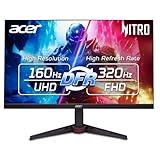
Resolution is the defining choice of any gaming monitor purchase, and in 2026 the real debate is 1440p versus 4K. A 1440p panel like the Samsung Odyssey G5 pairs sharp detail with high refresh rates that today’s GPUs can actually sustain, while a 4K display such as the Acer Nitro 4K 160Hz or Dell S2725QS delivers stunning pixel density that demands far more graphics horsepower to drive smoothly.
This matters because resolution dictates not just how your games look but how much GPU you need to buy and how many frames you’ll see. Pick the resolution that matches your graphics card and your priorities and you get a balanced, satisfying experience; pick wrong and you’ll either starve a powerful GPU or ask a mid-range card to do the impossible.
As an Amazon Associate we earn from qualifying purchases at no extra cost to you. Product prices and availability are accurate as of the date shown and are subject to change.


⚡ Save on Your Next PC — Amazon Prime
Prime members get fast free shipping on the systems above, plus early access to Prime Day & Black Friday PC deals. New members get a 30-day free trial.
Watch: 1440p vs 4K Gaming Monitor: 2026 Guide — Video Review
Quick Verdict
Choose 1440p if you want high, consistent frame rates on a mainstream-to-high-end GPU and value smoothness in fast games; a 180Hz panel like the Samsung Odyssey G5 is the mainstream sweet spot. Choose 4K if you own a top-tier GPU and prioritize maximum sharpness for cinematic single-player games, media, and desktop work, using a high-refresh option like the Acer Nitro 4K.
Key Differences
- Image sharpness: 4K packs roughly twice the pixels of 1440p for crisper detail, while 1440p still looks sharp at typical desktop sizes.
- GPU demand: 1440p is far easier to drive at high frame rates, whereas 4K requires a powerful, expensive graphics card for smooth play.
- Refresh rate: 1440p panels commonly hit very high refresh rates affordably, while high-refresh 4K displays cost more and stress the GPU harder.
- Price: 1440p monitors and the GPUs to run them cost less overall, whereas a 4K setup raises both the monitor and graphics budget.
- Best use-case: 1440p favors competitive and fast-paced gaming, while 4K rewards immersive single-player titles, media, and productivity.
- Scaling & text: 4K offers superb text clarity and desktop space, while 1440p keeps scaling simple and native-friendly.
1440p: The High-Refresh Sweet Spot
1440p has earned its reputation as the gaming sweet spot because it balances everything that matters. It’s noticeably sharper than 1080p yet light enough on the GPU that a mainstream-to-high-end card can push well over 100fps, and panels like the Samsung Odyssey G5 deliver 180Hz smoothness without a flagship graphics budget.
It’s ideal for competitive players and anyone who prizes fluid motion in fast shooters and racers. You get high frame rates, lower cost across both monitor and GPU, and plenty of detail for immersive games too. If you want the most responsive, best-value gaming experience in 2026, 1440p is the resolution most players should choose.
4K: Maximum Detail for Powerful Rigs
4K is the choice for players who want the sharpest possible image and have the GPU to back it up. With around twice the pixels of 1440p, panels like the Acer Nitro 4K 160Hz and Dell S2725QS render cinematic single-player worlds, media, and detailed desktop work with breathtaking clarity, and modern upscaling helps GPUs keep frame rates high.
The requirement is real horsepower: to enjoy 4K at high refresh you need a top-tier graphics card, and the whole setup costs more. It also doubles as a superb productivity and media display thanks to its space and text sharpness. For enthusiasts with a strong GPU who value fidelity over maximum frames, 4K is the premium destination.
Which Should You Buy?
- For competitive and fast-paced gaming: pick 1440p because it delivers the high, steady frame rates that fast games reward.
- For a mainstream or high-end GPU: pick a 180Hz 1440p panel like the Samsung Odyssey G5 because it matches the card’s output perfectly.
- For immersive single-player and cinematic games: pick 4K because its detail makes rich worlds shine.
- For a flagship GPU and maximum fidelity: pick a high-refresh 4K display like the Acer Nitro 4K because it fully uses that power.
- For gaming plus serious productivity and media: pick 4K because its sharpness and screen space benefit work as much as play.
Frequently Asked Questions
Is 4K worth it for gaming in 2026?
It is if you own a top-tier GPU and prioritize sharpness in single-player games; otherwise 1440p gives smoother frames for far less money.
What GPU do I need for 1440p versus 4K?
A solid mainstream-to-high-end card handles high-refresh 1440p comfortably, while smooth high-refresh 4K demands a flagship-class GPU and often upscaling.
Will 1440p look blurry next to 4K?
No, 1440p is sharp at common monitor sizes; 4K is visibly crisper up close, but the difference is subtle during fast gameplay.
Which resolution is better for competitive esports?
1440p, because it sustains the high frame rates and refresh that competitive play rewards without overtaxing your graphics card.
Final Verdict
For most gamers in 2026, 1440p at a high refresh rate, like the Samsung Odyssey G5, is the smart, balanced choice that keeps frames high and costs sensible. Step up to 4K, such as the Acer Nitro 4K, only when you have a flagship GPU and crave maximum detail for immersive games and media. Match the resolution to your graphics card and your play style, and either path delivers a great experience.