Key takeaways
- Choose linear switches for quiet, fast gaming and tactile switches for feedback-rich typing.
- Check actuation force in grams to predict whether a switch will feel light or heavy before buying.
- Pick a hot-swappable board if you are unsure, so you can try different switches risk-free.
- Avoid clicky switches in shared or quiet spaces unless everyone nearby tolerates the noise.
What's inside
- Watch: Mechanical Keyboard Switches Explained — Video Review
- The Three Switch Families
- Actuation Force and Travel Distance
- Switches for Gaming Versus Typing
- Hot-Swappable Boards and Custom Switches
- Sound, Stabilizers, and Overall Feel
- Tips
- Related Guides
- Frequently Asked Questions
- Conclusion
- Related Articles
- Related Guides
Ask two mechanical keyboard enthusiasts what the best switch is and you will get two passionate, contradictory answers, because the switch under each key defines how the entire board feels, sounds, and performs. Linear, tactile, or clicky; light or heavy; loud or quiet; the choice shapes everything from your typing accuracy to whether your roommate can sleep through a late-night raid. For newcomers, the terminology can feel impenetrable.
- Watch: Mechanical Keyboard Switches Explained — Video Review
- The Three Switch Families
- Actuation Force and Travel Distance
- Switches for Gaming Versus Typing
- Hot-Swappable Boards and Custom Switches
- Sound, Stabilizers, and Overall Feel
- Tips
- Related Guides
- Frequently Asked Questions
- Conclusion
- Related Articles
- Related Guides
This guide demystifies mechanical switches so you can choose with confidence. You will learn the three main switch families, what actuation force and travel actually mean, how switches affect gaming versus typing, and why hot-swappable boards have changed the game for anyone who wants to experiment before committing.
As an Amazon Associate we earn from qualifying purchases at no extra cost to you. Product prices and availability are accurate as of the date shown and are subject to change.





⚡ Save on Your Next PC — Amazon Prime
Prime members get fast free shipping on the systems above, plus early access to Prime Day & Black Friday PC deals. New members get a 30-day free trial.
Watch: Mechanical Keyboard Switches Explained — Video Review
The Three Switch Families
Nearly every mechanical switch falls into one of three types. Linear switches move straight down with no bump, smooth and quiet, favored by many gamers, like the yellow switches in the Razer BlackWidow V4 X. Tactile switches give a noticeable bump at the actuation point, useful feedback for typists. Clicky switches add a sharp audible click on top of that bump, satisfying but loud. Your ideal family depends on whether you value silence, feedback, or sound.
Actuation Force and Travel Distance
Two specs separate a light, fast switch from a deliberate, heavy one. Actuation force, measured in grams, is how hard you must press before the key registers; lighter switches feel effortless for fast gaming, while heavier ones resist accidental presses. Travel distance is how far the key moves. Some gaming-focused boards use shorter or speed switches to register inputs sooner. Understanding these two numbers lets you predict how a switch will feel before you ever type on it.
Switches for Gaming Versus Typing
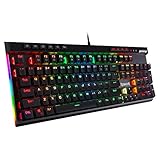
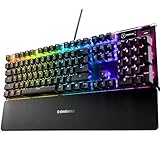
Gamers often prefer light linear switches for rapid, repeated actuation without the interruption of a tactile bump, which is why boards like the Redragon wired mechanical keyboard and Logitech G213 Prodigy lean toward smooth, fast feel. Typists frequently favor tactile switches because the bump confirms each keystroke and reduces errors during long documents. Many hybrid boards, such as the SteelSeries Apex 5, aim to please both camps with balanced switch designs.
Hot-Swappable Boards and Custom Switches
The biggest recent shift is hot-swappable sockets, which let you pull and replace switches by hand with no soldering. A board like the AULA F75 Pro lets you try linears today and tactiles next month on the same keyboard. This is a huge advantage for anyone unsure of their preference, because it turns an expensive commitment into a low-risk experiment and lets you tune different keys to different switches if you like.
Sound, Stabilizers, and Overall Feel
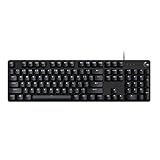
A switch does not act alone. Keycap material, the board’s internal foam, and the stabilizers under larger keys all shape the final sound and feel. The same switch can sound deep and muted in one board and hollow in another. When evaluating a keyboard like the Logitech G413 SE, consider the whole package, not just the switch name, because assembly quality determines whether a great switch reaches its potential.
Tips
- Choose linear switches for quiet, fast gaming and tactile switches for feedback-rich typing.
- Check actuation force in grams to predict whether a switch will feel light or heavy before buying.
- Pick a hot-swappable board if you are unsure, so you can try different switches risk-free.
- Avoid clicky switches in shared or quiet spaces unless everyone nearby tolerates the noise.
Frequently Asked Questions
What is the difference between linear, tactile, and clicky switches?
Linear switches are smooth with no bump, tactile switches have a felt bump at actuation, and clicky switches add an audible click to that bump. The choice comes down to your preference for smoothness, feedback, or sound.
Which switch type is best for gaming?
Many gamers prefer light linear switches because they actuate quickly and smoothly for rapid repeated presses. That said, some players like tactile feedback, so the best type is ultimately personal.
What does actuation force mean?
Actuation force is how much pressure, measured in grams, is needed before a keypress registers. Lower force feels effortless and fast, while higher force resists accidental presses and feels more deliberate.
Are hot-swappable keyboards worth it?
If you are new to mechanical switches or like to experiment, yes. Hot-swap boards let you change switches without soldering, so you can find your preference without buying multiple keyboards.
Conclusion
Understanding switches turns keyboard shopping from guesswork into an informed choice. Learn the three families, read actuation force and travel to predict feel, and match the type to whether you game or type most. If you are still undecided, a hot-swappable board lets you explore freely. With that knowledge, you can pick a keyboard that feels exactly right under your fingers.