Key takeaways
- Immersive 32:9 field of view that replaces two monitors seamlessly.
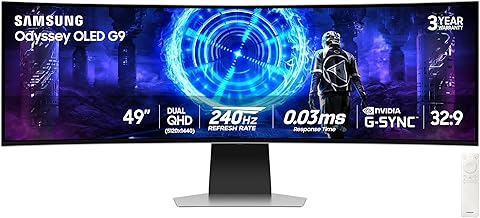
- Top-tier panel options, including QD-OLED with 0.03ms response.
- Excellent ergonomic stands with full height and tilt adjustment.
- Strong HDR up to DisplayHDR 1000 on the flagship VA models.
What's inside
A 49-inch curved Samsung monitor is one of the most dramatic upgrades you can make to a gaming or productivity setup. The 32:9 super-ultrawide aspect ratio replaces a dual-monitor arrangement with a single seamless panel, wrapping your peripheral vision in a way a flat 27-inch screen simply cannot. Samsung has dominated this category for years with its Odyssey G9 line, and the current generation spans everything from fast VA panels to jaw-dropping QD-OLED variants.
In this review we look at the leading 49-inch Samsung options available now, weighing refresh rate, panel technology, HDR performance, and value. Whether you want the pure speed of a 240Hz gaming display or the color depth of QD-OLED, this guide will help you match the right model to your desk and your budget.
As an Amazon Associate we earn from qualifying purchases at no extra cost to you. Product prices and availability are accurate as of the date shown and are subject to change.


🎮 Get More From Your Setup — Free
Prime Gaming gives you free PC games every month, in-game loot, and a free Twitch channel sub — plus fast free shipping on all the gear above. New members get a 30-day free trial.
Watch: 49 Curved Samsung Monitor: Review & Buyer’s Guide — Video Review
Design & Build
Every 49-inch Odyssey shares the aggressive 1000R curvature that gives the line its signature immersion, and Samsung’s build quality remains excellent across the range. The metal ergonomic stands on models like the Odyssey G9 (G95C) and the OLED G9 (G91SD) offer tilt, swivel, and height adjustment, which matters enormously on a panel this wide and heavy. Cable routing is clean, and the rear CoreLighting+ ambient glow on the flagship gaming units adds a tasteful accent without dominating the room. The business-focused LS49C954 trades some flair for a matte, office-friendly finish, built-in speakers, and a USB-C hub that can charge a laptop while driving the display.
Performance
Performance is where these panels separate. The QD-OLED G93SC and OLED G9 (G91SD) deliver near-instant 0.03ms response times and perfect blacks, making them the choice for anyone who prioritizes contrast and motion clarity. The VA-based G95C and G9 (G95C) push a blistering 240Hz with DisplayHDR 1000 certification, so highlights punch harder in HDR content even if blacks aren’t OLED-deep. The G91F sits lower at 144Hz with DisplayHDR 600, a sensible pick for mixed work and play. All models run the full 5120×1440 DQHD resolution, which demands a serious GPU to feed at high frame rates but rewards you with enormous horizontal desktop space.
Pros & Cons
- Immersive 32:9 field of view that replaces two monitors seamlessly.
- Top-tier panel options, including QD-OLED with 0.03ms response.
- Excellent ergonomic stands with full height and tilt adjustment.
- Strong HDR up to DisplayHDR 1000 on the flagship VA models.
- Demanding on your GPU at the native DQHD resolution.
- Large desk footprint that not every workspace can accommodate.
- Premium pricing, especially on the OLED variants.
Alternatives to Consider
If a 49-inch panel is simply too wide for your desk, a 34-inch ultrawide offers much of the immersive feel in a more manageable size. Shoppers focused purely on office multitasking may prefer the USB-C-equipped LS49C954 business model over a gaming Odyssey, since it prioritizes connectivity and eye comfort over refresh rate. And if OLED burn-in worries you for long work sessions, the VA-based G95C remains a superb, brighter all-rounder.
Frequently Asked Questions
What GPU do I need for a 49-inch DQHD monitor?
To drive 5120×1440 at high refresh rates, plan on at least a current-generation upper-mid-range card. For 240Hz gaming with settings turned up, a high-end GPU is strongly recommended.
Is a curved 49-inch monitor good for productivity?
Yes. The extra horizontal space lets you tile three or four windows side by side, and the curve keeps the edges at a comfortable viewing distance, reducing neck movement compared to a flat panel.
Should I choose OLED or VA?
Choose OLED for perfect blacks and the fastest motion clarity, ideal for dark, cinematic games. Choose VA if you want higher peak brightness, DisplayHDR 1000, and no concern about static-image burn-in.
Do these monitors work with FreeSync and G-Sync?
The current Odyssey models support AMD FreeSync Premium Pro and are G-Sync Compatible, so you get tear-free gameplay on both AMD and NVIDIA systems.
Verdict
Samsung’s 49-inch Odyssey lineup remains the benchmark for super-ultrawide displays. For enthusiasts chasing the best image quality, the QD-OLED G93SC and OLED G9 (G91SD) are worth the premium, while the 240Hz G95C offers the brightest, most versatile experience for HDR gaming. Whichever you pick, the leap in immersion and desktop space makes a 49-inch curved Samsung one of the most transformative purchases in PC gaming today.