Our Top Picks
 ASUS TUF Gaming NVIDIA GeForce RTX 4080 SuperRTX4080 Super|OC13.7 x 5.9 x 2.9 inches6.6 PoundsCheck on Amazon
The RTX 4080 Super is the clearly superior card, around 25 to 30 percent faster in 4K rasterized games and roughly twice as fast with heavy ray tracing, while also drawing less power and offering DLSS frame generation. The RX 6950 XT only makes sense as a much cheaper used option for raster-focused 1440p gaming, where its 16 GB of VRAM and strong traditional performance still hold up well.
Different Tiers, Different Eras
The RX 6950 XT was AMD’s refreshed RDNA 2 flagship in May 2022 at $1,099. The RTX 4080 Super arrived in January 2024 at $999, a price cut and slight speed bump over the original RTX 4080. Both carry 16 GB of VRAM on a 256-bit bus, so memory capacity is a tie. The real differences are architecture, ray tracing hardware, upscaling and efficiency. Both are now previous generation, replaced by the RX 9070 series and RTX 50 series respectively, so most buyers will be choosing between used or remaining stock.

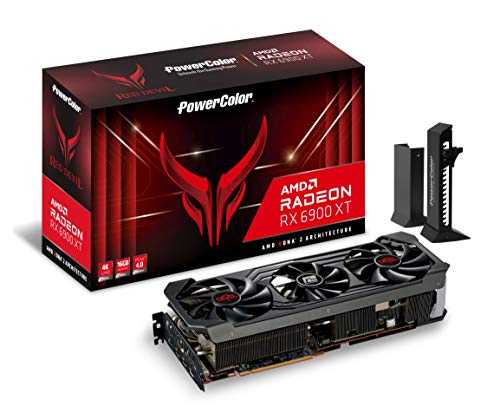
AMD Radeon™ RX 6950 XT gddr6 Graphics Card
Picked as a relevant option in this category.
View on Amazon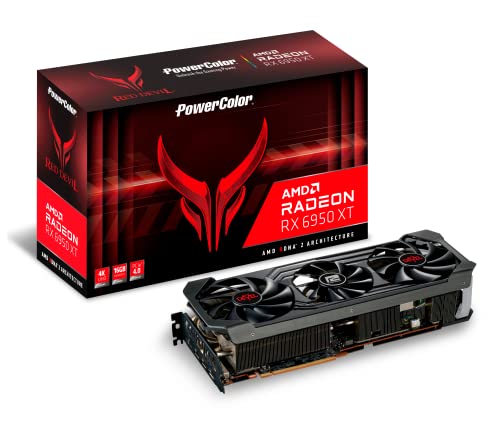
PowerColor Red Devil AMD Radeon RX 6950 XT Graphics Card with 16GB GDDR6 Memory
Picked as a relevant option in this category.
View on AmazonASUS TUF Gaming NVIDIA GeForce RTX 4080 Super OC Edition Gaming Graphics Card (PCIe 4.0, 16GB GDDR6X, HDMI 2.1a, DisplayPort 1.4a), 3 Year Warranty
Chosen because it specifies 16GB GDDR6X and HDMI 2.1a.
View on AmazonASUS TUF Gaming NVIDIA GeForce RTX 4080 Super OC Edition Gaming Graphics Card (PCIe 4.0, 16GB GDDR6X, HDMI 2.1a, DisplayPort 1.4a) (Renewed)
Chosen because it specifies 16GB GDDR6X and HDMI 2.1a.
View on AmazonThe Hardware Compared
| Spec | RX 6950 XT | RTX 4080 Super |
|---|---|---|
| Architecture | RDNA 2.0 | Ada Lovelace |
| Release date | 10 May 2022 | 8 January 2024 |
| Launch MSRP | $1,099 | $999 |
| Stream processors / CUDA cores | 5120 | 10240 |
| Boost clock | 2324 MHz | 2550 MHz |
| Process | 7 nm | 5 nm |
| TDP | 335 W | 320 W |
| VRAM | 16 GB GDDR6 | 16 GB GDDR6X |
| Bus / bandwidth | 256-bit / 576.0 GB/s | 256-bit / 736.3 GB/s |
| Cache | 4 MB L2 + 128 MB L3 | 64 MB L2 |
| Interface | PCIe 4.0 x16 | PCIe 4.0 x16 |
| Power connectors | 2x 8-pin | 1x 16-pin |
| Length / width | 267 mm, 3-slot | 310 mm, 3-slot |
| Outputs | 1x HDMI 2.1, 2x DP 1.4a | 1x HDMI 2.1, 3x DP 1.4a |
Performance in Practice
Rasterized games at 4K
Tom’s Hardware’s RTX 4080 review measured the original RTX 4080 about 29 percent ahead of the RX 6950 XT in its standard 4K gaming suite. Launch reviews of the RTX 4080 Super found it only marginally faster than the RTX 4080, so the Super’s lead over the 6950 XT sits in roughly the same 25 to 30 percent range. Aggregated benchmark data from Technical City puts the overall gap around 22 percent, which fits once lower resolutions are included.
1440p
At 1440p, the RX 6950 XT’s large Infinity Cache works in its favor and CPU limits begin to compress the difference, so the gap is smaller than at 4K. Both cards are well into high-refresh territory in most games at 1440p; typical demanding titles land somewhere around 90 to 150 FPS at high settings, depending on the game, CPU and patch level.
Ray tracing
This is where the cards separate dramatically. In Tom’s Hardware’s 4K ray tracing suite, the RTX 4080 was just over twice as fast as the RX 6950 XT. The 4080 Super inherits that advantage. In path-traced titles, the RDNA 2 card is simply not competitive, while the 4080 Super can deliver playable results with DLSS. If ray tracing matters to you at all, this one factor decides the comparison.
Upscaling and Frame Generation
The RTX 4080 Super supports DLSS 4 Super Resolution with the transformer model, Ray Reconstruction and single-frame DLSS Frame Generation. It does not support Multi Frame Generation, which is reserved for RTX 50 cards.
The RX 6950 XT uses FSR 3.x upscaling and frame generation, plus XeSS in compatible games. AMD’s machine-learning FSR 4 is limited to RDNA 4, so the 6950 XT does not get it officially. AMD also moved RDNA 1 and RDNA 2 cards to a maintenance-focused driver branch in late 2025, meaning fewer day-one optimizations for new games.
The practical result is that the 4080 Super can usually run 4K with DLSS Quality at excellent image quality, while the 6950 XT often has to choose between lower upscaling quality and lower settings at 4K.
Power Draw, Spikes and PSU Sizing
Rated power looks similar, 335 W versus 320 W, but behavior differs. RDNA 2 high-end cards were known for sharp transient spikes, and AMD recommended an 850 W supply for the RX 6950 XT. Ada cards are generally more efficient under load, delivering much more performance from slightly less power.
Formula: GPU TDP + CPU gaming draw + about 150 W headroom.
- RX 6950 XT: 335 W + about 150 W + 150 W = roughly 635 W. Given AMD’s guidance and transient behavior, a quality 750 W to 850 W unit is recommended.
- RTX 4080 Super: 320 W + 150 W + 150 W = roughly 620 W. NVIDIA recommends 750 W, which matches comfortably.
The RX 6950 XT uses two standard 8-pin connectors, convenient for older power supplies. The RTX 4080 Super uses a 16-pin connector; use a native ATX 3.x cable or the included adapter, and make sure the plug is fully seated.
Physical Size and Case Fit
The reference RX 6950 XT measures 267 mm and is a 3-slot design, while the RTX 4080 Super is listed at 310 mm, also 3-slot. Partner versions of both cards are commonly longer and thicker, with some 4080 Super models well beyond 330 mm. Measure GPU clearance and account for front fans or radiators before buying, and consider a support bracket for heavy cards.
Cost per Performance Calculation
Use the 4K raster figures: RX 6950 XT = 100, RTX 4080 Super = about 128.
- Launch MSRP: RX 6950 XT at $1,099 is about $10.99 per point; RTX 4080 Super at $999 is about $7.80 per point. The NVIDIA card was clearly better value at launch.
- Used market: an RX 6950 XT usually sells for around $380 to $480, and an RTX 4080 Super around $800 to $950. At $430 and $875, cost per point is about $4.30 versus $6.84.
So on the used market the RX 6950 XT is about 37 percent cheaper per unit of raster performance. That flips completely if you value ray tracing, where the 4080 Super delivers roughly twice the performance.
Choosing by Use Case
| You want | Better fit | Reason |
|---|---|---|
| Best raster value at 1440p | RX 6950 XT (used) | Strong raster, 16 GB, low used price |
| 4K gaming | RTX 4080 Super | About 25-30% faster plus DLSS quality |
| Ray tracing or path tracing | RTX 4080 Super | Around twice the RT performance |
| Frame generation | RTX 4080 Super | DLSS Frame Generation; 6950 XT uses FSR 3 |
| Older PSU with 8-pin cables | RX 6950 XT | Standard connectors, though higher wattage advised |
| Long-term driver support | RTX 4080 Super | RDNA 2 is on a maintenance branch |
How Current Cards Change the Picture
Both of these cards now compete with newer models. AMD’s RX 9070 XT, a current RDNA 4 card with 16 GB of VRAM, offers far better ray tracing than the RX 6950 XT plus FSR 4 support, along with much lower power draw. NVIDIA’s RTX 5070 Ti delivers performance in the same broad class as the RTX 4080 Super while adding Multi Frame Generation and a new-card warranty. When pricing either used card, compare it against these current alternatives rather than against each other alone.
A practical rule: a used RX 6950 XT is attractive only when it costs well below a new RX 9070 XT, because the newer card fixes its biggest weaknesses. A used RTX 4080 Super should be priced clearly under a new RTX 5070 Ti to compensate for missing warranty coverage and the lack of Multi Frame Generation.
Used-Buying Tips
For a used RX 6950 XT, check for coil whine, ask about mining history, and verify the hotspot temperature during a stress test; reapplied thermal paste can help older cards. For a used RTX 4080 Super, inspect the 16-pin connector and socket for any discoloration or melting, and confirm the card is not sagging enough to stress the PCIe slot. Remaining warranty transfers vary by brand, so ask the seller.
Frequently Asked Questions
How much faster is the RTX 4080 Super than the RX 6950 XT?
In 4K rasterized games, about 25 to 30 percent based on Tom’s Hardware data for the RTX 4080 and the Super’s small uplift over it. With ray tracing, the gap grows to roughly double. At 1440p, the raster gap is smaller.
Do both cards have the same amount of VRAM?
Yes, both have 16 GB on a 256-bit bus. The RTX 4080 Super uses faster GDDR6X with 736.3 GB/s of bandwidth versus 576.0 GB/s on the RX 6950 XT, which AMD partly offsets with 128 MB of Infinity Cache.
Can the RX 6950 XT use FSR 4?
Not officially. FSR 4 is limited to RDNA 4 cards. The RX 6950 XT uses FSR 3.x upscaling and frame generation, and XeSS in games that support it.
What power supply do I need?
A quality 750 W unit suits the RTX 4080 Super. For the RX 6950 XT, AMD recommended 850 W because of its transient spikes, so 750 W to 850 W is advisable depending on your CPU.
Is a used RX 6950 XT still a good buy?
For raster gaming at 1440p, yes, if the price is low. It offers strong performance and 16 GB of VRAM. Just accept weaker ray tracing, no official FSR 4 and a slower driver optimization pace.