Key takeaways
- 1080p: 12 GB is plenty for the 6750 XT; neither card is memory-constrained.
- 1440p: 12 GB covers most current games at high settings, but a handful of new releases with maximum textures already approach that figure. 16 GB gives the 6950 XT more margin.
- 4K: 16 GB is the realistic floor for high textures, which makes the 6950 XT the only one of the pair suited to 4K.
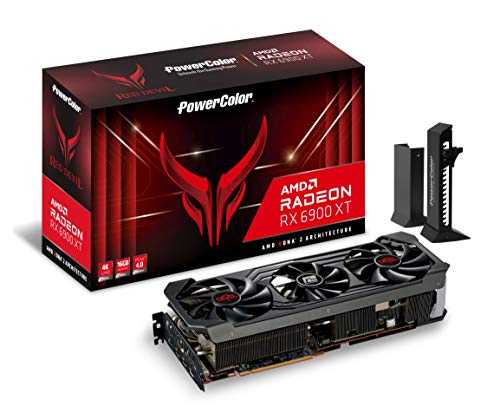
The RX 6950 XT is the better card for 1440p high-refresh and entry-level 4K gaming, typically running around 35-55% faster than the RX 6750 XT and carrying 16 GB of VRAM, while the RX 6750 XT is the smarter pick for 1080p and budget 1440p builds where its lower power draw, smaller cooler and lower used price matter more. Both are RDNA 2 cards from 2022, so today they are mostly bought used, and that shifts the value math considerably.
Two Ends of the RDNA 2 Refresh
AMD’s 2022 “50” refresh brought faster memory and higher clocks to the RX 6000 lineup. The RX 6750 XT launched on 3 March 2022 at $549 and the RX 6950 XT followed on 10 May 2022 at $1,099. Both use the same RDNA 2 architecture on a 7 nm process, so the differences come down to scale rather than features: the 6950 XT has exactly twice the shader count (5,120 versus 2,560), a wider 256-bit bus and a larger 128 MB Infinity Cache. The 6750 XT compensates partly with a higher boost clock of 2,600 MHz versus 2,324 MHz, but not enough to close a gap that large.
Because the feature set is identical, this comparison is mostly about how much performance you need, how much power and space your build can handle, and what each card costs today.
Spec Sheet Comparison
| Spec | RX 6750 XT | RX 6950 XT |
|---|---|---|
| Architecture | RDNA 2.0 | RDNA 2.0 |
| Release date | 3 March 2022 | 10 May 2022 |
| Launch MSRP | $549 | $1,099 |
| Stream processors | 2,560 | 5,120 |
| Boost clock | 2,600 MHz | 2,324 MHz |
| Process | 7 nm | 7 nm |
| TDP | 250 W | 335 W |
| Memory | 12 GB GDDR6 | 16 GB GDDR6 |
| Bus / bandwidth | 192-bit / 432.0 GB/s | 256-bit / 576.0 GB/s |
| L2 / Infinity Cache | 3 MB / 96 MB | 4 MB / 128 MB |
| Interface | PCIe 4.0 x16 | PCIe 4.0 x16 |
| Power connectors | 1x 6-pin + 1x 8-pin | 2x 8-pin |
| Length / width | 267 mm / 2-slot | 267 mm / 3-slot |
| Outputs | 1x HDMI 2.1, 3x DP 1.4a | 1x HDMI 2.1, 2x DP 1.4a |
Rasterized Gaming Performance
Launch reviews from outlets including Tom’s Hardware and KitGuru placed the RX 6950 XT at the top of AMD’s stack, trading blows with the RTX 3090 Ti at 1440p, while the RX 6750 XT landed slightly above the RX 6700 XT it replaced. How far apart the two sit depends heavily on how GPU-bound the test suite is. In review data where the graphics card is the limiting factor, the RX 6950 XT is roughly 35-55% faster at 1440p, and the gap widens toward 4K. Comparison sites that include lighter, CPU-heavy games report much smaller differences, around 15%, because both cards hit the processor’s limit.
In practice, approximate frame rates for demanding modern games at 1440p high settings tend to fall around 55-80 fps for the 6750 XT and 80-115 fps for the 6950 XT, with wide variation by title, settings, CPU and driver version. At 1080p the 6750 XT often already pushes past 100 fps, so the 6950 XT’s advantage matters mainly to buyers with 165 Hz or faster displays.
Ray Tracing and Upscaling
RDNA 2 was AMD’s first architecture with hardware ray tracing, and neither card is strong at it. The 6950 XT’s 80 ray accelerators let it handle light RT effects at 1440p with upscaling enabled, while the 6750 XT’s 40 struggle with anything heavier than RT shadows or reflections. Path-traced modes in games like Cyberpunk 2077 or Alan Wake 2 are effectively out of reach on both.
For upscaling, both cards support FSR 3.1 including frame generation in titles that implement it, plus AMD Fluid Motion Frames driver-level frame generation. They do not support FSR 4, which uses dedicated AI hardware found only on RDNA 4 cards such as the RX 9070 series. Intel’s XeSS also runs on both through its generic path. Expect upscaling image quality to trail what newer DLSS and FSR 4 deliver, especially in Performance mode.
VRAM Headroom by Resolution
The 4 GB difference is a meaningful one for longevity:
- 1080p: 12 GB is plenty for the 6750 XT; neither card is memory-constrained.
- 1440p: 12 GB covers most current games at high settings, but a handful of new releases with maximum textures already approach that figure. 16 GB gives the 6950 XT more margin.
- 4K: 16 GB is the realistic floor for high textures, which makes the 6950 XT the only one of the pair suited to 4K.
Power, PSU and Physical Size
This is where the 6750 XT earns its place. Its 250 W TDP versus the 6950 XT’s 335 W is an 85 W difference, and the larger card is known for sharp transient power spikes. A simple sizing calculation with a typical 125 W gaming CPU and about 150 W of headroom:
- RX 6750 XT: 250 + 125 + 150 = 525 W, so a quality 600-650 W unit.
- RX 6950 XT: 335 + 125 + 150 = 610 W, so a quality 750 W unit is the safer choice, particularly with a high-end CPU.
Connector needs differ slightly: the 6750 XT uses one 6-pin and one 8-pin, while the 6950 XT uses two 8-pin plugs. Many partner 6950 XT cards add a third 8-pin, so count your PSU’s cables before buying.
Both reference designs are 267 mm long, but the 6950 XT occupies three slots and partner models are often longer and heavier. In a compact or small form factor case the 2-slot 6750 XT is far easier to fit, and a support bracket is worth using with heavy 6950 XT models.
Value and Cost per Performance
At launch the math favored the smaller card. Taking the 6750 XT as 100 points and the 6950 XT as about 145 points at 1440p:
- RX 6750 XT: $549 / 100 = about $5.50 per point.
- RX 6950 XT: $1,099 / 145 = about $7.60 per point.
The used market tells a different story. A used RX 6750 XT usually sells for around $200-$260, while a used RX 6950 XT tends to sit around $330-$420. At those prices the cost per frame is much closer, and the 6950 XT can be the better buy for anyone with a capable power supply and room in the case.
Which One Should You Pick?
| Resolution / budget | Pick | Reasoning |
|---|---|---|
| 1080p, any budget | RX 6750 XT | Enough performance; lower power and smaller footprint |
| 1440p, 60-100 Hz | RX 6750 XT | Handles high settings in most games with FSR as backup |
| 1440p, 144 Hz or faster | RX 6950 XT | The extra 35-55% matters at high refresh |
| 4K | RX 6950 XT | Needs the 16 GB and wider bus |
| Small case or 550-650 W PSU | RX 6750 XT | 2-slot width and 250 W rating |
Buyers who care about ray tracing or modern upscaling should also look at current-generation cards. An RX 9060 XT 16GB or RX 9070 offers FSR 4 support and much better ray tracing with a warranty, which can outweigh the raw raster advantage of a used 6950 XT.
Buying Used: What to Watch
Both cards are now several years old. Ask whether the card was used for mining, check fan health and listen for coil whine, and expect to replace thermal paste on high-mileage units. The 6950 XT’s large coolers can sag over time, so inspect the PCIe bracket and slot area. If a seller has the original box and receipt, any remaining warranty may still transfer.
Frequently Asked Questions
How much faster is the RX 6950 XT than the RX 6750 XT?
In GPU-bound reviews the RX 6950 XT is roughly 35-55% faster at 1440p, with a larger gap at 4K. In CPU-limited or lighter games the difference can shrink to about 15%. The exact margin depends on the game, settings and processor.
Can the RX 6750 XT handle 1440p gaming?
Yes. It runs most current games at 1440p with high settings at playable frame rates, and FSR helps in heavier titles. It is less suited to 1440p at very high refresh rates or with heavy ray tracing.
What power supply does the RX 6950 XT need?
A quality 750 W unit is the safe recommendation because the card is rated at 335 W and can spike higher. It needs two 8-pin PCIe connectors on the reference design, and some partner cards need three.
Do these cards support FSR 4?
No. FSR 4 relies on AI hardware that only RDNA 4 cards have. Both cards support FSR 3.1 upscaling and frame generation, plus AMD Fluid Motion Frames in the driver.
Is a used RX 6950 XT still worth buying?
It can be at the right price, since its raster performance remains strong for 1440p and entry-level 4K. Weigh it against newer cards with better ray tracing, FSR 4 support and a full warranty before committing.